When businesses talk about green energy, the conversation usually centres on electric vehicles, renewable power contracts, and supply chain audits. Lawn care is rarely considered. Companies rethink their packaging, switch their fleets, and publish carbon reports, yet the petrol mower sitting in a maintenance shed goes unnoticed year after year.
That needs to change, and it is starting to. Businesses are learning that meaningful emissions cuts often come from smaller, overlooked corners of their operations rather than headline projects. As covered in Sustainable Spring Landscaping, modest adjustments to how outdoor spaces are managed can compound into measurable environmental gains. Grounds maintenance is one of the clearest examples.
The Overlooked Emissions Problem in Grounds Maintenance
Petrol garden equipment pollutes far more than its size suggests. Many mowers, trimmers, and blowers still run on small two-stroke or four-stroke engines with no catalytic converters and poor combustion efficiency.
A portion of the fuel passes through unburned, released as hydrocarbons alongside carbon monoxide and nitrogen oxides. Studies comparing small engines to cars have found that an hour of petrol mowing can emit as much pollution as a long car journey.
Now scale that up. A business park, hotel campus, or corporate headquarters might have grounds mowed weekly from March to October. Larger estates run fleets of equipment, often serviced by contractors who drive vans to the site for every visit. The fuel burned, the emissions released, and the transport involved all sit outside most sustainability reporting, which is precisely why they persist.
There are secondary costs too. Petrol equipment is loud, which restricts when crews can work near offices, hospitals, or residential neighbours. Fuel must be stored, handled, and transported on site, adding spill risk and administrative burden that most facilities managers would gladly eliminate.
Why Electrification Reached the Lawn Late
Road transport received the policy attention first, and for good reason, given its share of national emissions. The UK ZEV mandate shows how regulation can accelerate an entire industry’s transition, unlocking billions in investment and reshaping what manufacturers build. Grounds equipment had no equivalent push. No mandate required landscapers to abandon petrol, so the market moved slowly.
Battery technology changed the equation. The same improvements in energy density and cost that made electric cars practical made electric outdoor equipment viable. Cordless mowers and trimmers now match petrol performance for most commercial tasks.
Robot lawn mowers represent the furthest point of that evolution. They are not simply electric versions of the old machine. They remove the operator, the transport, and the weekly disruption entirely; they run on their own schedule with a fraction of the energy input.
How Robotic Mowers Cut Emissions in Practice
The most direct saving is at the point of use. Robotic mowers produce zero exhaust emissions and draw modest amounts of electricity, typically comparable to a household appliance. Sites powered by renewable tariffs or on-site solar can bring the operating footprint close to nothing.
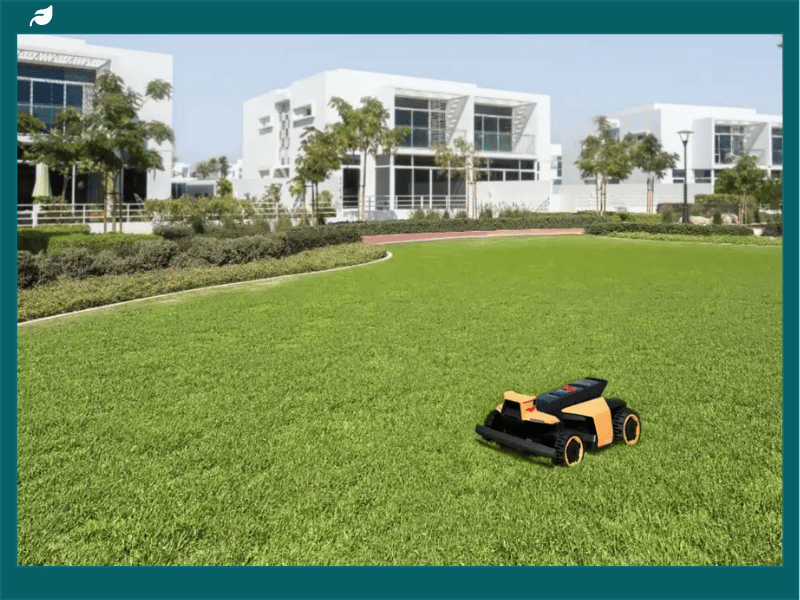
The technology has matured enough for serious commercial use. Mowers from top brands like Segway Navimow use satellite positioning and vision sensors instead of buried boundary wires, which makes them practical for larger and more complex grounds without the installation work older robotic systems required. Once mapped, the mower handles the lawn on its own, returning to its charging station between sessions.
The mowing method itself carries multiple environmental benefits. These robotic mowers cut little and often rather than removing large amounts of growth in one weekly pass. The fine clippings drop back into the turf and decompose, returning nutrients to the soil. That means no green waste to bag, transport, and process, and less need for synthetic fertiliser.
Then there is the transport factor. A contractor visiting weekly to mow puts a van on the road dozens of times a year for that task alone. An autonomous mower removes those journeys. Crews still visit for hedges, beds, and seasonal work, but the most frequent trip disappears from the schedule.
The Operational Case Beyond Emissions
Sustainability rarely wins budget approval on its own, so it helps that the operational argument is strong.
Labour is the obvious one. Lawn mowing is a repetitive, time-consuming work. Automating it frees grounds staff or contractor hours for skilled tasks: planting, pruning, drainage, the work that visibly improves a site. For businesses paying contractors by visit, the maths favours automation within a few seasons.
Noise is the quieter benefit. Robotic mowers operate at a fraction of the volume of petrol machines, so they can run during office hours next to meeting rooms, or overnight at hotels without disturbing guests.
Running costs become predictable too. Electricity prices do fluctuate, but nothing like petrol, and there are no spark plugs, oil changes, or carburettor repairs. Maintenance reduces to blade replacement and occasional servicing.
What to Consider Before Switching
A robotic mower is not a universal replacement, and a realistic assessment up front prevents disappointment later.
Start with the site itself. Slope gradients, tree cover, tight passages, and obstacles all affect which machines will cope. Satellite-guided models need reasonable sky visibility; heavily wooded grounds may need units with additional vision-based navigation. Lawn area matters most of all, since models are rated by the coverage they can manage per charge cycle.
Think through charging and security as well. The docking station needs a weatherproof power supply, and while modern units include PIN locks, GPS tracking, and lift alarms, high-footfall public sites deserve extra thought about placement.
Small Machines, Measurable Gains
No company will win an award for changing how its lawns get mowed. It still belongs on the list. The switch costs a fraction of fleet electrification, takes weeks rather than years to implement, and starts cutting emissions from the first charge.
Most businesses have already dealt with the obvious sources. What remains are the small, persistent ones, and petrol-powered grounds equipment sits near the top of that pile: burning fuel on a fixed weekly schedule, eight months a year, with a proven alternative already on the market. Few emission cuts are this simple, and fewer still reduce the workload while they’re at it.