Today, microplastic pollution can be found on 88% of the ocean’s surface and in areas as remote as the beaches of the Arctic and Antarctic, the summit of Mount Everest, and the bottom of the Mariana Trench.
Recent research suggests that humans are ingesting a credit-card size amount of microplastics every week on average, and one study found microplastics in the blood of nearly 80% of its human test subjects.
The health effects of microplastics are not well understood but researchers have found evidence that high levels of exposure lead to issues ranging from slower growth and tumors, to endocrine and liver issues, and even higher rates of mortality.
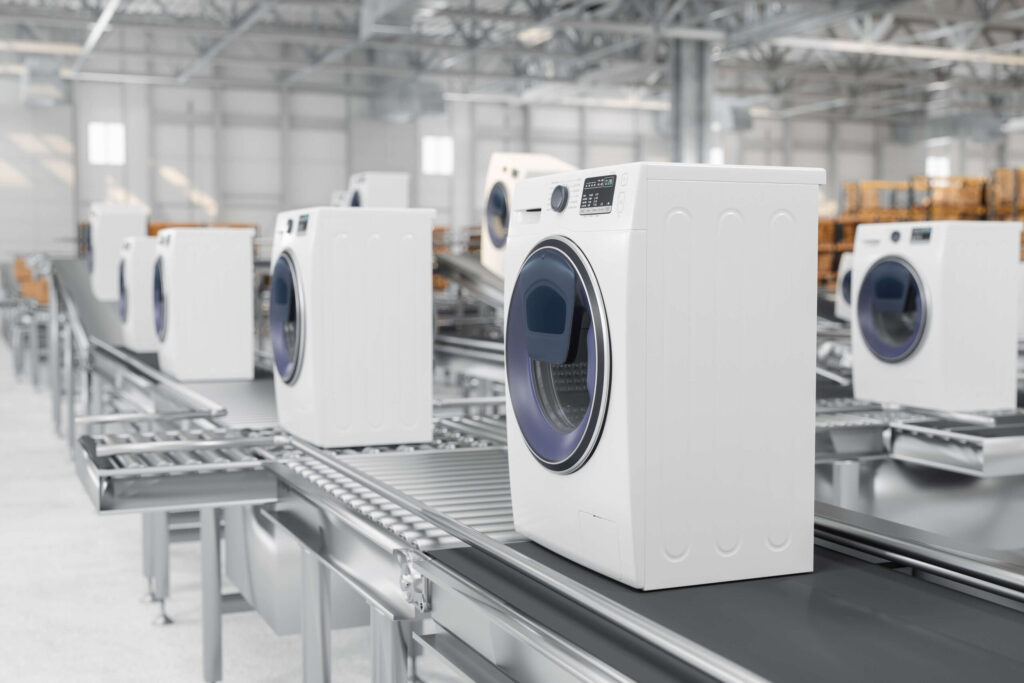
Household laundry is a key culprit
One of the most surprising research-findings has been that single biggest source of microplastic pollution is washing-machine wastewater. Over a half-million tons of microplastics currently spill into the oceans from it every year, and G20 researchers expect those emissions to double by 2050.
To head off these flows a growing number of governments, particularly in Europe, are mandating that new washing machines be outfitted with microplastic-filtering devices. Just as consumers are accustomed to filtering lint from their laundry, they may soon be equally accustomed to conveniently filtering out microplastics.
So far France has taken the lead, successfully enacting a law that goes into effect January 1, 2025. Meanwhile parliamentary leaders in the UK and the European Union, and state and province legislators in California, Illinois, Oregon, and Ontario are advancing similar proposals. Soon, the state of New Jersey may offer residents $100 rebates for purchasing microplastic filters that attach to their existing washing machines.
All of this has set off a cleantech innovation race within the appliance industry, with major brands like Samsung, Grundig, Electrolux – and even apparel makers like Patagonia – bidding to help tackle the microplastics pollution problem at one of its most critical sources.
A cleantech innovation race
One of the newest and most promising entrants is a U.S. venture called CLEANR, which emerged from the Sears think
Founded by three engineering students and backed by current and former senior executives from several leading global technology and business consultancies, CLEANR has developed the one and only microplastic filter so far proven to meet France’s rigorous upcoming regulations.
The company is in advanced negotiations with some of the world’s leading appliance manufacturers to integrate its technology into their new washing machine designs. CLEANR’s solution is currently patent-pending, according to its CEO Max Pennington, with a closely-held design that is “biomimicry-inspired.”
Pennington and his co-founders are moving quickly to industrialize their solution ahead of the pending microplastics regulations. Last month, the company partnered with Formlabs, a leading 3D printing company to produce “high-quality prototypes for washing-machine manufacturers in a matter of hours or days, instead of weeks or months,” according to CLEANR co-founder and chief operating officer Chip Miller.
Most recently, the company teamed up with the world’s leading mesh-fabricator, GKD Group, a 100-year-old German company. The two firms will collaborate on the development, engineering and manufacturing CLEANR’s solutions under a partnership Pennington says will “ensure the highest quality and precision manufacturing capabilities for our appliance-industry clients.”
“Microplastic pollution is becoming an urgent environmental and public health concern,” observed GKD Group’s Dr. Stephan Kufferath in their announcement. “The filtering of washing-machine wastewater will be a game-changer, which is why we’re so keen to help CLEANR achieve its market potential.”