Wind turbines are marvelous equipment. Get close to one and you will feel it, the low hum, the slow turning of blades that can be stretched out longer than the wing of a commercial aircraft. But that mechanical grace is based on something much less apparent: a heavy mass of electrical parts hidden within the nacelle, down the tower, and to the grid.
Get these elements correct and a turbine can last decades. Get them wrong and you will end up with unplanned downtime, high repair costs and energy that is nowhere near expectation. What, then, is it about the electrical components that make them so important to wind energy systems and why are the quality of those components an issue, here, more than in nearly any other application?
The Environment Is Cruel
The first that comes to mind is that wind turbines occupy harsh environments.
- Offshore facilities: Must withstand saltwater spray, humidity and vibration.
- Onshore turbines: In deserts, they have to contend with hot and dusty conditions.
- Northern locations: These face ice and thermal cycling which can put materials to a stress that most lab tests do not.
Within a turbine, the narrative is not much kinder. The nacelle the housing unit on the top of the tower, may undergo large temperature variations, mechanical vibration due to the rotating drives train and electromagnetic interference due to the generator. All the electrical components in that enclosure must be able to work under such conditions, day and night, year after year.
That is why material choice, sealing requirements and quality of building are not only technical boxes, but also the difference between a 20-year investment and the nightmare of maintenance.
The Reasons Why Wiring Solutions is a Foundation, Not an Afterthought
Cables may not appear to be as important a consideration as inverters or control systems, but in reality, wiring outages are considered as one of the most frequent causes of turbine downtime. Insulation can be damaged by:
- Abrasions
- Fatigue caused by vibration
- Moisture intrusion
These issues eventually result in shorts, ground faults, and communication problems. It is here that carefully designed Waterproof wire Harnesses are important. Wind harnesses must resist not only moisture, but also UV radiation, ozone, and steady flexing: in rotating machinery such as pitch control systems, cables are twisted thousands of times in their lifetime.
A properly designed harness is not merely a collection of cables with connectors at both ends; it is a strain-relieved, airtight system designed to withstand the environment that would ruin off-the-shelf in a few seasons. The difference manifests itself in the availability of turbines. The purpose-built wiring infrastructure results in lower unplanned outages and decreased inspection cycles by operators who invest in these infrastructures.
Accuracy in Signal and Power Transmission
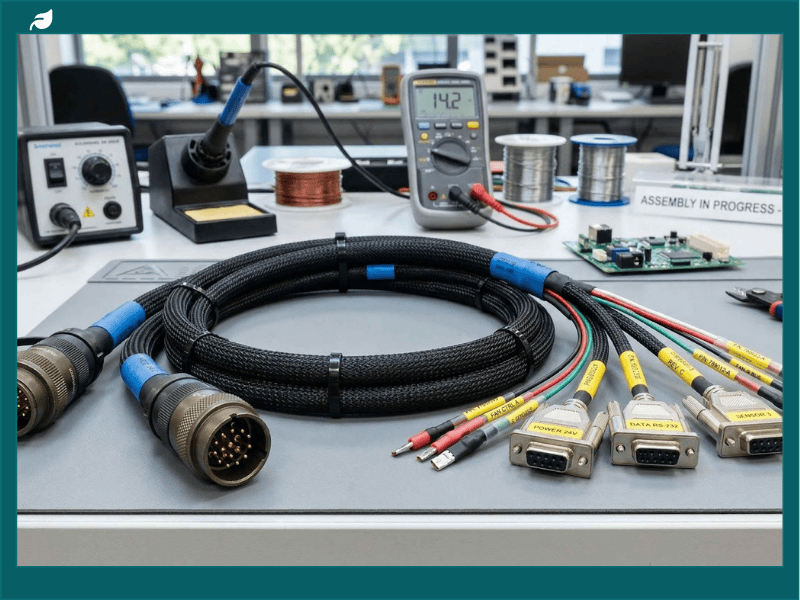
Wind turbines are becoming more advanced. The latest control systems measure the blade pitch, generator torque, grid frequency and dozens of other parameters in real time. Reliable transfer of such data by sensors to controllers demands signal integrity, which in turn demands that the interconnects between the signals themselves can not add noise, signal loss, or timing errors.
This is where High precision cable assembly is very much needed. Even in pitch control and SCADA, the slightest variation in impedance or shielding can lead to incorrect sensor measurements or communication failure. Even a small error in reading wind speed data by a turbine can cause it to mispitch blades, which causes mechanical stress and lowers the energy capture. These inefficiencies add up to actual losses over thousands of operating hours.
Cable assemblies are also manufactured to very fine specifications matched impedance, low insertion loss, sound shielding such that the signals which drive turbine decisions are clean and consistent on commissioning day through the end of the life of the asset.
The Price to Pay to Cut Corners
It is not resistant to temptation, particularly in high-volume wind farms purchase procedures, to save money by requiring components that match minimal standards instead of optimum ones. The reasoning is simple: a lower-cost connector which meets the spec sheet will save money during installation.
The problem is that wind assets are long-term investments. A turbine, which is commissioned now, is likely to be running by 2045 and beyond. An item that slightly exceeds specifications at installation can fail sooner during actual operation, and thus have to be replaced after eight or ten years of service, when the access is costly and the turbine must also be out of service.
Including technician time, crane expenses to reach the offshore location, and lost energy generation, that original saving can cost you many times during the lifetime of the asset. The lesson has been learnt by experienced project developers and operators. They are more defining parts to IEC and UL specifications to wind conditions, and are performing lifecycle cost analysis, not merely procuring comparisons upfront.
What This Means for the Industry Going Forward
With wind projects shifting to larger capacity turbines and more difficult locations deeper out in the water, remote onshore locations the electrical infrastructure within each machine becomes even more critical.
- Greater generators imply greater voltage DC systems.
- Increased blade length implies more complicated pitch control cabling.
- Distant sites imply less regular maintenance periods.
All this strains the elements that are used to make the system operate. More intelligent designs, improved materials and manufacturing tolerances are not the nice-to-have features but the foundation to creating wind assets that can perform as advertised.
Closing Thoughts
The potential of wind energy is immense, yet it is a matter of getting the details right in order to realize the potential. Turbines with the highest availability rates as well as lowest lifetime costs are not merely better engineered in their structural or aerodynamic details, but built on a base of electrical components that have been chosen, specified, and put in place with the understanding of longevity.
The electrical infrastructure of a turbine is what makes the difference between a performing asset and a maintenance nightmare: wiring harnesses that can withstand years of service in the harshest maritime conditions, control system assemblies that can operate decades without a problem, and more. That is not a little thing in an industry where even a single percentage point of availability is everything.