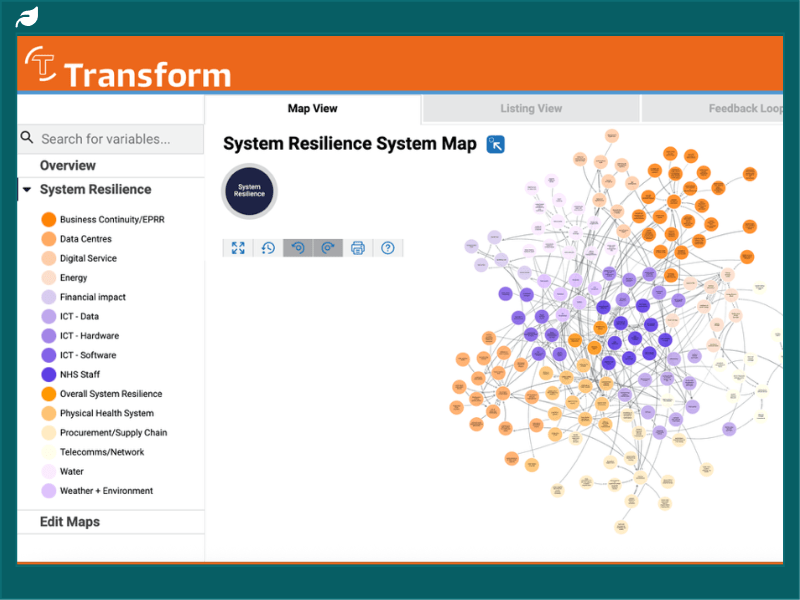
The NHS and Transform UK have developed a live systems map to model the severity of climate change impacts on digital services. The map exposes weak points across the whole supply chain involved in the delivery of health and social care. As long term warming creeps above 1.5 degrees we will continue to see an increase in extreme weather events. These events pose inherent risk to NHS digital systems that have become essential to the provision of healthcare in the UK.
NHS Digital Systems Resilience Map
A systems approach is required when attempting to address weak points in digital resilience. The digitalisation of the NHS has led to complex connections between key players dispersed across the UK. Doctors and the public depend on digital services which rely on software infrastructure that is dependent upon cooling mechanisms. Single points of failure must be addressed in order to ensure disruption at one level does not become system wide.
The NHS and Transform UK developed the systems map to expose the interconnectedness of digital healthcare services. The map is able to show how a single disruption event might cause positive and negative feedback loops in other actors. In this way it models the compound effects of changing variables, for example heatwave frequency. The map can also output a list of necessary interventions to reach certain goals, such as overall system resilience.
An Interconnected System
It is easy to assume that NHS digital systems are automatically resilient to climate change, but this is not the case. The Joint Committee on National Security Strategy was scathing in its 2022 report on the preparedness of UK infrastructure. The 2025 Adaption Progress Report also highlighted significant delays in the response of the UK Government. The interconnected nature of the system poses further threats to overall resilience. Single events are likely to have compound effects on healthcare delivery, ICT and telecom infrastructure.
To add further complexity, all Critical National Infrastructure (CNI) is dependent upon digital infrastructure, which itself is considered CNI. Claire Robinson, Director of Sustainable Business Consulting at Transform, refers to this situation as having ‘a distinct feeling of a house of cards’. In her own report she references the knock-on impacts of the July 2022 40 degree heatwave. At a critical time for healthcare delivery the data centres at Guys and St Thomas Hospital overheated.
High Risk Climate Events
The data centre failures at Guys and St Thomas during the 2022 heatwave caused a cascade of impacts. Critical IT outages at two hospitals caused over 100 treatment delays, including a missed organ transplant. The delivery of referrals and outpatient appointments dropped significantly just as the number of people requiring them rose. Full recovery of the IT systems took several weeks and cost £1.4 million. This incident exposed the susceptibility of digital healthcare delivery to climate change events.
The occurrence and severity of such events will only increase. 2024 was the first year global warming breached 1.5 degrees above pre-industrial levels. 2.0 degrees is the threshold the IPCC indicated to avoid critical tipping points in the climate system. An increase in catastrophic heatwaves, flooding and storms all pose significant risk to the stability of the healthcare system. The UK health system has legal responsibility to adapt to climate change as per the 2022 Health and Care Act. This includes improving the resilience of NHS digital systems.
Improved System Resilience
Accounting for the Impacts of Climate Change is a Government Green Book business case. It rules that all large scale digitalisation programmes must present resilience strategies for 2 degrees of global warming. The live systems map is a proof of concept for applying systems thinking to digital resilience of healthcare. It makes a case for the integration of risk planning across entities. This will encourage greater efficiency of investment in resilience strategies across supply chains.
Another finding from using the systems approach is the importance of procurement in facilitating change. Investment in awareness, training, tools and support will help to mitigate the greatest risks of system failure. Linking climate resilience strategies and improved cyber security is another strategy to increase investment in digital systems resilience. The next set of updates to the map will focus on the improved quantification of variables. The aim is to give different actors evidence based recommendations for improved resilience.
Modelling a Systems Approach
The NHS and Transform developed the live systems map as proof of concept for applying a system wide approach to digital resilience strategy. The end goal is the development of a nationally accessible tool capable of outputting tailored interventions at every level. The integration of risk planning across entities is essential to share risk and ensure the efficiency of resilience investments. A collaborative effort is essential if digital healthcare systems are to be resilient to the impacts of 2 degrees of global warming.