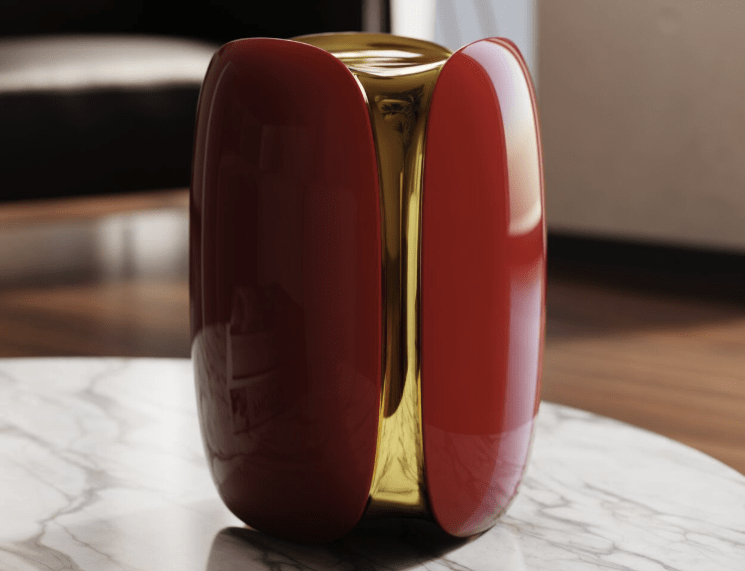
What actually separates a dignified cremation urn from a merely decorative one? Dignity, in this object, is closer to engineering than to styling. It comes from resolved proportions, a surface that behaves well under handling, a closure that opens calmly in front of people, and personalization restrained enough to age. Beauty is the visible result of decisions taken on behalf of a family living through a difficult week.
A cremation urn is a decorative container in which the cremated remains of a loved one are placed. That definition is accurate and, on its own, almost useless to a funeral director, because the same object also has to survive a ceremony, a journey and twenty years on a shelf. Before aesthetics enter the conversation, seven things are worth checking on any model under consideration:
- Stated capacity. Adult capacity is normally expressed in relation to body weight before cremation. Confirm the published figure for that specific model, and ask where the oversize threshold begins.
- Internal volume and external footprint. Two different numbers. The first decides whether the remains fit; the second decides whether the urn fits the niche.
- Closure method. How it opens, whether it seals for transport, and whether it can be opened in company without improvisation.
- Base stability. Width relative to height, flatness of the foot ring, centre of gravity when full.
- Published net and gross weight. These tell you how the piece will be carried and how it will ship, before delivery day.
- Material, finish and care instructions. How the surface is expected to behave after a decade of domestic display.
- Personalization limits. What can be added without dominating the piece, and whether matching keepsakes remain available later.
Everything that follows is an argument for why those seven points, and not decoration, are where dignity is actually built.
Why the urn stopped being an accessory
The numbers explain the shift better than any design argument. In the United States the projected 2025 cremation rate is 63.4%, against 31.6% for burial, with cremation expected to reach 82.3% by 2045. Recorded figures for 2025 put the US rate at 62.8% and the Canadian rate at 77.4%, up from 57.2% and 74.0% in 2021, with 2030 projections of 69.1% and 81.1% respectively.
The consequence for the object is direct. Where a casket is no longer at the centre of the arrangement, the urn becomes the thing the family actually lives with: carried, positioned, photographed, eventually inherited. It absorbs a symbolic load it never carried when it was an accessory to something larger. Choices that were once cosmetic now determine whether the object works at all.
What design with dignity actually means
Terminology first, because it shapes the brief. The preferred professional term is cremated remains rather than ashes, since what returns to the family is pulverized bone fragments, not ash. That distinction is not pedantry for a designer. It describes a physical volume with real weight, which is why capacity and structure cannot be afterthoughts.
Treating the urn purely as a container also misses most of its working life. The same piece is a ritual object placed on a table in front of a room of people, a parcel handled by strangers in transit, a form that sits on a shelf for two decades, and a decision made in a short, emotionally compressed conversation.
Dignity, in that context, is the sum of three qualities. Respect: the object does not compete with the person it holds. Discretion: it reads as intentional rather than loud. Usability: nobody has to improvise, apologise, or struggle with it in front of an audience. An urn that is beautiful but awkward to open, or elegant but unstable on a lectern, has failed at the exact moment it mattered.
The journey the object actually has
It helps to look at the urn across its real life rather than in a catalogue photograph. What follows is practitioner judgement rather than measured research, but it tends to hold in arrangement rooms.
Selection. Families choose under pressure, with limited time and limited appetite for comparison. Design can reduce that load: unambiguous capacity information, a coherent range where every piece visibly belongs to the same family, and a small number of genuinely different options instead of dozens of near-identical variations. A curated collection is not a marketing pose. It is a kindness to someone who cannot process forty decisions in one afternoon.
Ceremony. During a memorial the urn is seen, carried and set down, often by more than one person. A wide, flat base and a low centre of gravity are usually worth more than any decorative flourish. So is a form that stays legible from the back of a room, where fine detail disappears and only silhouette survives.
Aftercare. Then comes the long phase. The urn may go into a home niche, a columbarium slot, a bookshelf or a memorial cabinet. It has to coexist with domestic objects without turning into ornament, and without provoking anxiety every time someone dusts the shelf. This is the stage most product pages ignore entirely, and it is the one measured in decades.
Proportion and silhouette: why quiet forms read as respectful
Ask people to describe a dignified object and they rarely mention decoration. They mention balance. A form generally reads as calm when its proportions are resolved: a body wide enough to feel grounded, a shoulder that closes without abruptness, a lid that belongs to the volume instead of sitting on top of it like a hat.
Two practical consequences follow. Negative space does real work, which is why over-detailed surfaces often feel crowded even on a small piece. And symmetry is a default worth breaking only on purpose. Asymmetry can express movement, but it needs a stable base and a clear axis, otherwise it tends to read as accident rather than intent.
There is also a difference between contemporary and trend-driven, and it is not academic for an object expected to outlive the people who chose it. Contemporary means the form speaks today’s vocabulary without borrowing a look that will feel dated in a decade. The test is simple enough: imagine the piece on a shelf in 2045, in a house furnished by someone who never met the deceased.
Tactility and material honesty
Urns are touched more than most people expect. Lifted from a box, carried, positioned, occasionally held for a long minute. Touch belongs in the design brief. Matte and gloss are not better or worse than each other, but they behave differently in a room, and they are best chosen with the eventual setting in mind rather than with showroom lighting.
Ceramic is the most commonly used material for cremation urns, and there are structural reasons for that beyond tradition. It accepts glaze in ways metal cannot and produces a surface with visible depth. It is also unforgiving: firing schedules, glaze chemistry and hand finishing all show up in the final piece, for better or worse.
Which is why craft production is best argued as quality control rather than romance. The tell is specification. A supplier that publishes its process and its numbers is describing something verifiable; one that offers only adjectives is not. Take a concrete example: the ceramic urns for cremation by Fenicetek are documented at model level, with published dimensions of 18.5 × 18.5 × 25 cm, a net weight of 1.6 kg against a gross weight of 2 kg, and a stated requirement of at least six firings at temperatures between 700°C and 1,200°C. The Italian workshop has been producing since 2018 and supplies through a distributor network rather than as anonymous stock. The transferable point is the documentation, not the maker: a range that states its numbers can be checked, and one that does not, cannot.
Material honesty deserves a note as well. Ceramic finished to imitate marble, or resin finished to imitate bronze, often disappoints over time for a simple reason: the imitation is the first thing to fail. A chip reveals the substrate, and families notice.
Engineering the invisible: closures and handling
In practice, the least visible parts of an urn are the ones most likely to cause distress. A closure has to be secure enough for transport and composed enough to be opened in company. Exposed hardware, in my experience, tends to undercut everything the form is trying to say, so the design problem becomes how to conceal the mechanism without making it fragile or obscure. Whatever the solution, the professional’s job is to know how it opens before the family does.
Weight is the other specification worth reading closely. Published net and gross figures let a director judge in advance how a piece will be handled and shipped, rather than discovering it at delivery. Base diameter and the ratio of height to width matter for the same reason: they decide whether the object can be moved calmly by one person or needs two.
Placement adds constraints that are easy to overlook. Niche and columbarium openings have fixed internal dimensions, and a form measuring 18.5 × 18.5 × 25 cm will sit very differently from a sphere measuring 22 × 22 × 22 cm in the same aperture. Confirm the opening before the family commits to a shape. It saves a conversation nobody wants to have twice.
Discreet personalization: meaning without spectacle
Personalization is where dignity is most often lost. The instinct is generous — the family wants the object to say something specific — but the execution frequently produces a souvenir rather than a memorial.
The restrained options tend to hold up best:
- A small engraved plate, or an incised name and dates positioned off-centre rather than dominating the front face.
- A single symbol, sized as punctuation rather than illustration.
- Colour as identity: a glaze chosen because it meant something, which still reads as a design decision to anyone who does not know the story.
- Keepsake pieces for relatives who want a share of the remains, matched to the main urn in material and finish so the set stays coherent.
Adaptability is the other argument for keeping personalization light. An object that will be inherited, moved between households and possibly relocated abroad should not lock itself into one moment’s iconography. Identity and decoration are not the same thing: the first is quiet and lasts, the second is loud and expires.
Quality signals a professional can assess quickly
Funeral directors rarely have time for a technical inspection, but a short visual and tactile check at delivery tells you a great deal. Run a finger along the lid junction and look for a consistent gap all the way round. Examine the foot ring for glaze pooling or grinding marks. Check whether the interior is properly finished, not just the visible surfaces. Set the piece on a flat table and press each side; any rocking means a warped base, which will announce itself on the first lectern it meets.
Colour stability and surface resilience are worth a direct question to the supplier, particularly for pieces destined for home display near a window. Packaging counts too. Protective moulding, a presentable outer box, care instructions and clear documentation are part of what the family receives. An urn handed over in a scuffed carton has already lost some of the composure it was designed to carry.
Questions families ask most often
How do I know what size urn I need?
Adult capacity is conventionally expressed in relation to body weight before cremation. As an illustration of how that is communicated, one widely sold adult metal model is specified as sized for a person who weighed up to 180 pounds prior to cremation. That is a single product’s stated figure, not a universal rule. Always confirm the capacity published for the specific model, and expect an oversize option to be needed above the standard range.
What types of urn exist?
The commonly listed categories are individual urns, companion urns for couples, keepsake urns for sharing remains among relatives, infant urns, pet urns and biodegradable urns. Choosing between them is mostly a question of who will keep the remains and for how long.
What if the family wants something that returns to nature?
Biodegradable formats are designed for the opposite outcome to a display piece. Scatter tubes suitable for interment, scattering or use as keepsakes are made from over 90% recycled materials and are biodegradable, while planting urns are made to be placed in the ground, decompose over time and avoid polluting the soil. Interest in that direction is measurable: 61.4% of consumers say they would be interested in exploring green funeral options, up from 55.7% in 2021.
Can cremated remains be scattered wherever the family chooses?
Rules vary by country and should be checked before anything is arranged. In Italy, scattering without formal authorization from the local City Hall, the Comune, is illegal. Any professional advising an international family should verify local requirements before the remains travel, not afterwards.
What to ask a supplier, and what should worry you
The seven checks listed at the top of this piece are the buyer’s side of the conversation. The supplier’s side is shorter and just as revealing: lead times, whether care instructions are supplied in writing, whether matching keepsakes and replacements will still be catalogued in two years, and whether the range is documented at model level or described in adjectives. A firm that cannot answer those questions quickly is unlikely to answer them better when a family is waiting.
There is a commercial dimension to this as well. With 15,401 funeral homes operating in the United States, roughly three quarters of them family- or privately owned, and a sector employing 105,300 people on $16.3 billion of revenue, alongside a further $4.274 billion generated by crematories and cemeteries, a distinctive and well-specified range is one of the few genuine differentiators available to an independent firm. It only works if the pieces survive handling.
The warning signs are consistent across price brackets: applied elements fragile enough to chip in transit, motifs so specific that half the family feels excluded by them, and specifications vague enough that nobody can confirm the urn will fit a niche already paid for. What defines a new generation of cremation urns is largely the absence of those problems, worked out quietly in the details that catalogues never photograph.