Sustainable Business Magazine speaks to Sherry Lionel, General Manager for Aviation Services St Lucia, about the role that a small company in the middle of the aviation sector supply chain can play in improving the industry’s sustainability. Written by Glen Westall
For a small island nation like St. Lucia, air travel is not a luxury. It is the primary means by which residents, workers, and businesses stay connected to the rest of the Caribbean and to the wider world beyond. The infrastructure that makes that connectivity possible extends well beyond the aircraft themselves. It encompasses the ground crews, the equipment, and the logistics that keep every flight moving safely and on schedule.
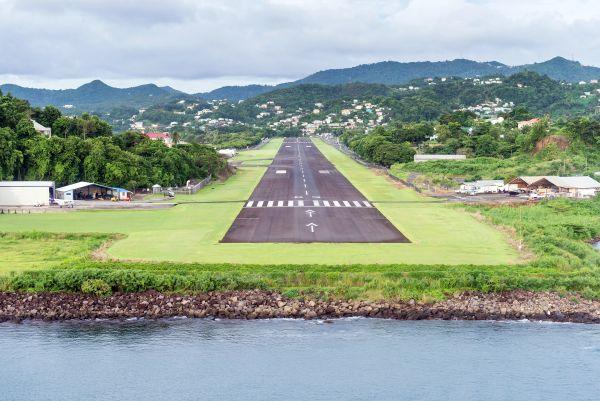
Aviation Services St. Lucia has provided that ground infrastructure from its base at George F.L. Charles Airport in Vigie, Castries, for the last eight years. Sherry Lionel, General Manager of Aviation Services, describes both her role and the company’s core mission.
“My current position really involves the management of resources, so that could be financial, human, information. That is what I do relating to the day-to-day operation of the business. And of course, with ground handling, it’s basically we offer the services on ground for safe and secure movement of passengers and cargo. So these services have been subcontracted to our company by our very prestigious airlines throughout the region. We currently handle six commercial carriers and we handle one cargo carrier.”
With a team of around 50 employees, the company provides ramp handling, baggage delivery, passenger check-in, security screening, VIP handling, catering coordination, and private jet fixed-base operator services. Aviation Services is, in every practical sense, the connective tissue between aircraft and island.
Social sustainability
Ms. Lionel explains that Aviation Services’ sustainability contribution can be understood primarily in social terms:
“Sustainability covers a whole range. Of course, we work with our airport authorities and they’re governed by ICAO and IATA. If there are changes that involve fuels, reducing emissions, or optimizing flight paths for example then that would be for our airport authorities. They would have discussions with us as to what we can improve on and what changes need to be made. When it comes to us as the ground handler, as an organization, we more provide social sustainability by ensuring that there’s global connectivity, jobs for locals, and economic development for the area. That’s something we’ve been doing for the last eight years.”
Inter-island air travel is commonplace and necessary throughout the Caribbean region. Sustaining the ground infrastructure that makes regional flights possible is therefore itself an act of social investment and sustainability. Furthermore, with its payroll of 50 staff still growing, Aviation Services also represents a meaningful source of formal employment for a small island economy where aviation-sector jobs are limited.
Re-use, Reduce
Aviation Services depends on two distinct supply chains: a local network for passenger-facing services, and an international network for specialized ground support equipment. Ms. Lionel explains how both are managed, and where sustainability considerations enter the picture:
“For our supply chains, when it comes to local, we have hotels, because of course we do have to offer accommodation to passengers that are facing interruptions to their flights. We have our taxi drivers, taxi associations.
“When we look at our suppliers for equipment, for our ground support equipment, of course we would ask them for the most cost-effective units, equipment that would produce the least emissions while also performing the function that we need for our operation. Most of our suppliers are based in the US, in Florida, so meet high standards.
“We work at a very small airport. So, when it comes to sustainability, it’s not at such a grand scale for us. Our team of around 50 is relatively small for an airport, although we are expanding, and we’ve had the same equipment for years, actually. That means our priority is to use existing machinery for as long as we can, that’s the best type of sustainability. However, when we need to bring in new equipment, then we would look at how we can reduce carbon emissions. We would look at getting something that would last longer and more sustainably for our commercial use.”
For a lean operation, retaining equipment and looking at sustainability options only when replacement is necessary is both an environmental stance and sound business practice.
Safety First
Aviation Services’ most visible environmental work has come through participation in initiatives organized by the airport authority. Ms. Lionel recalls a clean-up campaign that mobilized the airport community around a shared environmental goal, and explains how the company approaches broader community engagement:
“For environmental initiatives, a couple of years back, there was an airport clean-up, tidying up areas surrounding the airport. That was organized by our airport authorities, so not something that we spearheaded but we work very closely with the airport authority and share their vision. If there is something that they see that needs to be done, then we do it.
“There was another campaign where it was an airport clean-up of waste, garbage, which we call FOD or ‘foreign object debris’. When it gets onto the airport, it can cause serious problems. We dealt with that for the community. Community engagement is really spearheaded by our airport authorities and if there’s something that we can participate in, we do so.”
FOD management, the identification and removal of any loose material that could be ingested by an aircraft engine or cause damage on the airfield, is one of the most safety-critical responsibilities in ground handling. At a compact airport like George F.L. Charles, where ramp areas are close-quarters, clean-up campaigns serve both an environmental and an operational safety purpose simultaneously, making participation more than a goodwill gesture.
Affordability
The sustainability agenda for Aviation Services is still being shaped. The company relies on regular briefings from the airport authority to set its direction for the year, but Ms. Lionel already has a clear sense of the tensions that will need to be navigated:
“At this moment, in terms of future projects or sustainability goals, I would say it is something that’s in the works. I suppose the airport authorities are looking at balancing the environmental goals with affordability. Of course, we want to ensure that travel is sustainable for persons in the region, but people need to be able to afford it as well. We’ve seen, based on taxes, some people find it difficult to travel. So I know there’s been communication with heads of each island to try to get travel to where it used to be, or at least something where persons can travel comfortably within the islands.
“We don’t have international travelers here. As a result, because all of our passengers are regional, I believe they want to ensure that the needs of the local communities are met. The authorities want to look at operational efficiency, maybe reduce taxiing time and idling time. Maybe they’re looking at new designs for aircraft, but that is something that’s on a greater scale because we’re a very small organization, a very small airport on a very small island.
But being small doesn’t mean our impact has to be small. Over the past eight years, our team has shown what can be achieved with a small, dedicated group of people who understand their community, care deeply about what they do, and are committed to making a difference. We may be small in size, but our contribution has been significant—and I believe the potential of this team is even greater.”