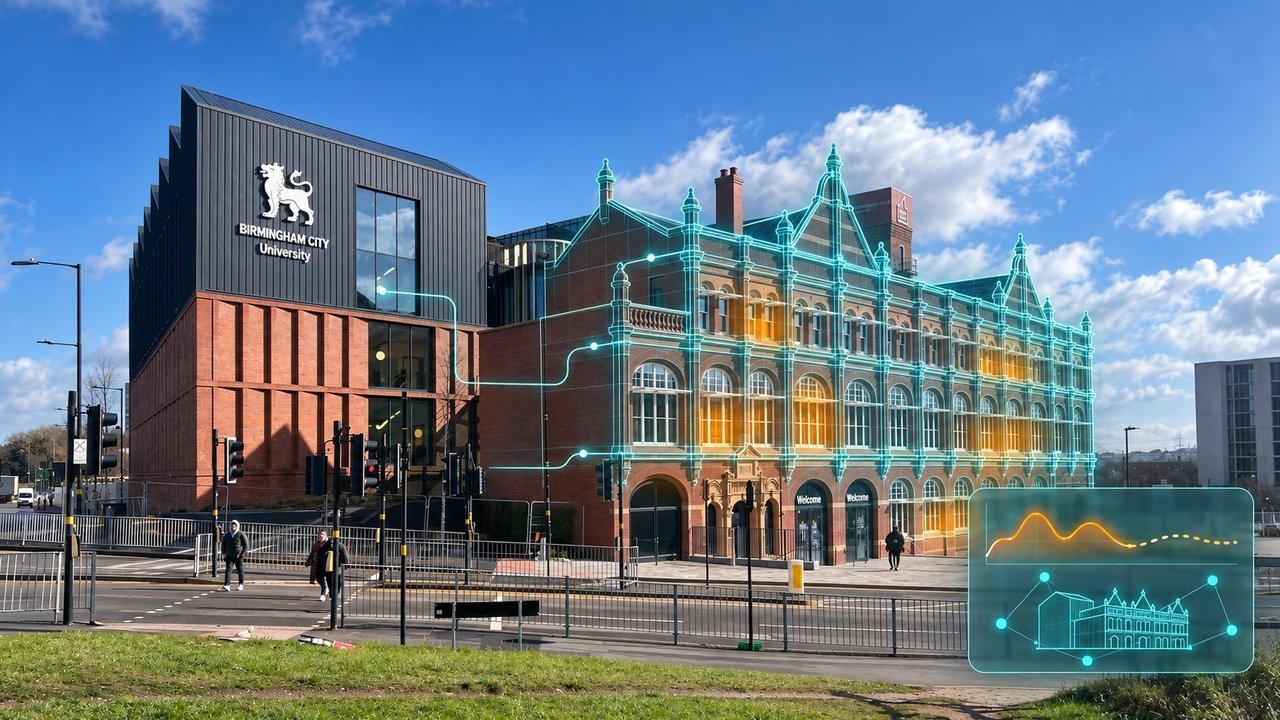
Birmingham City University has secured £50,000 to develop an AI-powered digital twin designed to help communities and businesses anticipate energy demand, use renewable electricity more effectively and explore lower-cost, lower-carbon energy choices. The research will examine how buildings, renewable generation, battery storage and electric-vehicle charging can operate together as connected parts of a local energy system. Led by Dr Syed Attique Shah, the project will produce a functional demonstrator using historical data, available real-time information and simulated scenarios. Its work offers a practical route towards testing energy decisions before they are introduced in real-world settings.
Testing Energy Decisions Virtually
Digital twins provide a virtual representation of a physical system, using data to reflect its behaviour. At BCU, the technology will be combined with artificial intelligence to forecast both energy demand and renewable generation, identify potential faults and assess operating strategies.
That capability could give energy operators a clearer view of how choices made at one point in a system affect another. Rather than responding only after demand shifts or generation changes, users could test options in a virtual environment and assess likely consequences for energy use, costs and emissions.
The work arrives as attention remains focused on UK energy security and infrastructure resilience. By bringing together AI, energy data and virtual testing, the research addresses the operational detail required to make connected local energy systems more responsive.
Connected Local Energy Systems
The project will focus on the interaction between energy-efficient buildings, renewable electricity, battery storage and electric-vehicle charging. These assets can support one another, yet their value depends on when electricity is generated, stored and consumed.
For example, the demonstrator could examine an evening demand peak and assess whether surplus solar electricity stored earlier in the day would reduce costs and pressure on the electricity grid. Such scenarios are particularly relevant where operators need to balance local energy needs while making the best use of available renewable generation.
The research will develop and evaluate forecasting and optimisation methods, considering prediction accuracy alongside potential improvements in renewable-energy use, peak demand, operating costs and emissions. This makes the demonstrator more than a technical model, positioning it as a useful decision-support tool for organisations managing increasingly interdependent energy assets.
Dr Syed Attique Shah, Senior Lecturer in Smart Computer Systems at Birmingham City University, said:
“Energy systems are becoming increasingly interconnected, with buildings, renewable generation, batteries and electric vehicles all influencing how electricity is produced and consumed,
“Our aim is to help operators understand those interactions, anticipate changing conditions and test their options before making decisions.
“By combining AI with a digital twin, we can explore questions such as when to store renewable electricity, how to manage electric-vehicle charging and how to respond when demand rises or generation falls.
The technology could help operators anticipate an evening demand peak and assess whether storing surplus solar electricity earlier in the day would reduce costs and pressure on the electricity grid; delivering practical benefits for energy costs and increase resilience of local energy systems.”
Building A Multidisciplinary Demonstrator
Dr Shah is Principal Investigator for the project, working with Co-Principal Investigators Dr Muhammad Ajmal Azad and Michael Grace. Research assistants Dr Ali Hamza and Dr Ahmad Wahab, together with PhD researcher Fatima Iqbal, complete a team spanning artificial intelligence, digital twins, cybersecurity, energy systems and sustainable urban development.
This breadth of expertise reflects the range of issues involved in operating smarter energy systems. Accurate forecasts and optimisation methods need to work alongside secure digital infrastructure and an understanding of how energy assets operate within buildings and urban areas.
The immediate objective is a functional demonstrator rather than a finished commercial deployment. Its value will lie in bringing data and simulated scenarios into a single environment where different operating choices can be assessed before changes are made in the physical system.
Foundation For Wider Applications
The methods developed at BCU are intended to support future applications across university campuses, business premises and urban regeneration projects. These settings can bring together buildings, local generation, storage and vehicle charging, creating opportunities to assess how flexible energy decisions could work in practice.
The project is supported by the Engineering and Physical Sciences Research Council, part of UK Research and Innovation, through the Digital Twinning NetworkPlus. The funding gives the research team a defined platform for developing evidence and methods that could inform larger real-world pilots and further industry collaboration.
By concentrating on the operational choices behind energy use, storage and generation, BCU’s digital twin research offers a measured contribution to more resilient local energy systems. The demonstrator’s findings could help organisations assess where renewable electricity can be used most effectively while responding to changing demand with greater confidence.