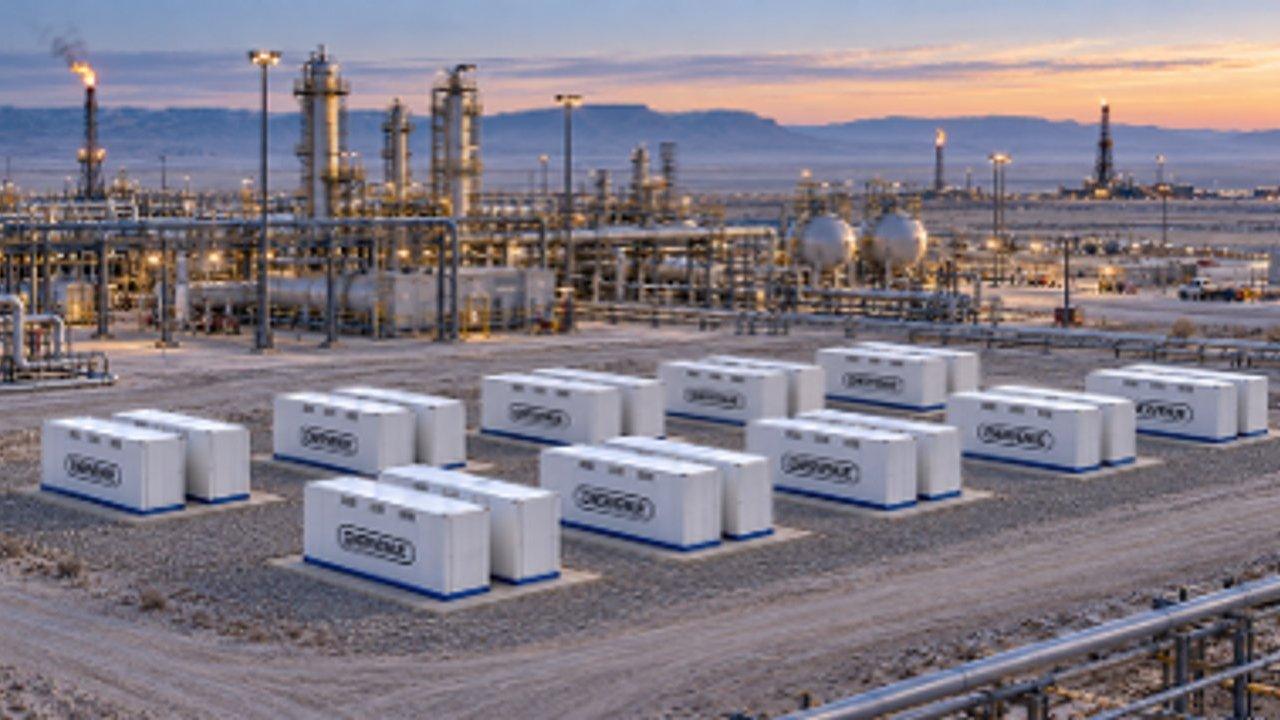
EnerVenue has secured its first multi-megawatt-hour commercial order, supplying 26 Energy Prism containerised storage units with a combined capacity of 11 MWh to an oil and gas production site in northern China. The systems will store power from an onsite solar array and return it to the operation when required. Three units are scheduled to ship in December 2026, followed by the remaining 23 in March 2027. The contract marks an important commercial step for the company’s lithium-free, water-based battery technology in a setting where fire safety is a central requirement.
Solar Storage For Oilfield Operations
The order was placed by a major Chinese oil and gas producer for an established production site, although the end user has not yet been named. The installation will pair solar generation with onsite battery storage, allowing daytime output to be shifted into periods when the oilfield draws electricity.
For an operational oil and gas site, storage equipment must satisfy process and fire-safety requirements before its commercial or technical performance is assessed. EnerVenue’s Energy Prism units are intended for utility and heavy industrial applications and will be delivered as complete containerised systems for connection to the site’s power conversion equipment.
Henning Rath, Chief Executive Officer at EnerVenue, said:
“An oil and gas producer does not put new technology on a working site unless it is completely satisfied that the safety case is sound, and this customer examined everything before choosing us. It is a perfect location to deploy a large scale project.”
Water Based Battery Chemistry
The project will use EnerVenue’s fourth-generation Aqueous Metal Cell, a nickel-hydrogen battery with a water-based, non-flammable electrolyte. The company states that the technology contains no lithium and presents zero fire risk from thermal runaway.
EnerVenue reports that its cell has passed UL 9540A, the industry test for battery fire propagation, with no propagation at cell level. That characteristic is particularly relevant to industrial locations where equipment selection is shaped by the potential consequences of fire, ignition or explosion.
Dr Majid Keshavarz, Chief Technology Officer at EnerVenue, said:
“While thermal runaway is generally defined as a self-accelerating sequence of exothermic reactions, the AMC chemistry does not produce the same progression of events that leads to ignition, fire, explosion, or propagation to adjacent cells. That is a property of the chemistry itself, and it is what allows this battery to go onto sites with the strictest fire safety requirements.”
The company has adapted nickel-hydrogen chemistry previously used for decades by the Hubble Space Telescope and the International Space Station, re-engineering it with lower-cost materials for terrestrial energy storage. EnerVenue identifies steel, nickel, glass-fibre composite and water-based electrolyte as the cell’s principal materials, with nickel and steel recoverable for reuse at end of life.
Long Life Storage Infrastructure
EnerVenue positions the Aqueous Metal Cell as infrastructure designed for a long operating life rather than short-cycle asset replacement. The battery is designed for 30,000 charge cycles, which the company equates to as many as three cycles a day over 30 years. It says the system requires no scheduled augmentation over that period.
In addition to its fire-safety proposition, the company says an installation can operate without active cooling and, where local codes permit, without a fire suppression system. Reducing those auxiliary components could simplify the balance of plant required at a storage site, particularly for remote and industrial facilities.
Henning Rath, Chief Executive Officer at EnerVenue, said:
“A battery designed to run for thirty years is a piece of infrastructure, and infrastructure gets judged on how it performs across its whole life rather than on the day it is delivered. We built the Aqueous Metal Cell for customers who think about it that way, and it’s very satisfying to see such huge demand for our product.”
The oilfield contract follows EnerVenue’s first Aqueous Metal Cell installation, a 150 kWh system at Jintan in Changzhou that has operated since November 2025. That project combines onsite renewable generation with electric bus charging, while the northern China deployment takes the technology to commercial multi-megawatt-hour scale.
Changzhou Manufacturing Expansion
Cells for the 11 MWh order will be produced on EnerVenue’s high-volume manufacturing line in Changzhou, Jiangsu, due to open on 24 September. In its first phase, the facility is planned to produce 250 MWh of Aqueous Metal Cells annually, or around 300 cells a day at full automation.
The company expects production capacity to rise to 1 GWh in 2027 and to multi-gigawatt-hour scale by 2028 as the site expands. EnerVenue describes the Changzhou plant as the first facility in the world to manufacture Aqueous Metal Cells at scale. The manufacturing line is funded through the company’s $300 million Series B extension announced in March 2026, led by Full Vision Capital.
At the factory launch, EnerVenue will also introduce its wider product range. Energy Core, rated at 30 kWh, is aimed at distributed and remote locations; the 108 kWh Energy Cube is intended for in-building and data centre use; and the 150 kWh Energy Rack is designed for commercial, industrial and grid-connected applications. Each platform uses the same underlying battery chemistry as Energy Prism.
A Meaningful Commercial Milestone
The order offers a notable test of long-duration, lithium-free storage in a safety-sensitive industrial environment. It also adds momentum to EnerVenue’s international project portfolio, which spans China, Australia, the United States, the European Union, Saudi Arabia and Canada.
With solar power being stored for use at an operating oilfield, the project illustrates how onsite renewables can support energy needs beyond conventional grid-connected settings. For EnerVenue, the deployment provides a high-profile early commercial reference for a technology built around fire safety, long life and material recovery.
Rahul Mehta, Chief Revenue Officer at EnerVenue, said:
“Oil and gas operators are among the world’s most demanding buyers of industrial equipment, and fire safety is non-negotiable. We are proud that our first multi-megawatt-hour order has come from a customer that rigorously evaluated our technology on precisely this critical requirement.
This order demonstrates growing demand for energy storage designed not only for exceptional fire safety, but also for reliable performance over decades. That combination of safety and long operating life is the value EnerVenue brings, and the conversation we want to advance across every market we serve.”