Sustainable Business Magazine speaks to Emma Fromberg, Course Director of the Cambridge Institute for Sustainability Leadership’s Postgraduate Certificate in Sustainable Business. She explains how the programme remains at the forefront of sustainability through diversity and changing with the times.
The Postgraduate Certificate in Sustainable Business (PCSB) is a Master’s-level programme designed for industry professionals. It is a world-leading programme run by the University of Cambridge Institute for Sustainability Leadership (CISL) for nearly 30 years. Today, it remains at the forefront of developing ideas, technologies and strategies for industry’s response to the increasing need for environmental and social sustainability.
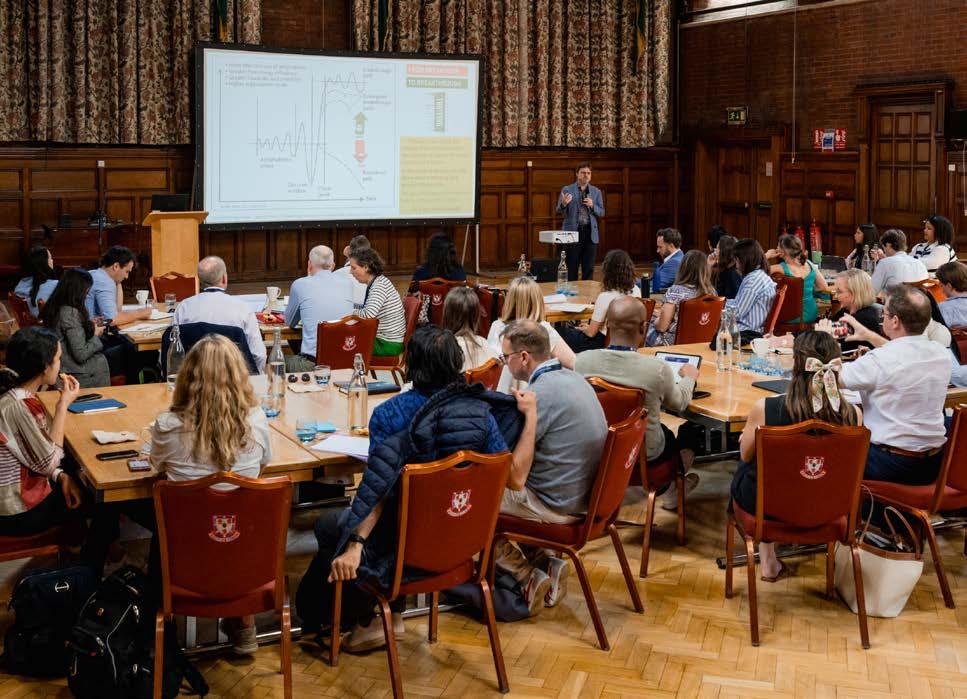
“It is one of the most iconic programmes in the sustainability academic landscape,” says Emma Fromberg, the PCSB Course Director. “The Certificate is one-third of a Master’s degree, run part-time for nine months. During the programme students attend two workshops in Cambridge and submit three written assignments. This is an academic programme that approaches sustainability from a business perspective, not a training course. The emphasis is on academic process and rigour. Nonetheless, it’s for business professionals and entry requires students to have worked within a business for a minimum of three years. PCSB, gives our students a chance to step back from the details of their own business to look at the bigger picture of how business and sustainability can work together.”
Ms. Fromberg explains that PCSB can be used as the first stage of an optional Master’s degree:
“The Certificate is a great starting point for students’ academic journeys. Some complete it and then move straight onto the full Master of Studies in Sustainability Leadership degree. Others choose a step-by-step route named the flexible route, moving from the students who had a break between the Certificate to the Postgraduate Diploma and then completing the Master’s through two additional years of study. All the programmes are designed in a modular way so Certificate students won’t have to repeat the assignments or the content covered during the Certificate if they then move onto the Master’s.”
The Course Director expands on what PCSB involves:
“Our approach is to make two of the assignments problem-based learning so when students apply to the course they bring a sustainability challenge with them. It needs to be a business challenge, not just ‘how do I implement this technology?’ but a sustainability problem that’s broader than the business itself. During the programmes’s first assignment they will understand the complexity within which the problem exists and then conclude with strategic areas for intervention. In the second assignment, they will write a very specific plan of action to put to the group or organisation they wish to influence. This way they are immediately applying knowledge from academia and applying that to their real-life business context.
“Sometimes students go on to study the Postgraduate Diploma, which is the second stage of the full Master’s for those that opt for the flexible route. The Diploma’s first assignment is to look at a case study, and students who had a break between the Certificate and the Diploma can leverage this additional assignment to check how the implementation of their change project went. This is harder to do for those that move onto the Diploma right after the Certificate, because they might not have had sufficient time to implement their change project, but in that case they get to explore how others have successfully achieved what they are aiming for, and can learn from that. I think that’s really cool and shows how our robust academic perspective is really tangible and applicable for students in a business context.”
Expanding Horizons
One of the most exciting aspects of the PCSB is that CISL brings in guest speakers and facilitators to teach and speak with students.
“One interesting speaker we had was Tim Brooks from Lego,” Ms. Fromberg says. “He shared some of the projects he’s worked on, how they went, and what he learned from them. Rather than lecture, he just has a conversation with our students. It was right after the news that Lego was cancelling its plan to make bricks from recycled plastic because it didn’t make sense from a sustainability or commercial perspective, so our students were able to have a long conversation with him about that. It was really special because I felt like the speaker got as much out of it as the students.
“I believe it’s important to have people from the academic side too, though, and not just the commercial side. This summer, for example, we welcomed Bill McDonough who co-wrote the book Cradle to Cradle. I feel like so many ideas in the sustainability space trace back to his book, which was published in 2002. Last year we had Walter Stahel, who wrote The Performance Economy. Both talked about the history of sustainability and how it has changed, giving the students a sense of being part of such an incredibly massive movement where many others have gone before them and really made a substantial change in the public discourse.”
“Other notable speakers we’ve had include Kresse Wesling from Elvis and Kresse, Prof. Wayne Visser from the Antwerp Management School, and Prof. Jennifer Howard-Granville from the Cambridge Judge Business School. We always get a really interesting mix of people and every year we’re trying to tailor that to reflect what really goes on in the lives of our students.”
Ms. Fromberg believes this sense of scale created by sharing all sides of sustainability is an essential learning tool for the course:
“For sustainability, the devil is in the detail. However, if you don’t look at the bigger picture then you’re going to miss the point. Being able to see yourself and your humble circle of control, being part of this larger movement, yet also going back into the technical detail of where something is going to happen or not happen – oscillating between those two worlds is really critical. Being able to do that with good spirits and find enjoyment will ultimately put sustainability into your career as well.”
Oscillating Between Worlds
Ms. Fromberg explains how all of these constituent parts come together to support, improve and direct students in their professional life:
“On the one hand, the very specific assignment tasks apply to the student’s individual situation and their company. On the other, many of the competencies the programme works towards are timeless. It’s not that students could necessarily create a list at the end of the programme to show exactly what lessons solved which problems, but more about how the programme has influenced patterns of thinking about their lived experiences. We talk about ethics and have sessions on leadership, systems thinking, sustainability concepts, and what to focus or not focus on. We’re building academic critical thinking for business professionals.
“Peer learning is also important. Students complete an academic research project working alongside a small group of their peers. Many of the students have been out of academic life for some time, leaving them a bit uncertain about research or academic writing, but this group work means they are more comfortable in figuring solutions out together. Every group has one supervisor that stays with them throughout the programme, supporting them in academic research and individual issues. The purpose of this group work isn’t just about academic competency and how to research as a group but also building cohesion within the group and how to learn with each other. Those skills then feed back into their careers. Nobody can tackle sustainability alone and this project helps them understand that.”
Another really important part of this team-based learning is the opportunity for students to learn from each other.
“Last year we had the CEO of a large company in the cohort,” explains Ms. Fromberg. “That was really useful because sometimes we had conversations in the classroom where students that were more middle-management level were demanding things from the CEOs in their own compa- nies. But this CEO-level student was able to explain that they were beholden not only to the needs of those middle-managers but to other shareholders in the company. It produced really interesting conversations that helped the middle-management level students learn from a different perspective. We also have students from different industries and different countries. They can then compare and reflect on how business is run in the UK versus China, or in construction versus hospitality. That leads to a well-rounded way of understanding what sustainability really means for business.”
Diversity plays a key role in the course, and CISL offers bursaries to people that may otherwise feel they aren’t in a position to fund the Certificate.
“It’s a very international cohort that’s diverse culturally, geographically, industrially, and in terms of seniority and disciplines. That’s really close to my heart. A lot of our speakers get an honorarium but then they say they wish to donate the honorarium to the bursary fund. Our contributors also pay directly into that pot. That means more people get access to this kind of education at a prestigious university, meaning they can bring their perspective to the mix as well. Otherwise, we’d have entire groups in society under-represented and that would leave big gaps in the programme.”
Challenges Of The Future
Ms. Fromberg says every year raises new issues and questions for sustainability, and the next few years are no exception. She explains that sustainability has come a long way since CISL started, but it’s stayed at the front by responding to the changing global landscape:
“Sustainability 27 years ago when PCSB began was very different to what it is now. I have spent days going back through the old course designs, seeing what was involved, and it’s clear the early days were mostly equipping students with what sustainability means and why companies should look at it. Today, that awareness is very much part of mainstream consciousness and there are very few companies that don’t already have sustainability on their radar. As a result, we are now approaching sustainability in terms of systems thinking and critically reviewing information because there is so much of it out there. Sustainability is no longer treated as an add-on, we are making our students ready to put it at the core of their business.
“What I’ve found this year in terms of challenges is that there are so many policy and reporting requirements, people are really focused on getting better at that. So how is PCSB responding? By getting students to ask big questions about the need for reporting, like what exactly are they reporting on? What’s the bigger change or vision that’s meant to come out of this reporting? PCSB this year is looking at the role reporting has to play, how it can drive radical change, and understanding the stories behind the numbers. That’s an example of how we’re trying to create that oscillation between the micro and macro worlds of sustainability.
“I think we’re quite lucky to have such an iconic programme and there are people working in the sustainability space today that completed PCSB 25 years ago. It’s a well-known programme for the industry and it’s very well received. We’re going to continue creating great content and compelling programme design for industry professionals, making sure it is very applied but also has that academic integrity.”