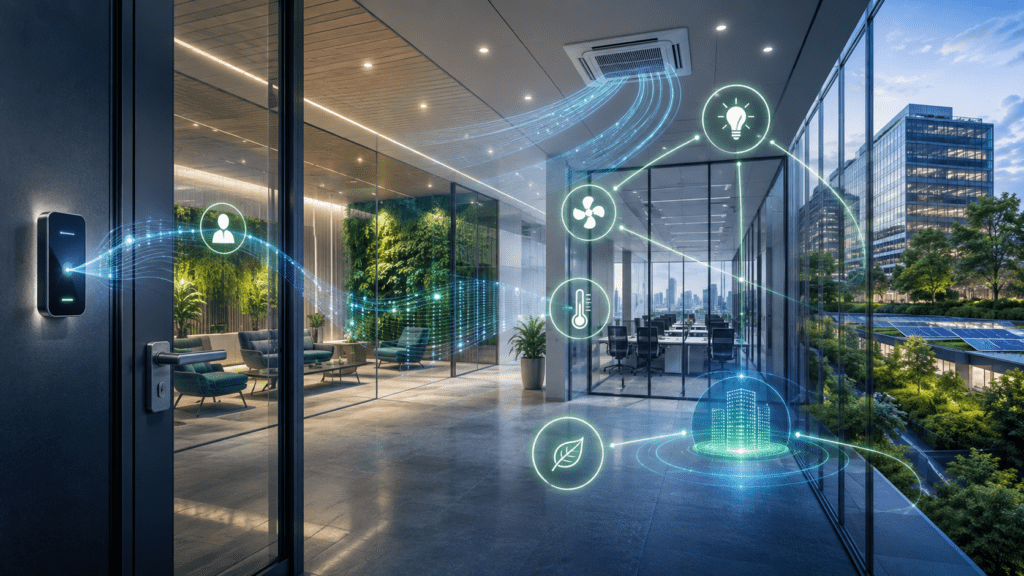
Most facility managers do not think about access hardware when reviewing energy consumption. Yet the devices installed at entrances and throughout a building can provide valuable information about how spaces are actually being used.
When access hardware connects with building management platforms, occupancy information can help control lighting, heating, cooling, and other systems based on real activity rather than fixed schedules.
That creates an opportunity to connect security infrastructure with broader sustainability efforts. Instead of treating access control and energy management as separate systems, facility teams can use the data generated at entry points to support more efficient building operations.
Where Access Control Meets Energy Control
For years, security teams and energy managers often worked independently. Smart building technology is gradually changing that relationship by allowing access systems, occupancy sensors, building management platforms, and other infrastructure to exchange data.
From “Who Gets In” to “What Happens Next”
Traditional security hardware had a straightforward role: authenticate a user and allow or deny access.
Modern access systems can contribute much more information. Occupancy signals generated when people enter or leave spaces can help smart building energy management systems make real-time decisions about lighting, climate control, and other equipment.
Door Access Control Systems and Smarter Energy Use
Facility teams evaluating modern door access control systems can consider how access infrastructure fits into a broader building automation strategy.
When access events are shared with compatible building management platforms, they can provide useful occupancy signals. Those signals may help systems determine when rooms or areas are being used and adjust lighting, HVAC, or other building services accordingly.
The sustainability value comes from the integration rather than the access hardware alone. A card reader or smart lock becomes more useful for energy management when its data can inform other systems and help reduce unnecessary operation of equipment in unoccupied spaces.
Access Data as the Backbone of Building Intelligence
Consider a conference room.
When someone enters, connected building systems could:
- Turn on required lighting
- Adjust temperature settings
- Activate relevant room equipment
- Update occupancy information for facility teams
When the space becomes unoccupied, systems can reverse those actions according to predefined rules.
Repeated across hundreds or thousands of access events, this information can help facility teams develop a more accurate understanding of building occupancy and energy demand.
Smart Building Energy Management: The Engine Underneath Everything
Understanding the relationship between access control and energy management is only the first step. Sustainability improvements depend on how effectively building systems work together.
Architecture That Works Together
A properly designed smart building energy management system usually includes several connected layers, such as sensors, controllers, middleware, access hardware, building management systems, and analytics platforms.
Access hardware naturally sits near the edge of this ecosystem and can generate valuable occupancy information.
The infrastructure is already present in many commercial buildings. The important question is whether its data can be securely and reliably shared with the systems responsible for building operations.
The Data That Justifies the Investment
IoT-integrated access systems can provide more information than basic occupied or unoccupied status.
Depending on the configuration and technologies involved, occupancy systems may help facility teams understand:
- How many people are using particular spaces
- When occupancy typically peaks
- How long rooms remain occupied
- Which spaces are consistently underused
- How occupancy patterns correspond with energy consumption
Research from Pacific Northwest National Laboratory found that more detailed people-count occupancy sensing can produce greater building-energy savings than basic presence detection.
The broader lesson is important: better occupancy data can improve the quality of energy-control decisions.
Why Access Control Systems Can Support Energy Management
The access control infrastructure installed primarily for security can also provide useful operational data.
The key is understanding which signals are available and how they can be integrated with other building systems.
Modern Smart Locks Do More Than Control Entry
Modern smart access hardware may include capabilities such as:
- Biometric authentication
- Remote management
- Programmable schedules
- Occupancy information
- Door-status monitoring
- Building management integrations
These capabilities can support both security and building operations.
For example, a door that remains open longer than expected can trigger an alert. In some environments, that information could also help facility teams investigate whether heating or cooling energy is being wasted.
PoE: One Cable for Power and Data
Power over Ethernet, or PoE, can simplify certain access control deployments by carrying power and data through the same Ethernet infrastructure.
Compared with systems that require separate electrical connections, PoE can reduce installation complexity while giving IT and facility teams centralized visibility into connected devices.
| Feature | PoE Access Control | Wireless Access Control |
| Power source | Ethernet cable | Battery or local power |
| Installation requirements | May reduce separate electrical cabling | Depends on device and location |
| Energy monitoring | Can support centralized monitoring | Often managed at device level |
| Maintenance | Generally low after installation | May require battery replacement |
| Scalability | Well suited to networked environments | Useful where cabling is difficult |
The better choice depends on the building, available infrastructure, maintenance requirements, and integration strategy.
Understanding Wireless Power Consumption
Wireless access hardware is not automatically inefficient.
Modern devices can use low-power communication protocols and sleep modes to reduce energy demand between access events.
Poor efficiency is more likely when devices are incorrectly configured or poorly maintained.
Facility teams should review:
- Firmware versions
- Sleep settings
- Battery health
- Wireless signal strength
- Communication frequency
- Device configuration
These factors can affect both reliability and energy consumption.
Turning Access Data Into Building-Wide Sustainability Improvements
Individual access technologies can provide useful capabilities, but larger sustainability benefits usually depend on how effectively those technologies work together.
Access Logs Are Useful Beyond Security Audits
Access logs traditionally help security teams understand who entered particular areas and when.
Aggregated and appropriately governed occupancy information can also help facility teams identify patterns in how buildings are used.
For example, occupancy patterns may inform decisions about:
- HVAC schedules
- Lighting schedules
- Elevator usage
- Workspace allocation
- Cleaning schedules
- Building operating hours
The goal is not simply to collect more data. It is to use appropriate data to operate spaces according to actual demand.
LEED, WELL, and Performance Documentation
Building certifications generally require organizations to document performance rather than simply state sustainability intentions.
Access-integrated occupancy data may contribute to the evidence facility teams use when evaluating building performance, environmental quality, and occupant experience.
For teams pursuing frameworks such as LEED or WELL, the practical benefit is better documentation of how spaces are being used and how building systems respond.
Organizations should still evaluate the specific requirements of the certification program they are pursuing rather than assume access data automatically qualifies for particular credits.
AI Can Help Buildings Adapt Over Time
Machine learning and analytics can add another layer to connected building operations.
Historical occupancy and energy information can potentially help systems anticipate demand and optimize schedules.
Applications may include:
- Occupancy forecasting
- HVAC pre-conditioning
- Lighting optimization
- Equipment scheduling
- Anomaly detection
- Predictive maintenance
These capabilities are most valuable when predictions are based on reliable building data and remain subject to appropriate operational controls.
From Planning to Pilot: How to Put the Strategy Into Practice
A strong smart-building strategy still requires careful implementation.
Starting with a focused pilot can make it easier to validate integrations, identify operational problems, and measure whether expected improvements actually occur.
Start With a Site Audit
Before installing new technology, map where access control and energy systems already overlap and where they remain disconnected.
A useful audit can include:
- Existing access controllers
- Access reader locations
- Building management platforms
- Energy metering coverage
- Existing occupancy sensors
- High-traffic areas
- Underused spaces
- HVAC and lighting zones
This gives the facility team a realistic picture of what can be integrated before additional hardware is purchased.
Choose Vendors That Support Integration
When comparing smart access hardware, PoE systems, wireless solutions, and building management technologies, interoperability should be a major consideration.
Open architecture and documented integration capabilities can make it easier to connect access data with other platforms.
Highly proprietary environments may make future integrations more difficult, particularly when facility teams need data to move between systems from different vendors.
Pilot First, Then Expand
Start with a high-traffic floor, department, or zone where HVAC and lighting consumption can be measured.
During the pilot:
- Establish baseline energy consumption.
- Track access and occupancy patterns.
- Connect selected occupancy signals to building controls.
- Monitor changes in energy consumption and comfort.
- Identify false triggers or operational problems.
- Adjust the system before expanding it.
A controlled pilot provides actual operating data that can guide a larger rollout.
What Facility Teams Need to Know Day to Day
Connected technology performs best when the people responsible for operating it understand what the system is doing.
Technology alone does not guarantee efficient building operation.
Train Teams to Read the Dashboards
Facility staff should understand how occupancy signals relate to building controls.
Training can help teams recognize:
- Unusual occupancy patterns
- Unexpected energy consumption
- Manual overrides
- Equipment that continues running unnecessarily
- Access or sensor anomalies
This allows automation and human oversight to work together.
Cybersecurity Is Essential
Connecting access and energy platforms can increase the number of systems exchanging operational information.
That makes cybersecurity an important part of the architecture.
Organizations should consider measures such as:
- Regular firmware updates
- Network segmentation
- Role-based access controls
- Strong authentication
- Device inventories
- Security monitoring
- Vendor security requirements
A compromised access device can create more than a physical security problem when it is connected to other building infrastructure.
Schedule Regular System Reviews
IoT-integrated building infrastructure should be reviewed periodically.
Firmware issues, sensor alignment, battery degradation, configuration changes, and network problems can all affect performance over time.
Regular reviews help facility teams identify these problems before they significantly reduce reliability or efficiency.
Questions Facility Managers Ask Most
What’s the Real ROI?
The return on investment depends on the size of the building, existing infrastructure, occupancy patterns, energy costs, and the scope of integration.
Organizations should establish their own baseline costs and measure changes in HVAC consumption, lighting use, maintenance, and operational efficiency after implementation.
How Do I Keep Wireless Power Consumption Low?
Configure appropriate sleep cycles, keep firmware current, monitor battery condition, and avoid installing devices in locations with consistently poor wireless signals.
Periodic reviews can identify devices consuming more power than expected.
Can Older Buildings Retrofit Without Major Renovations?
In many cases, yes.
Wireless technologies, network-connected controllers, and modular building management systems can provide retrofit options when major structural changes are impractical.
A site assessment should determine which approach best fits the existing infrastructure.
Your Doors Are Already Doing More Than You Think
Access control and energy management no longer need to operate as completely separate disciplines.
Every access event can provide information about how a building is being used. When that information is securely integrated with appropriate building systems, it can help facility teams make better decisions about lighting, HVAC, scheduling, and space utilization.
The objective is not to turn every access device into an energy-management system.
It is to use existing building data more intelligently.
Organizations that connect access information with broader facility operations can build a stronger foundation for energy efficiency, sustainability goals, building performance, and long-term operational planning.