When a business sets out to cut its transport emissions, the conversation tends to leap straight to electric vans and company EVs — big, capital-heavy commitments that take years to pay back. There’s a far smaller, cheaper lever sitting largely ignored in the bike shed, and for the right journeys it punches well above its weight: electrifying the bicycles a business already has.
It’s an unglamorous idea, which is probably why it gets overlooked. But converting an existing bike to electric assist is one of the most resource-efficient mobility moves available — it reuses what you already own, it costs a fraction of buying purpose-built electric bikes, and for short urban trips it replaces precisely the car journeys that are most wasteful to make by car in the first place. Here’s why it deserves a proper place in the sustainability conversation rather than a footnote.
Transport is the footprint hiding in plain sight
For many organisations, transport is a stubborn and visible part of the overall footprint, and a surprising share of it is made up of short, low-value journeys. The quick dash across town, the last-mile delivery, the staff commute of a few miles each way — individually trivial, collectively significant, and frequently done by car or van out of habit rather than genuine necessity.
Short trips are where the inefficiency concentrates. A cold engine running a couple of miles is about as wasteful as motoring gets, and yet that is exactly the kind of journey a bike handles beautifully. The barrier has always been effort and range — hills, loads, distance, arriving in a sweat — and that is precisely the barrier electric assist removes. An e-bike turns a journey that felt like too much hard work into an easy one, which is what finally tips people out of the car for the trips that never really needed it. For a business, replacing those short vehicle journeys with electric-assisted cycling is a direct, measurable reduction in fuel use and emissions, achieved with kit that costs remarkably little.
Why conversion is the genuinely circular choice
Here’s the part that makes conversion specifically such a strong sustainability play, rather than merely a cheaper one: it sidesteps the environmental cost of manufacturing something new.
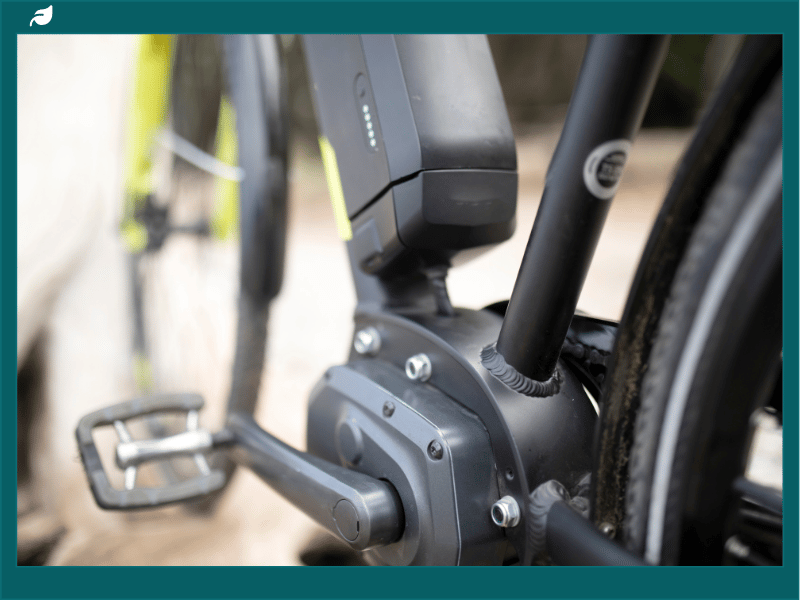
Every purpose-built electric bike carries embodied emissions — the energy, materials, and transport that went into making it before it ever turns a wheel. Buying new to “go green” always carries that hidden cost, however clean the bike is to run afterwards. Converting an existing bike largely avoids it. You’re taking a frame, wheels, and components that already exist and already work, and adding only the electric drive, rather than manufacturing an entire vehicle from scratch. Reusing what already exists, instead of building anew, is the essence of circular thinking. Fitting a 1500 watt ebike conversion kit to a sound second-hand bike keeps a serviceable machine in use and adds only the components genuinely required to electrify it — a far lighter footprint than commissioning a brand-new build.
There’s a waste-reduction angle, too. Plenty of perfectly good bicycles sit unused in sheds and storerooms precisely because they feel like too much effort for the journeys people now make. Conversion gives those bikes a second working life rather than leaving them to seize up or head to landfill. Extending the useful life of something already manufactured is almost always greener than replacing it, and conversion does exactly that, quietly and cheaply.
Right-sizing the power to the need
A genuinely sustainable approach also means not over-specifying, and with conversions that comes down to choosing the right amount of power rather than simply the most. Over-powering a build wastes battery capacity, adds weight, and buys capability that goes unused — none of which serves an efficiency goal.
The honest question is what the bike actually has to do. For flat commuting and light loads, a modest kit is ample and barely sips energy. For hillier routes or heavier carrying, a little more output earns its place — a 1200w ebike kit and similar mid-range builds suit those more demanding journeys without leaping straight to the heaviest, most power-hungry option on the shelf. Matching the power to the real-world task keeps the build efficient, the battery sensible, and the whole thing closer to the genuinely lightweight solution it’s meant to be.
One important caveat sits alongside this, and it’s a matter of law rather than preference. Road-legal electric bikes are tightly regulated in many places — in the UK and across much of Europe, for instance, an electrically assisted pedal cycle is limited to a modest continuous power output, with the assistance cutting off above a set speed. Higher-output kits exceed those limits and are intended for private land, off-road use, or jurisdictions that permit greater power, rather than for unrestricted use on public roads. Anyone specifying a build for road use needs to check the local rules first and choose accordingly. Sustainable and legal should go hand in hand, not pull against each other.
Right-sizing pays a second sustainability dividend that’s easy to miss: it’s kinder to the battery. A motor that isn’t constantly straining draws its power more gently, which tends to extend the working life of the battery pack — and since the battery is both the most resource-intensive part of the build to manufacture and the trickiest to dispose of responsibly, a build that makes its battery last longer is meaningfully greener over its lifetime. Choosing appropriate power rather than maximum power isn’t only about efficiency on the day; it’s about how many years the most precious component survives before it has to be replaced at all.
Where the real savings actually come from
It’s worth being clear-eyed about where the impact lives, because not every cycling mile is a green win in the same way. The emissions savings come overwhelmingly from substitution — from each e-bike journey that genuinely replaces one made by car or van.
Swapping a short car trip for an electric-assisted ride is the high-value move, and it’s exactly the trip e-bikes are best at: a touch too far or too hilly to cycle unassisted, far too short to justify a vehicle, repeated daily. A business that targets those journeys deliberately — the commutes, the local deliveries, the cross-town errands — gets a genuine reduction rather than a token gesture for a report. By contrast, an e-bike that simply replaces an ordinary bike ride saves very little, because that trip was already clean. The strategy, then, isn’t to electrify everything in sight; it’s to identify the car and van journeys a bike could realistically absorb, and to make those particular switches as easy and obvious as possible.
Framed that way, conversion becomes a targeted intervention rather than a vague green gesture — and targeted interventions are the ones that actually shift a footprint in a way you can stand behind.
It also helps to measure honestly. A business that wants to claim a genuine reduction should track which journeys actually moved from vehicle to e-bike, rather than counting every mile ridden as a saving — the two are not the same thing, and conflating them produces a number nobody can defend under scrutiny. That discipline tends to sharpen the scheme itself, because once you’re watching which trips convert, you quickly learn which routes, riders, and loads make the switch stick and which quietly drift back to the van. The schemes that endure are the ones treated as something to monitor and improve, not a box ticked on a sustainability report and then forgotten about until next year.
Making it stick: the practical side
A good idea only delivers if it survives contact with daily reality, and a few practical things decide whether electrified bikes get ridden or quietly abandoned in a corner.
Charging and storage need somewhere sensible and secure to happen, because an e-bike that’s awkward to charge or vulnerable to theft simply won’t get used. Safety matters — helmets, lights, and a little confidence-building for staff who aren’t used to riding in traffic. Battery stewardship is both a safety and a sustainability question: buying quality cells, charging them responsibly, and planning for proper recycling at end of life rather than landfill, since a poorly handled battery undoes a chunk of the good you set out to do. And uptake depends on culture as much as kit; people use what’s easy, visible, and encouraged, so a degree of organisational nudging goes a long way. None of this is onerous, but skipping it is exactly how a promising scheme ends up as a row of dusty bikes nobody touches.
Maintenance deserves a mention here too, because a well-kept e-bike stays in service far longer than a neglected one, and longevity is itself a sustainability outcome. Keeping the tyres inflated, the brakes working, and the drivetrain clean is ordinary bike care; attending to the battery and motor at sensible intervals is the small addition that electrification brings. A bike that’s looked after simply lasts, which spreads its embodied footprint across many more years of useful trips and pushes the eventual replacement — with all the manufacturing that implies — further down the road. Neglect does the opposite, quietly turning a green choice into landfill ahead of its time.
The bottom line
In the rush towards electric vehicles, the humblest option tends to get overlooked, and it shouldn’t. Electrifying bikes a business already owns is cheap, fast, and genuinely circular — it reuses existing machines, avoids the embodied cost of manufacturing new ones, and goes after exactly the short, wasteful car journeys that are ripe to replace.
Choose conversion over buying new to keep the footprint light and the cost down. Right-size the power to the task and to the law rather than over-building for its own sake. Target the journeys that actually displace a vehicle, where the savings genuinely live. Look after what you build, too, so it lasts — because a long-lived bike is a greener one. Do that, and a quiet corner of the bike shed becomes one of the more cost-effective sustainability moves on the table — the kind that pays for itself while it’s busy cutting emissions, and asks remarkably little in return.