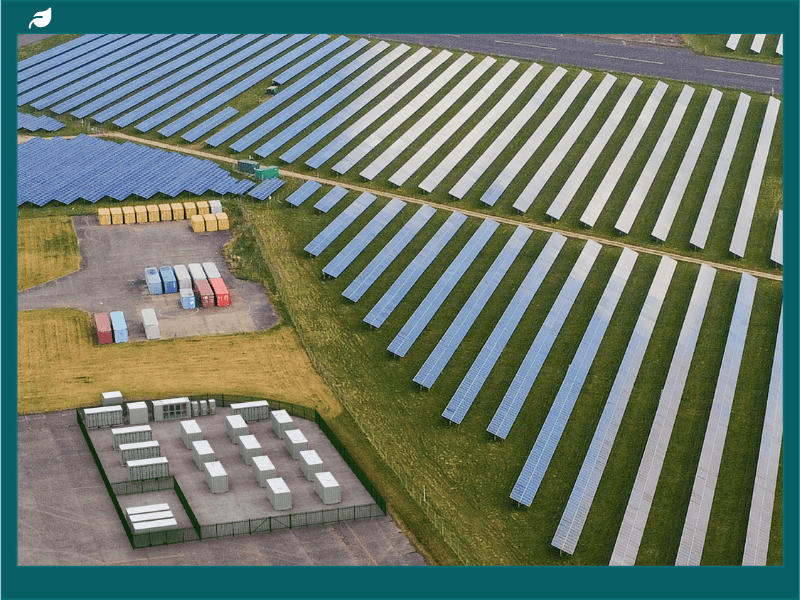
EDF has signed two long-term battery optimisation agreements with Trinasolar International Solution Business Unit, covering 89.9MW and 179.8MWh of grid-scale storage planned for England and Scotland. The Ruby BESS near Aberdeen will have 40MW / 80MWh of capacity and is scheduled to become operational in October 2026, while Gloucestershire’s Chatterley BESS is expected to provide 49.9MW / 99.8MWh from March 2027. EDF will manage both assets through its Powershift digital trading and optimisation platform. The arrangement is designed to give Trinasolar ISBU long-term revenue certainty while providing flexibility services for Britain’s electricity system.
Two Projects Across Britain
The agreements cover two-hour battery energy storage systems positioned to serve local and national grid requirements. Ruby BESS will be located near Aberdeen in Scotland, while Chatterley BESS will be located in Gloucestershire, England.
Both projects are intended to store electricity when demand is lower and release it at times of higher demand. That operating model can support grid stability, help manage price volatility and accommodate a larger volume of low-carbon electricity generation on the system.
The projects arrive as battery storage takes a more prominent role in the electricity mix. Flexible capacity can respond to changes in demand and generation, particularly as renewable generation and electrification increase across Britain’s energy system.
Powershift Platform Management
EDF’s Powershift platform will manage the trading and optimisation of the two assets under the long-term agreements. The digital system will be used to identify and deliver flexibility services while supporting commercial performance over the operating life of the projects.
Long-term optimisation contracts can offer developers greater confidence in the expected route to market for storage capacity. For asset owners, that certainty can support investment decisions for infrastructure designed to respond dynamically to electricity-system needs.
Stuart Fenner, Commercial Director of Business & Wholesale Services at EDF, said:
“As renewable generation and electrification continue to grow, flexible assets such as battery storage are becoming increasingly important to maintaining system stability. We’re pleased to be working with Trinasolar ISBU to optimise both projects and help unlock the flexibility needed to support Britain’s transition to a low carbon, electrified energy system.”
Supporting Storage Investment
Trinasolar ISBU acquired the Ruby and Chatterley projects before appointing EDF to optimise them. The partnership combines ownership of new battery assets with an operational platform intended to manage their participation in electricity markets and flexibility services.
For the wider energy system, storage can help shift available electricity between periods of differing demand. As a result, assets such as Ruby and Chatterley can contribute flexible capacity alongside other forms of low-carbon generation and electricity infrastructure.
Leonardo Lotti at Trinasolar ISBU, said:
“Following our acquisition of the Ruby and Chatterley projects, we are proud to be partnering with EDF as an important next step in maximising their long‑term value. Through this collaboration, we can invest with confidence while ensuring the projects are operated effectively to deliver strong commercial outcomes and meaningful benefits for the wider energy system.”
A Growing Battery Portfolio
Ruby and Chatterley form part of EDF’s growing battery storage portfolio in Great Britain. The company is also a major generator of zero-carbon electricity in Britain and has renewable generation in operation, construction, planning and development through EDF Power Solutions UK and Ireland.
The new agreements place battery storage alongside EDF’s wider electricity activity, including nuclear generation, wind, solar and customer electrification services. The company’s investment in managed storage reflects the practical importance of matching supply and demand as the power system incorporates more low-carbon generation.
With the two projects due to enter operation in 2026 and 2027, the agreements provide a clear route for their capacity to contribute to a secure, flexible and lower-carbon electricity system. For Trinasolar ISBU, the contracts establish long-term operational arrangements for recently acquired projects. For EDF, they extend the reach of its Powershift platform within Britain’s expanding energy storage market.
Looking for a solar installer?
Compare MCS-certified solar panel installers across the UK in our directory, with ratings, reviews and free quotes, listed by county.
Related solar guides: