For years, solar panels and EV chargers were sold mostly as personal choices for homeowners. That leaves out a growing group of buyers: business owners who see solar and charging as part of how they run a company.
Think of a small manufacturer with a big flat roof, a clinic whose staff drive in daily, or a contractor whose vans return to the yard each night. For each, the question is about numbers. Does it lower operating costs, does it help with staff and customers, and how long before it pays back?
Why businesses look at the numbers differently
Homes use most of their electricity in the morning and evening. Many businesses use theirs during the day, which is when solar panels produce. That timing match is one of the strongest points in the commercial case. Power generated on the roof is used on site at the same moment, offsetting electricity that would otherwise be bought at full rate.
Businesses also tend to have:
- Larger, simpler roofs or parking areas suited to panels or solar carports
- Predictable operating hours that make savings easier to estimate
- Accounting rules that may allow equipment to be depreciated over time
- Fleet vehicles that return to the same place each day
None of this guarantees a quick payback. It does mean a business can often model the return more confidently than a household can.
Equipment prices have also moved in the right direction. The International Renewable Energy Agency has tracked steep drops in solar costs over the past decade, which is part of why small firms now consider projects that once seemed out of reach.
Workplace charging as a staff and customer benefit
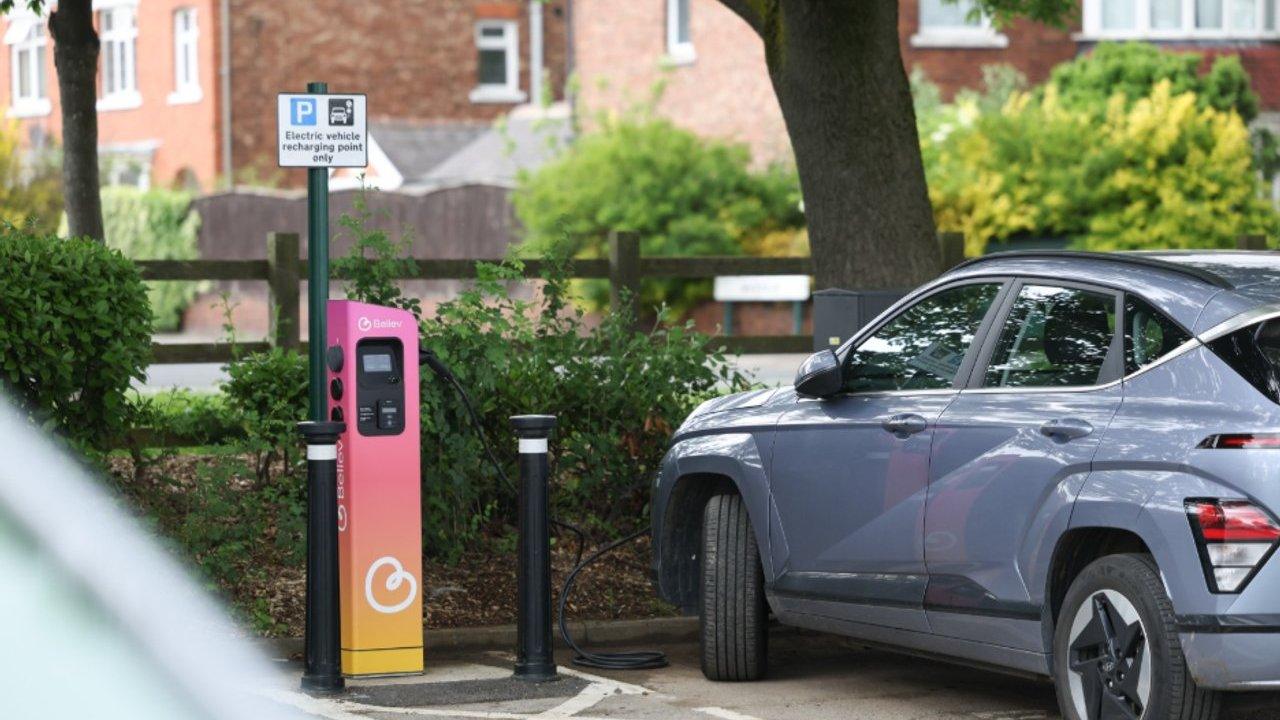
Workplace charging is easy to underrate. For employees who live in apartments or condos without their own charger, being able to plug in at work can decide whether an electric car is practical at all. That makes charging a modest but real perk, similar to bike storage or a good transit pass program.
For businesses that serve the public, a couple of Level 2 stations may bring in customers who plan stops around charging.
There are a few choices to make early:
- Free or paid. Free charging is simple and generous. Paid charging through networked stations recovers electricity costs and controls who uses the spots.
- Level 2 or fast charging. Level 2 suits staff who park for a full shift. DC fast charging costs far more to install and usually only makes sense where customers stop briefly.
- How many ports. Starting small and running conduit for future stations is often cheaper than trenching twice.
- Load management. Smart chargers can share available power so the building does not need a costly electrical service upgrade.
Do not forget the home side
Many owners of small businesses also want to charge at home, and the two decisions are linked. If you drive a company vehicle home each night, a home charger may be part of the business case. Keep records of how the charger is used so your accountant can advise on what, if anything, can be claimed.
For the home part of the plan, homeowners on southern Vancouver Island can talk to a local installer such as Oceanvolt Solar & EV, which installs solar, battery storage and Level 2 home chargers around Greater Victoria. Pairing a home charger with an existing or planned rooftop system is a separate project from a workplace install, with its own permits and sizing.
Building the ROI picture
A useful return-on-investment estimate includes more than the price of panels. Ask your installer or energy advisor to walk through each piece.
| Cost or value | What to consider |
| Upfront cost | Equipment, installation, permits, any electrical upgrades |
| Incentives | Government grants, utility programs and tax treatment, which change often |
| Energy savings | Electricity generated and used on site, plus any credit for power sent to the grid |
| Demand charges | Whether solar or smart charging lowers peak demand fees on commercial rates |
| Fleet fuel savings | Cost per kilometre of electricity versus gasoline or diesel |
| Maintenance | Inverter replacement over the system’s life, charger servicing |
| Soft benefits | Staff retention, customer goodwill, sustainability reporting |
The soft benefits are hard to price, so many owners leave them out of the formal calculation and treat them as a bonus. If the project makes sense on energy and fuel savings alone, that is a strong sign. Local electricity rates, roof conditions and incentive timing will shape your own numbers more than any national average.
Questions to ask before you sign
Whether the project is on a home, an office or a warehouse, a few questions protect the business:
- Has the installer reviewed at least a year of electricity bills to size the system?
- What does the roof look like, and will it need replacing before the panels reach the end of their life?
- If you lease the building, does the landlord agree, and who owns the equipment if you move?
- What warranties cover panels, inverters and chargers, and who handles service?
- How will the system be monitored so you can see whether it performs as promised?
Get more than one quote, and ask each installer to show the assumptions behind their savings estimate.
A practical way to start
Not every business needs a large array and a row of fast chargers. A sensible first step might be a small solar system sized to daytime use and two Level 2 stations for staff, with conduit in place for more later. Measure the results for a year, then decide whether to expand.
Done carefully, solar and EV charging lower costs, give staff and customers a useful service, and show the company’s sustainability goals in a form people can see in the parking lot.
Looking for a solar installer?
Compare MCS-certified solar panel installers across the UK in our directory, with ratings, reviews and free quotes, listed by county.
Related solar guides: