Understanding Geothermal Energy
Right now, beneath your feet, the earth is running a furnace that never switches off. It has been burning for roughly 4.5 billion years, and it will keep burning long after every coal seam and gas field on the planet is exhausted. Geothermal energy is simply the art of using that furnace wisely.
So what is geothermal energy, exactly? It is heat drawn from the earth’s interior, converted into electricity, hot water, or warmth for buildings, and delivered without burning a single gram of fossil fuel. Unlike wind or solar energy, it does not care whether the sun is shining or the air is still. It runs around the clock, every day of the year, which is exactly the kind of reliability a decarbonising grid desperately needs.
The case for geothermal is not just environmental. Natural gas prices swung wildly in 2022 and 2023, exposing how fragile price-sensitive energy systems really are. Geothermal resources, once developed, cost remarkably little to run. The fuel is free.
And as drilling technology borrowed from the oil and gas industry matures, the upfront costs that once put investors off are falling fast.
Defining Geothermal and Its Core Principles
The earth’s heat comes from two places: residual warmth left over from the planet’s violent formation, and the slow, continuous decay of radioactive elements such as uranium, thorium and potassium deep in the mantle. Together, these processes push enormous quantities of heat toward the earth’s surface, where human beings can, in the right locations, intercept it.
Geothermal resources are not spread evenly. They are richest where tectonic plates meet, where the crust is thin, and where volcanic activity keeps rock temperatures close to the surface. Iceland sits directly on the Mid-Atlantic Ridge and meets almost all of its heating needs geothermally. Kenya’s Olkaria field in the East African Rift generates over 800 megawatts of geothermal power.
The western United States, the Philippines, Indonesia and New Zealand all punch well above their weight in geothermal electricity. But the resource is genuinely global: even regions without obvious volcanic activity hold heat at depth, and enhanced geothermal technology (more on that shortly) is making those quieter spots viable too.
At its core, the principle is simple. Heat flows upward. Geothermal systems capture that flow before it dissipates into the atmosphere, and put it to work. The higher the temperature of the resource, the more electricity you can generate.
Lower-temperature resources are better suited to direct heating applications or heat pump systems. Understanding that spectrum is the starting point for understanding the whole industry.
The Mechanics of Geothermal Heat
Pull a pot of water off a stove and the water stays hot for a while. The earth does the same thing, but on a scale that makes any stove look trivial. Temperatures in the outer mantle reach 1,300 degrees Celsius. Even at just three kilometres below the earth’s surface, you can find rock hot enough to boil water.

Geothermal heat is everywhere underground. The trick is getting to it efficiently and converting it into something useful.
How Geothermal Heat is Harnessed for Energy
Before a single drill bit turns, geologists and geophysicists run detailed surveys: seismic studies, gravity measurements, soil chemistry analysis. The data from this work narrows down where to drill and how deep to go. Once a viable site is confirmed, wells go down, sometimes to depths of three kilometres or more, to reach zones where steam or pressurised hot water sits in porous rock.
From there, three main conversion technologies take over.
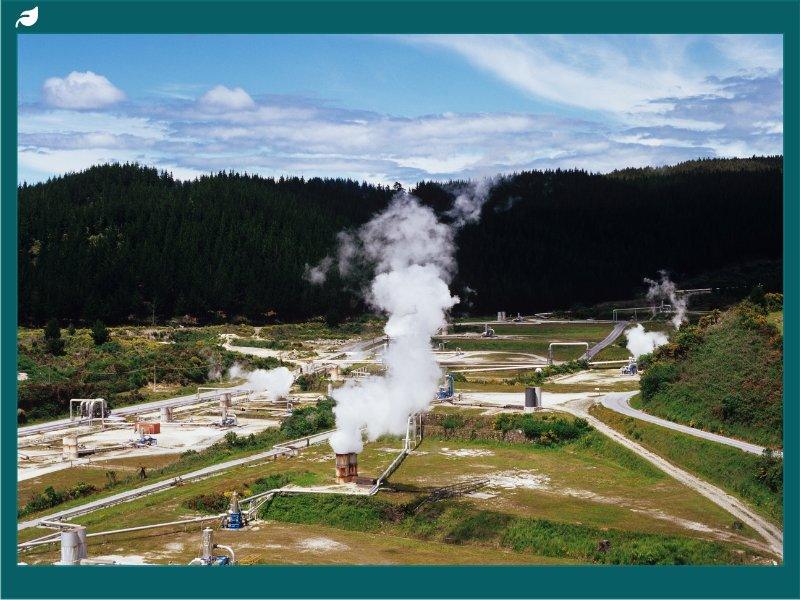
Dry steam is the oldest and most straightforward. Steam rises directly from the reservoir through production wells, spins a turbine, generates electricity, and is then condensed and returned to the ground. The Geysers field in California, the world’s largest single geothermal electricity complex, runs on dry steam and has operated continuously since 1960.
Flash steam systems handle high-pressure hot water rather than pure steam. As that water rises and pressure drops, a portion of it flashes to steam. That steam drives turbines, while the remaining water is either flashed again at lower pressure to extract more energy, or re-injected into the reservoir. Flash steam plants are the most common type in operation globally.
Binary cycle plants are the youngest of the three and arguably the most important for the future. Here, the geothermal water never contacts the turbine directly. Instead, it passes through a heat exchanger, transferring its energy to a secondary working fluid, typically an organic compound with a lower boiling point. That secondary fluid vaporises, drives a turbine, and condenses back into liquid, ready to repeat the cycle.
Because the loop is closed, emissions are negligible. And because the system works at lower temperatures, binary cycle plants can exploit geothermal resources that dry steam or flash plants cannot touch, opening up a much wider range of locations worldwide.
All three approaches share one quality that matters enormously from a grid-stability perspective: they produce baseload power. No storage required. No backup diesel generator sitting idle. Just steady, dispatchable electricity, hour after hour.
Types of Geothermal Power Systems
Not every geothermal site looks like Yellowstone. Most of the earth’s heat lies in rock that is hot but dry and impermeable, with no natural water pathway to carry that heat to the surface. Conventional geothermal power systems need permeable, water-saturated rock close to the surface. That limits them geographically.
Enhanced geothermal systems were designed specifically to break that limitation.
An Overview of Enhanced Geothermal Systems
Enhanced geothermal systems, universally shortened to EGS, work by engineering the reservoir that nature forgot to provide. Engineers drill two or more wells into hot dry rock, then inject water at high pressure down one well. The pressure opens existing micro-fractures in the rock and creates new ones, building a network of cracks that water can flow through. That water picks up heat from the surrounding rock, travels through the fracture network, and returns to the surface through a second well, hot enough to generate electricity, usually via binary cycle technology.
The numbers are striking. The United States Department of Energy has estimated that EGS could unlock more than 100 gigawatts of electricity generating capacity in the US alone. Projects are running or under development in Australia, France, South Korea and Switzerland. Fervo Energy, one of the most closely watched EGS developers, completed a 400-metre horizontal well pair in Utah in 2023 using techniques borrowed directly from oil and gas shale drilling, and the data from that project confirmed production rates that would have seemed optimistic just five years earlier.
EGS is not without risk. Injecting water at pressure into rock can trigger small seismic events, and managing that risk requires careful monitoring, adaptive pumping protocols and close engagement with local communities. But the industry is learning fast. Seismic management approaches developed for the oil and gas sector are being adapted and improved specifically for enhanced geothermal projects, and regulatory frameworks are catching up.
The strategic importance of EGS is hard to overstate. Conventional geothermal power is geography-bound. EGS, at least in principle, puts geothermal energy within reach of almost any country willing to drill deep enough. That is a genuinely transformative prospect for the global energy mix.

The Role of a Geothermal Reservoir
Think of a geothermal reservoir as a natural pressure cooker buried in the earth’s crust. Hot rock surrounds a body of water or steam, the overlying rock acts as a lid, and enormous heat and pressure build up over geological time. Tap into that system carefully and you have a long-lived, self-renewing energy source. Tap into it carelessly and you drain it faster than it recharges.
Exploring the Potential of Geothermal Reservoirs
The best conventional geothermal reservoirs share a few characteristics: high temperatures, good permeability (so fluids can move through them), sufficient fluid volume, and a cap rock that holds pressure in place. Identifying all four in the same location, at a depth that makes drilling economical, is where most of the exploratory risk sits. Roughly a third of geothermal wells drilled in new areas do not find what the surveys predicted. That is the central reason early-stage geothermal projects have historically struggled to attract private finance.
Data quality is improving that picture considerably. Remote sensing satellites can now detect subtle surface heat anomalies. Machine learning models are being trained on historical drilling data to sharpen resource predictions before a single well is sunk. And collaborative data-sharing initiatives between geothermal developers, academic institutions and government geological surveys are building the kind of knowledge base that reduces risk across the whole industry.
Once a reservoir is confirmed and production begins, reservoir management becomes the ongoing discipline. Re-injecting spent water back into the reservoir is standard practice. It sustains pressure, extends the productive life of the field, and, by keeping the fluid cycle closed, prevents the release of any dissolved gases. The Wairakei field in New Zealand has been producing geothermal electricity since 1958 and continues to operate today.
Many geothermal resources managed this way sustain production for decades, which changes the economic calculus completely compared to a coal or gas plant that needs a continuous fuel supply.
Good reservoir stewardship is also good for the environment. A closed-loop geothermal system that returns water underground and keeps dissolved gases out of the atmosphere is about as clean an energy operation as you can run at industrial scale. That matters not just for carbon accounting but for public acceptance, particularly in communities that have watched fossil fuel extraction degrade local land and water.
Applications of Geothermal Energy
Geothermal energy does more than spin turbines. Its applications run from the grand scale of utility electricity generation right down to keeping an individual home warm in winter, and everything in between. That versatility is one of the strongest arguments for investing in geothermal energy as a long-term pillar of the global energy transition.
Residential and Industrial Uses of Geothermal Energy
At the residential level, the dominant technology is the ground source heat pump. These systems do not require access to a high-temperature geothermal reservoir. They exploit the fact that the ground a few metres below the earth’s surface stays at a relatively constant temperature year-round, around 10 to 16 degrees Celsius in temperate climates. A heat pump moves heat from the ground into a building in winter and reverses the process in summer.
For every unit of electricity it consumes, a well-designed ground source heat pump delivers three to five units of heating or cooling energy. Compared to a gas boiler or an oil furnace, the operating cost savings are substantial, and the carbon savings are even more so.
For homeowners, the economics increasingly make sense as natural gas prices rise and electricity from renewable sources gets cheaper. Several European countries now offer grants or zero-interest loans to cover the higher upfront installation cost. Sweden has had ground source heat pumps in mainstream residential use since the 1980s, and today nearly a quarter of all Swedish homes use them. That is a useful proof point: when the policy environment supports adoption, geothermal heating moves from niche to normal remarkably quickly.
Industrial geothermal energy applications cover a wide and perhaps surprising range. In Iceland, geothermal heat warms greenhouses that grow tomatoes and cucumbers year-round despite subarctic latitude. In New Zealand and Kenya, it dries agricultural products and timber. In the United States and the Philippines, geothermal electricity powers large-scale manufacturing operations.
The food processing, mineral extraction and paper industries all use direct geothermal heat for process heating. Where the alternative is oil, gas or coal, the shift to geothermal cuts both fuel costs and emissions in one move.
What unites the residential and industrial applications is reliability. Geothermal heat does not have a cloudy day. It does not have a calm day. It is always there, which makes planning and budgeting around it straightforward in ways that intermittent renewable energy sources simply are not.
For any business or household trying to lock in stable energy costs over the long term, that predictability has real monetary value.

Environmental and Economic Benefits of Geothermal
Clean energy is only half the story. The other half is whether it makes economic sense, and geothermal energy clears that bar more convincingly than most people realise.
Why Geothermal Energy is a Sustainable Choice
On the environment side, the case is clear. Binary cycle geothermal plants, the fastest-growing category, emit almost nothing: the working fluid loops in a closed system, and the geothermal water is returned underground. According to REN21 Global Status Report, in 2024 New Zealand added 225 MW of new geothermal capacity, more than half of the world’s total new geothermal power additions that year, including the Tauhara facility, one of the world’s largest single-unit binary power stations, which reinjects all of its CO2 emissions. Even flash steam plants, which vent some steam to the atmosphere, emit a tiny fraction of the greenhouse gases that a coal or gas plant of equivalent capacity would produce. The land footprint of a geothermal power plant is compact compared to a coal mine plus a coal plant, or to the area needed for an equivalent solar farm.
And it is not just about carbon. Geothermal development, done properly, has a genuinely light touch on the broader environment. There is no open-cast mining, no ash disposal problem, no pipeline running across sensitive habitat. The wells go down, the plant sits on a modest pad of land, and the surrounding environment carries on largely undisturbed.
Communities living near well-managed geothermal fields in Iceland and New Zealand consistently report far lower levels of environmental concern than those living near fossil fuel infrastructure.
The economic benefits deserve equal attention. Once a geothermal plant is built, the marginal cost of each kilowatt-hour it produces is very low. No fuel to buy, no price volatility to hedge against. The Levelised Cost of Energy for established geothermal plants is competitive with coal and, in markets where natural gas prices are high, often cheaper.
Geothermal projects are also labour-intensive during both construction and operation, which translates into local jobs in geoscience, engineering, construction and ongoing plant operation. In rural communities near geothermal fields in Kenya, the Philippines and New Zealand, geothermal development has been a meaningful driver of economic activity.
The stability of geothermal electricity also carries grid-level value that simple cost comparisons miss. A grid manager who can count on a geothermal plant delivering a fixed output at any time of day or night can build a cleaner, simpler grid around it. That hidden reliability premium will only grow more valuable as the share of variable renewable energy sources on the grid increases. Solar and wind are essential, but they need something to lean on.
Geothermal is exactly that something.
Challenges and Solutions in Geothermal Development
Addressing Geothermal’s Limitations and Opportunities
The biggest single obstacle is upfront cost combined with geological uncertainty. Drilling a deep geothermal well costs between five and fifteen million dollars, and you might need several wells before you confirm a viable resource. Early-stage investors carry that risk with limited ability to hedge it. Compared to a wind or solar energy project where the resource can be characterised with weather data before a dollar is spent, geothermal exploration feels expensive and unpredictable.
Several strategies are chipping away at this problem. Risk-sharing mechanisms modelled on insurance pools have been established in Iceland, Germany and Kenya, where public funds cover part of the exploratory drilling risk in exchange for a share of future revenues. The data from these schemes is encouraging: when exploration risk is partially socialised, private investment flows in behind it. These models are now being studied by policymakers in Japan, Chile and several East African nations as templates for accelerating their own geothermal development.
Technology transfer from oil and gas is another significant accelerant. Directional drilling, advanced logging tools, real-time downhole sensors, and high-temperature-rated casing materials all came out of the oil and gas sector and are being adapted for geothermal applications. Companies with roots in shale drilling, particularly in the United States, are now pivoting hard toward enhanced geothermal, bringing capital and engineering expertise with them. The overlap is larger than it looks from the outside, and the energy industry’s institutional knowledge of drilling at scale is one of geothermal’s most underrated assets.
Seismicity management, discussed briefly in the EGS section, remains a genuine concern requiring genuine solutions. Induced seismicity events have halted projects in Switzerland and South Korea, and rebuilding public trust after such events is slow. The industry’s best response is rigorous pre-drilling hazard assessment, transparent real-time monitoring, published data, and clear community communication before and throughout project development. None of that is easy, but all of it is possible, and the projects that have done it well have shown that communities are willing to accept a carefully managed geothermal development in ways they would never accept a coal mine or a gas terminal.
So here’s the thing: geothermal energy’s challenges are engineering and finance problems. They are hard, but they are solvable, and the pace of progress over the last decade has been faster than most commentators predicted. The resource itself, the earth’s heat, is effectively limitless on any human timescale. Getting to it reliably and cheaply is the only question left to answer.
And across dozens of active projects on every inhabited continent, that question is getting answered right now, one well at a time.