An investigative report published in the Guardian yesterday into the world’s leading carbon
standard Verra found “90% of their rainforest offset credits – among the most commonly used
by companies – are likely to be “phantom credits” and do not represent genuine carbon
reductions.”
The nine-month investigation by the Guardian, Die Zeit and SourceMaterial analysed around 57
of 87 Verra-approved projects and found 94% of the credits the projects produced should not
have been approved. Verra has disputed the claims and questioned the methodology used.
The challenge with this report, says Earth Blox CEO and net zero scientist, Dr Genevieve Patenaude,
is that REDD+ (Reducing Emissions from Deforestation in Developing Countries) projects are just one type of carbon emission reduction project, and they rely heavily on future projections.
“Simply put, for REDD projects, which predominantly consist of avoiding future deforestation or
forest degradation, developers need to say, ‘we estimate that this would happen in the future if
the REDD activity weren’t going ahead’. Hence, uncertainties are large, as many variables are
very difficult to predict accurately, such as human behavior. This isn’t the case with all types of
projects. A number of our customers are focused on afforestation, reforestation and
revegetation (ARR) projects, for instance, where carbon stocks are increased by planting trees
or helping the natural regeneration of vegetation where one can measure how much carbon has
been stored.”
“Forest, land and the agricultural sectors represent nearly a quarter of global greenhouse gas
(GHG) emissions – the largest emitting sectors after energy. Hence these are key sectors to
tackle in our quest to abate emissions and reach net zero. While such debates are needed and
important, this should serve as a catalyst for increased collaboration, lessons learned, and not a
distraction from the urgency to act,” she added.
Satellite data to play a key role in the carbon market
Professor Iain H Woodhouse, knowledge and outreach lead at Earth Blox, said the issue
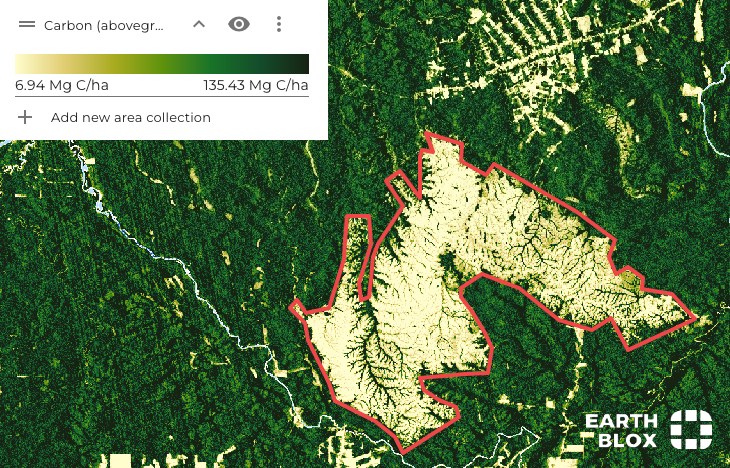
highlights the increasing importance of satellite remote sensing data in the carbon market.
“Satellite data provide a robust mechanism for quickly tracking forest cover and forest loss over
very large and remote areas. We also have a history of data that goes back more than two
decades. And because much of the data is easy to access, it also provides a level of
transparency that ensures that third-party validation of carbon projects can be done in a
straightforward way. This is amply demonstrated by the fact that the scientific papers discussed
in this investigation that evaluated the Verra-certified projects did so using data derived from
satellite images.”
Accessible satellite technology vital to scaling carbon projects
While access to satellite data is easier than ever before, being able to analyse and interpret the
information is not as straightforward. Google Earth Engine, Microsoft Planetary Computer, and
Amazon Web Services make their data available through APIs and online coding interfaces that
require computer programming skills to use them.
It was these barriers that led a team of remote sensing scientists and academics to build Earth
Blox. They understood the only way to accelerate the adoption of Earth observation insights for
climate change mitigation was to make it more accessible. The team developed the no-code
software for Earth data analysis and launched it in 2019. It removes barriers like coding and the
need for specialist skills in Earth observation or remote sensing, enabling a wider range of users
to work faster and more efficiently. Cloud processing and software-as-a-service subscriptions
allow businesses to control costs and only increase usage when necessary. Earth Blox is
headquartered in Edinburgh, Scotland and has clients in the United Kingdom, Europe and Asia.