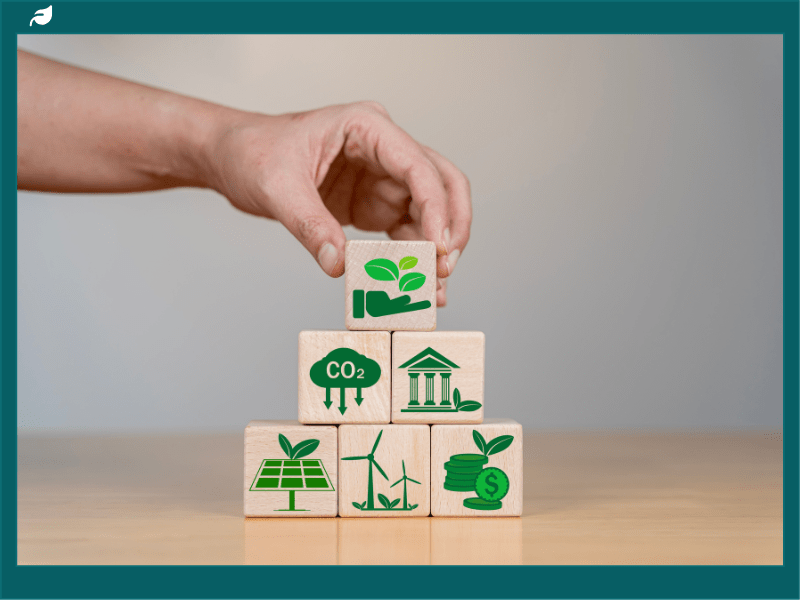
The term ‘net zero’ is important because, at least regarding carbon dioxide, this is the state at which global warming stops – but what does it actually mean and how can we use the term to strengthen climate policy?
Net zero refers to the state at which the greenhouse gases going into the atmosphere are effectively balanced out by the removal of greenhouse gases already in the atmosphere.
That is to say, net zero is not so much a cessation of emissions, as it is the balancing of inputs and outputs.
The Paris Agreement, which was signed in 2016 and underlines the need for achieving net zero, requiring states to “achieve a balance between anthropogenic emissions by sources and removals by sinks of greenhouse gases in the second half of this century.”
Why do we need net zero?
We need to reach net zero emissions in order to achieve the main goal of the Paris Agreement, which is to limit the increase of global average temperature increases to 1.5°C above pre-industrial levels.
The Intergovernmental Panel on Climate Change (IPCC) have stated that, in order to keep the rise in global temperatures below 1.5°C, it is necessary to achieve a global balance between emissions and removals by 2050.
While the Paris Agreement sets a global objective for net zero, action to achieve that objective is driven at the national level – each country is responsible for setting their own policies to achieve the common goal.
The delivery of these policies will then take place at the local level; all countries, cities, and businesses need to develop plans as to how they intend to achieve net zero.
What does net zero mean for the United Kingdom?
The British government has announced a target of net zero for UK greenhouse gas (GHG) emissions by 2050.
Reaching net zero GHG emissions requires extensive changes across the economy, but the foundations are already expected to be in place; major infrastructure decisions need to be made in the near future and quickly implemented.
These changes are unprecedented in their overall scale, but large-scale transitions have been achieved successfully in the UK before, such as the natural gas switchover in the 1970s or the switch to digital broadcasting in the 2000s.
The green change to legislation came into force on 27 June 2019 and amended the Climate Change Act 2008 target of an 80% reduction in GHG emissions compared with the 1990 levels.
Net zero can be achieved by emission reduction and removal, meaning that the UK’s total GHG emissions would be equal to or less than the emissions the UK has removed from the environment through a combination of emission reduction and emission removal.
The continued switch away from coal towards gas and renewable energy by the energy supply industry has resulted in a general reduction in GHG emissions since 1990; reaching net zero would require continuing to reduce emissions from this industry, households, and from other industries – in particular, those with the highest associated emissions such as transport, manufacturing, and agriculture.
GHG emissions can be removed by the natural environment or by using technologies like carbon capture and storage.
Is the UK on target to become net zero by 2050?
The first (2008-2012) and the second (2013-2017) carbon budget have been met and, as such, the UK is on track to meet its third (2018-22) budget.
However, it is not on track to meet the fourth, which covers the period 2023-2027, or the fifth, which covers 2028-32, according to current projections by the climate change committee. Crucially, these budgets were set against the previous target of an 80% reduction in emissions by 2050.
The new net zero target (at least 100% reduction by 2050) means that progress will need to accelerate in order for the UK to reach its target to become net-zero by 2050.