Packaging design is often treated as a visual exercise, but the decisions made during the design stage can influence much more than how a product looks on a shelf. Before a package reaches production, designers may work through printed proofs, physical mockups, material samples, structural experiments, and multiple rounds of revisions. When a concept changes late in the process, some of that work may become unusable. This makes the early design stage an important place to consider not only appearance and function, but also how much physical material is being used to reach the final result.
AI can also make iteration less expensive in terms of time, which can encourage designers to examine alternatives they might otherwise skip. For example, a team could compare a minimal-ink visual direction with a more detailed concept, explore different structural presentations, or test how a design might appear across several package formats before selecting a direction for physical development. Tools such as AI packaging design platforms can support this early-stage work, but the sustainability decision remains with the design and production team. AI should generate possibilities; people still need to determine whether those possibilities are practical, responsible, and manufacturable.
Why Packaging Sustainability Starts Before Production
The environmental impact of packaging is not limited to the finished box, bottle, pouch, or wrapper. The development process itself can involve materials that are printed, cut, assembled, transported, reviewed, and eventually discarded. The U.S. Environmental Protection Agency reported that containers and packaging accounted for 82.2 million tons of municipal solid waste in 2018, representing 28.1% of total municipal solid waste generated that year. While this figure covers packaging waste broadly rather than design prototypes specifically, it shows why decisions about packaging materials deserve attention long before products reach consumers.
Physical prototypes are still valuable because they reveal problems that a screen cannot always show. A package may look correct digitally but fail when folded, printed, filled, stacked, opened, or handled. The opportunity is therefore not to eliminate physical prototypes, but to avoid producing them for every minor design variation. If dozens of visual directions can first be reviewed digitally, a design team may be able to reserve physical sampling for the concepts that have already passed basic visual and structural checks. That creates a more selective development process without pretending that digital tools can replace real-world validation.
How AI Moves More Packaging Exploration Into the Digital Stage
Traditional packaging development can require designers to manually create and compare many versions of the same basic idea. Changing a color system, visual theme, illustration style, layout, or product presentation may require considerable design time before stakeholders can properly compare the results. AI can shorten this early exploration stage by generating multiple visual directions from a defined concept. Designers can then reject weak ideas quickly and concentrate their attention on the options that have genuine potential.
This matters from a resource perspective because the earlier a poor direction is rejected, the less reason there is to turn it into a physical sample. Digital concepts can be shared with clients, marketing teams, and other stakeholders before materials are ordered or proofs are produced. The process also makes it easier to revisit an earlier direction without starting completely from scratch. AI therefore works best as a way to expand digital exploration while keeping physical development focused on decisions that are further along.
Digital Prototyping Can Make Physical Sampling More Selective
Virtual prototyping is already being explored as part of more sustainable packaging development. A 2020 study published in Procedia CIRP examined packaging for a household appliance and used virtual prototyping alongside life-cycle assessment to compare packaging options. In that particular case, a redesigned package using a molded-pulp interior instead of expanded polystyrene was associated with an approximately 15% reduction in environmental impacts. The result should not be treated as a universal saving from digital design or AI; it was a specific packaging redesign evaluated through a broader sustainability methodology.
The more useful lesson is that digital evaluation can help designers examine alternatives before committing fully to production. A team can compare different structures, material choices, and visual concepts while much of the development remains digital. AI can contribute to this process by making visual exploration faster, but environmental performance still needs appropriate assessment. Material sourcing, recyclability, manufacturing requirements, durability, transportation, and end-of-life considerations cannot be reliably determined from an AI-generated image alone.
Sustainability Can Be Evaluated Earlier in the Design Process
One reason packaging waste can be difficult to address is that sustainability decisions are sometimes considered after important design choices have already been made. By that point, changing the material, structure, or manufacturing approach may affect cost, appearance, protection, and production requirements. Recent research is increasingly looking at ways to bring sustainability evaluation into the conceptual stage instead.
Other recent research has similarly examined methods for combining packaging performance requirements with material selection and circularity considerations during the conceptual phase. One 2025 study proposed a design methodology that considers performance criteria, material selection, circularity potential, and cost rather than treating these decisions separately at a later stage. This approach fits naturally with a more digital packaging workflow. AI can help generate and modify concepts, while sustainability tools and human expertise can be used to determine whether those concepts make sense from environmental and production perspectives.
AI Packaging Design Can Support More Resource-Efficient Concepts
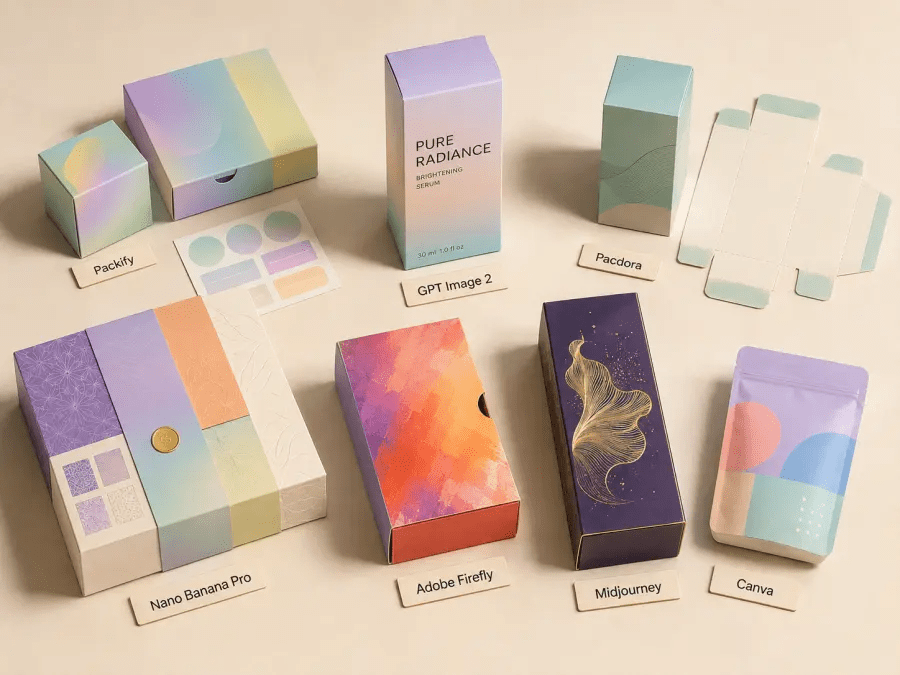
The value of ai for packaging design becomes clearer when it is treated as an exploration tool rather than a complete design solution. Instead of immediately producing a physical sample for every creative direction, designers can use AI to investigate different layouts, visual identities, color combinations, illustrations, and package presentations on screen. This can be particularly useful during the stage when a team is still trying to determine what the package should communicate. More digital exploration can mean fewer reasons to physically produce concepts that are unlikely to survive the next review.
From Digital Mockups to Physical Validation
Digital mockups are particularly useful when a packaging concept needs to be reviewed by people who are not involved in the day-to-day design process. A realistic digital presentation can show how artwork might appear on a carton, bottle, pouch, or other package format without requiring a physical sample for every presentation round. This can reduce the need to print multiple visual proofs simply to communicate an idea. It can also make remote collaboration easier because stakeholders can review the same digital concept before a decision is made.
Ideogram Reframe V3 can be particularly useful after a strong visual direction already exists and needs to be adapted for another format. Its current GPT Proto listing focuses on image-to-image generation, smart reframing, typography, and brand-color control. The listed GPT Proto price is $0.048 per image at the time of review.
However, the physical stage cannot simply be removed. Packaging has to work as an object, not just as an image. Designers and engineers still need to check dimensions, folds, seams, closures, material behavior, print quality, strength, product protection, and other production requirements. A digital mockup can show whether a label appears visually balanced, but it cannot prove that a package will survive transportation or that a selected material will perform as intended. The sustainability benefit comes from using digital tools to narrow the options before physical testing, not from treating virtual concepts as substitutes for production validation.
A More Resource Conscious Packaging Workflow
A more efficient process can combine AI-assisted exploration with conventional design controls instead of treating the two as competing approaches. The first stage is broad digital exploration, where designers generate and compare concepts without immediately producing samples. Once a smaller group of directions has been selected, the team can examine structure, materials, printing requirements, recyclability, protection, and other practical considerations. Sustainability evaluation can happen alongside these decisions rather than being added after the package is already defined.
| Development stage | Digital role | Resource-conscious benefit |
| Initial concepts | Generate and compare visual directions | Reduces the need for early physical samples |
| Design refinement | Explore layouts, colors, graphics, and variations | Helps reject weak concepts before proofing |
| Mockup review | Present realistic package visuals | Reduces unnecessary presentation samples |
| Material and structure review | Compare feasible options digitally | Supports earlier sustainability discussions |
| Physical prototype | Test selected concepts | Focuses material use on stronger candidates |
| Production preparation | Finalize dielines and specifications | Ensures the approved design is production-ready |
The workflow does not promise that every project will use fewer physical samples. Some packaging categories require extensive testing, and a highly protective package may need multiple rounds of physical development before it can be approved. The point is to make each physical iteration more purposeful. If digital tools can eliminate several weak directions before materials are ordered, the remaining samples can be used for decisions that genuinely require physical evidence.
The Role of AI Is Better Decisions, Not Replacing Designers
The strongest sustainability case for AI in packaging design is therefore not that artificial intelligence magically creates environmentally friendly packaging. It is that faster digital iteration can change when and how teams commit resources. Instead of spending physical materials to discover that a concept does not work visually, teams can reject more options on screen. Instead of producing several presentation samples for a client, they can first review realistic digital mockups. These changes may appear small individually, but they can make the development process more deliberate.
That is why the most useful role for AI is as an accelerator inside a broader responsible design process. It can help packaging teams explore more ideas, make digital decisions earlier, and potentially reduce unnecessary physical prototypes, printed proofs, and discarded material samples. When combined with sustainability assessment, material knowledge, production expertise, and physical testing, AI can help move packaging development toward a process where fewer resources are committed before the strongest ideas have been identified.