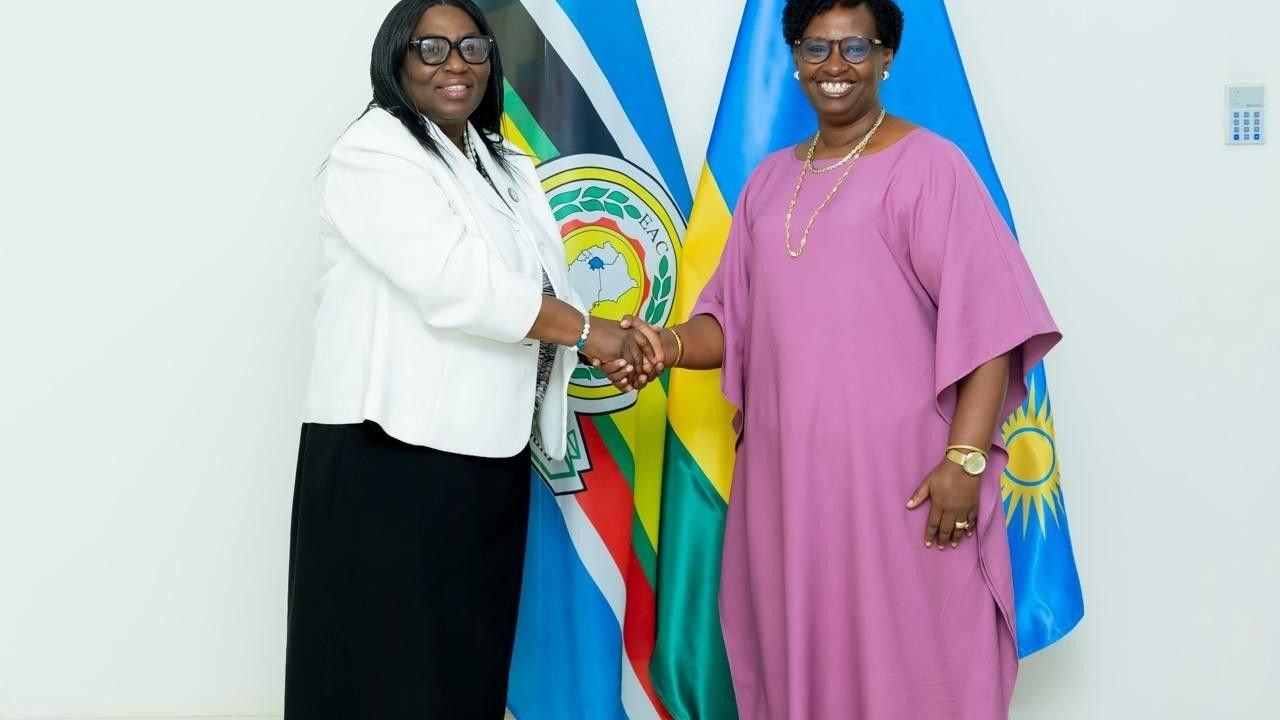
The International Fund for Agricultural Development has appointed Dede Ekoue as its Country Director and Representative in Rwanda, reinforcing a partnership that has supported rural transformation in the country since 1981. Ekoue presented her credentials to Dr Usta Kaitesi, Minister of State for Foreign Affairs, as Rwanda advances its Vision 2050 and agricultural transformation plans for 2024 to 2029. IFAD has financed 21 projects in Rwanda worth US$893.1 million, including US$451.5 million in IFAD financing and US$441.6 million in co-financing and other contributions. The portfolio has reached more than 1.5 million rural households through work spanning watershed management, livestock, export value chains and inclusive rural finance.
A Timely Appointment
Ekoue arrives as Rwanda places agricultural productivity, market-oriented value chains and climate resilience at the centre of its development agenda. The country’s current plans set out a framework for economic and agricultural transformation, with small-scale producers, women and young people positioned as important participants in rural progress.
Her appointment also provides continuity for IFAD’s engagement with Rwanda while bringing experience across agriculture, rural development, inclusive finance, climate resilience, social development and public policy. Ekoue has held leadership roles in international organisations and government positions, most recently serving as IFAD Country Director in Nigeria from 2022 to 2026.
Dede Ekoue, Country Director and IFAD Representative in Rwanda, said, in comments translated from French:
“Rwanda has set an ambitious agenda for agricultural and economic transformation, and IFAD is proud to support the Rwandan Government and people in this effort, scaling up innovation, climate resilience and access to finance, technologies and markets, so that small-scale producers, women and young people can be drivers of change.”
Investment In Rural Communities
IFAD’s long-running work in Rwanda reflects the breadth of interventions needed to strengthen rural economies. Its projects have supported watershed management and livestock, alongside export value chains and financial services designed to make finance more accessible in rural areas.
The scale of the partnership is evident in the US$893.1 million committed across 21 projects. IFAD’s contribution accounts for US$451.5 million, while US$441.6 million has come through co-financing and other contributions. These investments have benefited more than 1.5 million rural households, placing agricultural development alongside wider efforts to improve household incomes and production.
An independent evaluation of Rwanda and IFAD cooperation covering 2019 to 2024 found that participating households recorded an average income increase of 118%. It also reported that 84% of participating households said they had improved their production, offering a useful indication of the outcomes associated with the programme portfolio.
Contribution To IFAD Fourteen
Rwanda’s role extends beyond programme delivery. Ekoue welcomed the country’s active participation in IFAD governance and its contribution to the institution’s Fourteenth Replenishment, known as IFAD14.
Rwanda increased its contribution to US$900,000 for IFAD14, representing a 200% rise from its contribution in the previous three-year cycle. The commitment points to continued national interest in rural transformation, agricultural productivity, climate resilience and market-oriented value-chain development.
The replenishment contribution sits alongside project-level activity in the country, connecting Rwanda’s domestic agricultural ambitions with an international financial institution focused exclusively on rural economies. For businesses and development partners working across food systems, this combination of policy direction, investment and local participation offers a clear basis for sustained engagement.
Building On Shared Progress
IFAD’s partnership with Rwanda has developed over more than four decades, adapting its investment focus to changing rural priorities. The appointment of a new Country Director comes at a point when access to technology, finance and markets is closely tied to the country’s agricultural transformation objectives.
IFAD’s activities in Rwanda will continue to centre rural households while supporting stronger food value chains and climate-resilient production. With Ekoue now formally accredited, the relationship enters its next phase with a substantial existing portfolio, measurable household outcomes and a shared focus on inclusive rural prosperity.