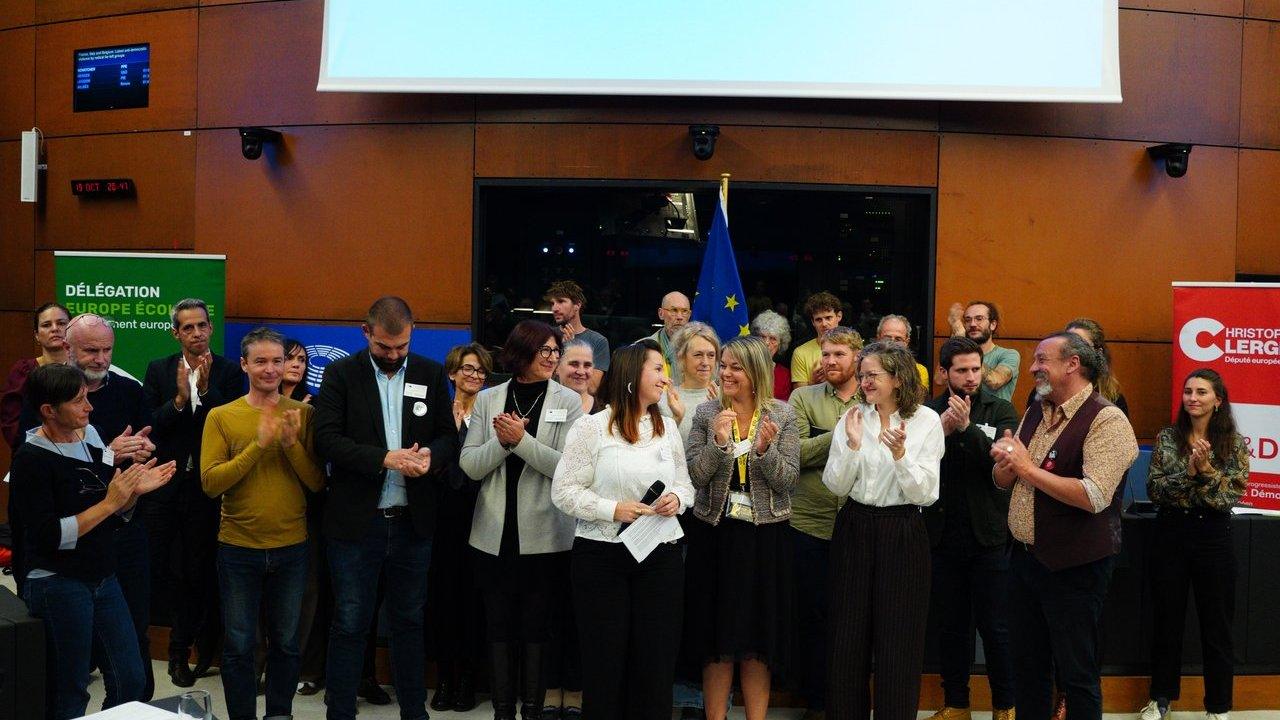
The European Parliament hosted the launch of “Green Prescriptions”, a prevention scheme intended to reduce expectant parents’ exposure to pesticides and endocrine-disrupting chemicals. The event, organised by PAN Europe, IFOAM Organics Europe, Friends of the Earth Europe and the Association of Mutuals for Planetary Health, brought together six parents whose children have died or become ill following pesticide exposure. The Association represents more than 20 mutual health insurers providing cover for 14 million people. The coalition is seeking wider access to locally sourced organic fruit and vegetable baskets, healthcare guidance and information workshops during pregnancy. It also called for the withdrawal of the proposed Food and Feed Safety Omnibus package, known as Omnibus X.
Parents Demand Action
The Strasbourg gathering gave parents affected by serious childhood illness a platform to issue a joint declaration on pesticide exposure. They called for stronger prevention, recognition for victims and a public policy response centred on children’s health.
The declaration brings personal testimony into a wider debate about how Europe manages potential health risks from pesticides. Sabine Grataloup’s son, Théo, was born with severe malformations, and his exposure to glyphosate during pregnancy was recognised by the Pesticide Victims Compensation Fund.
Sabine Grataloup, mother of Théo, said:
“We had to gather the evidence and scientific studies into a dossier of more than 1,000 pages. Should families in pain have to investigate for themselves? And do you really want to grant pesticides lifetime authorisation through Omnibus X, despite the evidence of their toxicity?”
Other families described the strain of navigating serious illness while seeking answers and recognition. The group is urging public authorities to apply the precautionary principle and place protection of children at the centre of decision-making.
Franck Rinchet-Girollet, father of Elliot, said:
“I wish I could promise him, ‘It’s over; you’ll never have to go through this again.’ I can’t make him that promise. So I promised him I would not remain silent.”
A Preventive Health Offer
Green Prescriptions combines advice from healthcare professionals with practical support for families. Prescribed by a healthcare professional, the scheme offers workshops on chemical exposure alongside organic fruit and vegetable baskets tailored to beneficiaries’ financial circumstances.
The initiative has been piloted in Strasbourg and elsewhere. Its organisers say the model can improve access to healthy food, support local organic producers and help families reduce avoidable exposure during pregnancy, when child development is a particular concern.
Martin Rieussec-Fournier, President of the Association of Mutuals for Planetary Health, said:
“We want preventing exposure among unborn children to be an absolute priority in Europe.”
The proposal links health prevention with food policy and local supply chains. The coalition states that organic producers and supply chains already have the capacity to contribute, while local authorities and mutual insurers could help extend the scheme beyond its existing pilots.
Science And Regulation
The campaign arrives as campaigners raise concerns about changes to pesticide rules in France and across Europe. The coalition argues that Omnibus X could weaken protections by allowing authorisations with no time limit, relaxing some rules on drone spraying and making it easier to extend authorisations for hazardous substances.
The scientific sources cited by the organisers include an INSERM collective expert review on pesticides, the GEOCAP-AGRI study, a Public Health France report on cancer incidence among adolescents and young adults, the IPBES Global Assessment Report and a Rés0Pest analysis of zero-pesticide cropping systems.
The group says these sources should inform prevention policies rather than remain separate from agricultural and health decision-making. It has also pointed to concerns raised by scientists, healthcare professionals, legal experts and United Nations Special Rapporteurs about potential effects on human health and the precautionary principle.
Health In Food Policy
Beyond the legislative proposal, the coalition wants agricultural and food policy to phase out pesticides, expand organic farming and increase the proportion of organic food served in school canteens and public procurement. Members of the European Parliament are being asked to support these objectives in budgetary and legislative discussions.
The event formed part of the “Odyssée pour notre santé” cycling campaign, which began in Gouzeaucourt on 10 October and is travelling 1,200 kilometres through France, Belgium, Luxembourg, Germany and Switzerland. The campaign is due to reach Geneva on 29 October after 15 stages focused on prevention, organic food access and pesticide victims’ rights.
Dr Alexandre Feltz, who devised the “Green Prescriptions” initiative, said:
“We have the scientific knowledge, the solutions and a coalition ready to act: what are we waiting for? ‘Green Prescriptions’ bring together parents, healthcare professionals, mutual insurers, producers, manufacturers, retailers and local authorities around a shared goal: preventing exposure to pesticides and endocrine disruptors from pregnancy onwards. At a time when protective policies are being rolled back in France and across Europe, public authorities must support and expand these solutions. Prevention must become the foundation of our health policies.”
For the coalition, Green Prescriptions offers a practical route to connect healthcare, food access and organic production. Its wider rollout would depend on support from public authorities, healthcare professionals, mutual insurers and local communities.