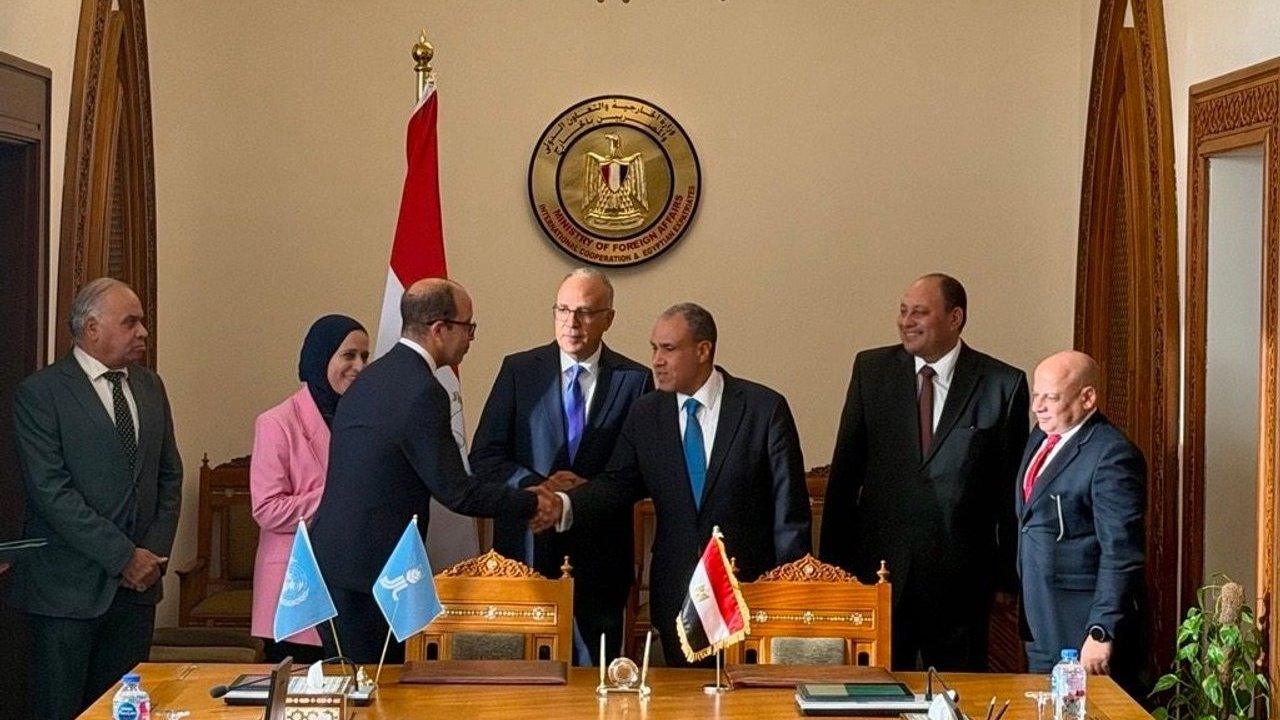
The Government of Egypt and the International Fund for Agricultural Development (IFAD) signed two agreements on 2 November 2026 to help small-scale farmers improve water management, increase their incomes and adapt to climate change. The first covers the Climate-Resilient On-Farm Water Management in the Nile Valley (CROWN) project, supported by US$64.85 million in IFAD financing. The second covers the Positioning Egypt for Agricultural Resilience and Leadership (PEARL) project, backed by a US$470,000 grant. CROWN will support around 90,000 rural households, while PEARL is expected to benefit 2,000 people. The package also aims to strengthen Egypt’s role in sharing agricultural expertise across Africa and the Middle East.
A Ceremony With Three Ministers
The signing ceremony was attended by Badr Abdelatty, Minister of Foreign Affairs, International Cooperation and Egyptian Expatriates, Hany Sweilam, Minister of Water Resources and Irrigation, and Mostafa Al Sayyad, Deputy Minister of Agriculture and Land Reclamation. Their presence reflects how closely the agreements touch foreign relations, water policy and agriculture at once.
The agreements come as climate pressures, scarce water resources and regional uncertainty sharpen the case for investing in resilient food systems. Together, they connect financing for rural communities with the technical expertise, institutions and partnerships needed to sustain results and share effective approaches more widely.
The thinking behind the two projects is that infrastructure alone is not enough, and that farmers need the means to turn better water access into stronger businesses.
Naoufel Telahigue, IFAD Regional Director for the Near East, North Africa, Europe and Central Asia, said:
“Water investments deliver lasting results when farmers also have the knowledge, finance and market opportunities to make their businesses more productive and resilient. These agreements bring those elements together, while enabling Egypt to share practical solutions with other countries facing similar challenges.”
CROWN Targets On-Farm Water Management
CROWN will improve water management across 30,000 feddans (about 12,600 hectares) in Beni Suef and Minya, two governorates in the Nile Valley. It contributes to the presidential initiative Hayah Karima and to Egypt’s Nexus of Water, Food and Energy (NWFE) programme, translating national climate priorities into investment in rural livelihoods.
The project combines modern irrigation and drainage infrastructure with climate-smart farming, stronger farmers’ organisations and improved access to markets and finance. This integrated approach will help farmers use water more efficiently, increase productivity and strengthen their incomes.
Inclusion is built into the design. Women and young people will benefit from greater access to services, technology, skills and employment opportunities, widening the reach of the investment beyond those who already hold land and equipment.
PEARL Builds Capacity to Share Expertise
Where CROWN works in the fields, PEARL complements it by strengthening Egypt’s capacity for agricultural innovation and South-South and Triangular Cooperation. Financed through the China-IFAD South-South and Triangular Cooperation Facility, it will revitalise the Egyptian International Centre for Agriculture, modernise training and promote climate-smart and digital solutions.
The project is expected to benefit 2,000 people. Through regional knowledge exchange and policy dialogue, it will enable Egypt to share its expertise while adapting relevant experiences from other countries in Africa and the Middle East. The grant is modest beside the CROWN financing, but it points to a two-way flow of learning rather than a single direction of support.
Nearly Five Decades of Partnership
The agreements build on nearly five decades of partnership since Egypt joined IFAD in 1977. Cooperation has evolved from the Nile Valley and Delta to reclaimed lands and desert communities, supporting national priorities for rural development, water management and economic opportunity.
Read together, CROWN and PEARL show how a long-running relationship is being extended. One project puts irrigation, drainage, farmer organisations and market access in the hands of rural households in Beni Suef and Minya. The other builds the training, institutions and regional links that allow lessons from those efforts to travel. For a country facing scarce water and climate pressure, the pairing offers a practical model of investment that aims to last beyond the life of any single project.