Sustainable Business Magazine returns to the Cambridge Institute for Sustainability Leadership to speak with Dr Kayla Friedman, Course Director for the sustainable built environment programmes. She explains how its programmes are helping shape business leaders for a more sustainable future.
The University of Cambridge Institute is a flagship academic centre that focuses on building sustainability into the businesses of tomorrow. Part of the University of Cambridge, it runs a number of postgraduate-level courses targeted at people already within industry who are looking to expand their capabilities.
Two such programmes are the Master’s and Postgraduate Certificate in Interdisciplinary Design for the Built Environment (IDBE). In this context, the built environment industry includes everything from real estate construction to facilities management, architecture and design to urban planning. Course Director Dr Kayla Friedman tells Sustainable Business Magazine about its background and its aims for students:
“We are right now receiving applications for our 30th cohort. The programme has been around for 30 years and was originally conceptualised following the publication of the Latham Report in the early 1990s. Constructing the Team was, at the time, a seminal publication in UK built environment research. It explored the idea that inefficient outcomes were the result of a lack of collaboration between different disciplines. Subsequently, this was picked up by research that discusses the ‘vicious circle of blame’, which still appears to be endemic within the built environment industry.
“The course was built on the idea that people have trained in their own disciplines but lack enough understanding of other disciplines to work better together. A lot of challenges in practice therefore arise from the lack of communication and understanding related to inter-disciplinary workflows. The IDBE course was designed to address this issue at a postgraduate level for working professionals.
“For a long time the Master’s sat with the University of Cambridge’s departments for architecture and engineering. However, somewhat ironically, within the complexity of the University structure, the departments found it challenging to run an interdisciplinary course! CISL, as a sustainability focussed institute of the university was much better suited to hosting the programme, and as a result the course was moved to CISL.
Ultimately, we are trying to deliver better and more efficient built environments because they are also more resilient and sustainable built environments.”
When the course arrived at CISL, it was reviewed to make sustainability and resilience the explicit outcome of better working between disciplines. Today, the course is presented in two different formats to meet the needs of its students: a two-year, part-time Master’s course; and a ten-month, part-time Postgraduate Certificate course.
Professional Networks
Both sustainable built environment courses are designed to reflect the practicalities of the industry today. To that end, they are structured around what’s at the cutting edge of theory, research, development and reg- ulations. However, what marks the courses out is that they stress the importance and benefits of interdisciplinary collaboration, and how people can help and learn from one another.
“What’s interesting is that people in the built environment work with other people by default, but their thinking is often confined,” Dr. Friedman says. “Within their firm or discipline they’re probably pretty active. Real estate professionals know other real estate professionals, architects know other architects. However, a lot of the time, it doesn’t occur to them that they don’t then have a wider professional network.
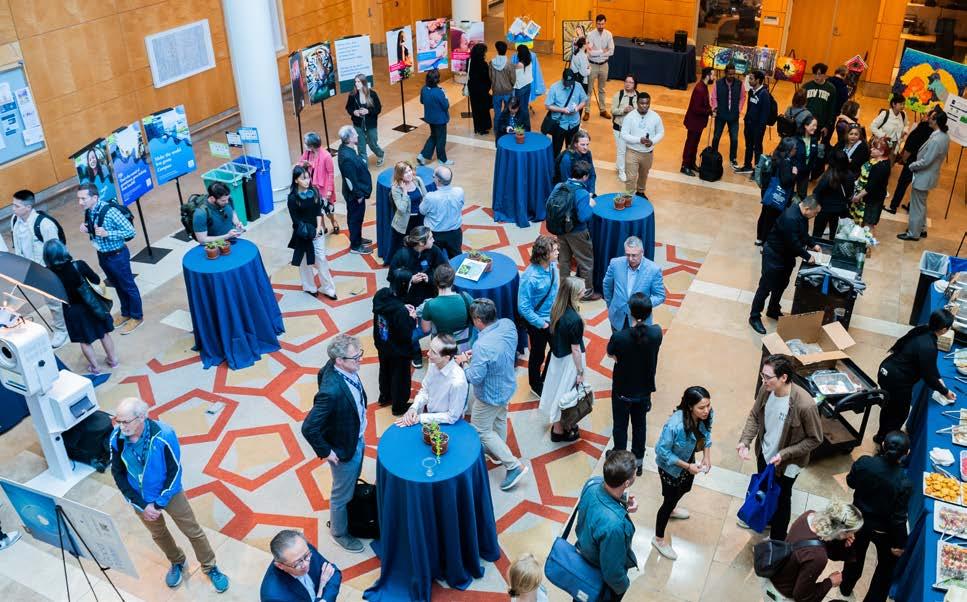
“We survey students when they first join us to learn about what they’re looking to get out of the courses. Usually they talk about sustainability and leadership. That’s great, we do offer that. But when we ask our alumni what they gained and what they thought was the biggest benefits of our courses were, they talk about the interdisciplinary network it helped develop and how much they value having a wide range of professionals to whom they can ask questions. You don’t know that you don’t have a good professional network. We want to show people how important it is. By the end of our programmes, the students often talk about the network and relationships with other students on the cohort being as important as the teaching they get from us.
“In CISL’s other postgraduate programmes – where most of our students come diverse business backgrounds – the people are all over the professional network. Part of the nature of business is understanding the benefits of connections. So much of it comes down to the training you get. If you’re going to get a degree in geography, real estate, architecture, engineering, or urban planning, it’s unlikely that someone in those disciplines is teaching you about business networks. Then you go to work and you think you know loads of different people so it doesn’t occur to you. Our courses change that.”
Academic Rigour
While networking is an unexpected benefit of the sustainable built environment programmes, it also has plenty of expected benefits as well. Specifically, it’s a Masters-level academic programme with all the advantages that academic rigour provides. Dr. Friedman explains further:
“We really want students to think deeply and question what they hear and what they’re being told. We want them to get to the root of problems and understand how exactly to do that. Our programmes use academic rigour and structure to encourage students to make arguments and decisions based on evidence. We want to show them how to find evidence, how to critique evidence, and how to create their own data so that it’s not just what someone told you or what you heard or is popular, but that they understand it factually. That’s powerful when you’re trying to persuade other people – and so much of leadership is about persuading other people.
“The built environment industry is a collaborative one. Nobody can do it on their own. In practice you’ll have to convince clients, consultants, financiers and other stakeholders to buy into your idea. They’ll want to see proof because you might be asking them for more work or resources. They want the evidence that what you’re saying is the right thing to do and our course helps our students learn to build the case in a way that gets others on board. We really focus on using evidence, knowledge, and questioning skills to do that. That’s what the academic rigour of this course provides.
“It’s also essential that our students understand the impacts of their choices on other people. Built environment projects are many-staged and long, involving lots of people and someone makes a choice that could limit or restrict the choices that other involved people make. We provide systems training that cultivates an understanding of complexity, acknowledging that there is no winning in the real world but a series of trade-offs.”
One of the most notable benefits is the expert supervisors and guest speakers available as part of the programme.
“In our core team we have myself and fellow director Dr. Tim Forman as well as six other supervisors for Year 1 of the Master’s,” Dr. Friedman explains. “Those supervisors work with us and the students for the whole year, supervising assignments and supporting group project activities. The supervisors come from across the value chain of construction. One is from an ESG finance background, another from an engineering background, others from whole life carbon or heritage and innovation, and so on. They each provide a summary of their expertise and students select who they want to work with during their studies. It’s telling of the diversity of our course that most students get their first or second choice. During Year 2 of the Master’s, when students are doing their dissertations, we have a vast range of former students that supervise and support the dissertation work. We pair students up with an expert that is knowledgeable in their area of interest and help them go deep into that subject area.
“During our residential weeks, we will typically have 20 to 25 speakers come in. Those speakers represent the breadth of our discipline as well as the geographic diversity that is crucial to the industry today. The interconnectedness of sustainability means that it’s not just the Global North that matters but the Global South as well. Recent speakers have come from countries in Africa as well as China and Singapore, for example. Others have been involved with Sterling Prize-winning projects.
“We have to represent different perspectives as well as teach the content, so we blend academic insight and real-world practice when balancing the programme. I say to the students that they come to us for ten months – if studying the Certificate – or two years – for the Master’s – and we can show them whatever is new and exciting now, but they still have 20 or 30 years of professional practice ahead of them. I want them to have the critical skills to evaluate the things they hear about in the future. Everything moves so quickly. We can’t just teach it to you and then you’re done, so we’re teaching the skills to understand what’s being proposed and how to evaluate, assess, and decide whether implementing it is worthwhile. That’s the empowered part of teaching people to evaluate technology and innovations.”
Back To The Future
Sustainable and resilient design is essential for the future of the planet. For that to succeed, people need to work together, and disciplines must be able to communicate effectively with one another. Together, they can reach better conclusions and more effective solutions. That’s what CISL is achieving through the sustainable built environment courses alongside its other programmes and research.
“Our course is still really unique even though it’s 30 years old, but that’s probably not a great thing,” says Dr. Friedman. “I’ve worked in industry and I’ve learned so much from the diversity of speakers and students we have and I can’t imagine what it’s like still to be in a little silo. The reality of our future is that we’ve got to join up our thinking. It’s also a reality that we don’t know how to talk to each other because there’s a lot of animosity and mistrust between disciplines and within industry. Sometimes there are good reasons, but we need to be creative and think about ways to work around those because they’re not helping deliver the types of projects that we need.
“Looking at the future, in the Global North, restrictions are increasing. The circular economy is growing in importance and there are expanding restrictions on new construction. Meanwhile, material scarcity is growing. There’s no overcoming those challenges without joined-up thinking. We need more people that can be nimble and think outside the box. We can’t just tear down a building to make flat ground and go fresh, we can’t keep doing that. Instead, we’re going to have to work within the limitations of space and resources. That’s going to demand a lot of working together. Meanwhile, in the Global South, we also have the challenge of an incredible need for so many new homes, streets, and infrastructures but with less concrete, less steel, more renewables, more regenerative materials. Whether you are looking to the Global North or South, there is so much need and we can’t keep doing things the way we’ve been doing.”
Dr. Friedman says CISL aims to try and push the industry in the right direction, something that is for the betterment not just of the industry but for everybody, everywhere:
“People come to us for that help and we want to provide it, to help them move forwards. We help them mobilise other people to achieve the sustainability and resiliency goals that they and everybody needs. That’s what leadership is all about. It’s not that you can make all the decisions, but that you can find the right people to help you make and execute those decisions. We are better together.” c
Applications for the 2024 the Master’s and Certificate in Interdisciplinary Design for the Built Environment (IDBE) close 8 May 2024.