By Alice Bazzano, Sustainability Director at Trivium Packaging
As businesses and policymakers work to accelerate the transition to a more sustainable economy, one fact is becoming increasingly clear: the way we produce, use, and dispose of materials has lasting consequences for the planet, for society, and for generations to come. Yet despite growing awareness, we are moving in the wrong direction.
According to the Circularity Gap Report 2025, the share of secondary materials entering the economy has fallen from 7.2% to 6.9%. This reflects a broader challenge: most materials entering the economy are still designed for linear use, rather than to remain in circulation. That means that even as we talk more about sustainability, our reliance on virgin resources is actually increasing.
When it comes to packaging, the conversation too often stops at recycling. But recycling is only part of the picture. For circularity to work, every stage matters, from how packaging is designed and produced to how it is collected, sorted, and recycled. Even highly recyclable materials depend on well-designed systems to ensure they are actually kept in use.

Designing for circularity
True circularity begins with design, but it isn’t defined by a single material or solution. Different approaches, from reuse and recycling to compostable formats, can play a role depending on the application. The key is to ensure that packaging is designed to remain in use within a system rather than become waste.
In practice, the most effective solutions balance circularity with real-world constraints, including product protection, shelf life, and compatibility with existing infrastructure.
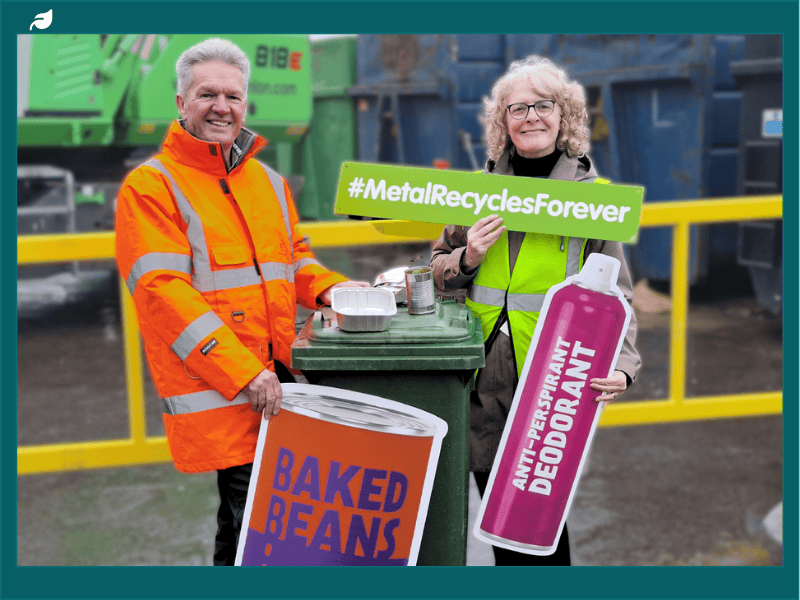
Materials still matter. Some packaging types lose quality each time they are recycled, while others can be reprocessed multiple times, without compromising quality. Metal is one example of a material that can be infinitely recycled without any loss of properties. This durability is why around 75% of all metal ever produced is still in use today.
But circularity doesn’t rely solely on materials; it requires a structured design approach. At Trivium, this is embedded through Ecodesign criteria that guide how packaging is developed, focusing on areas such as: lightweighting to minimise resource extraction, working with suppliers to increase recycled content to support secondary markets, and carbon footprint reduction.
This focus on Ecodesign is closely linked to innovation. Trivium set a target for 80% of new product developments to meet its Ecodesign standard by 2030, with 57% already meeting this in 2024. At the same time, circularity is being scaled across the business, with a target for 50% of revenue to come from ecodesigned products by 2030, reaching 27% in 2024. Together, these targets show how circularity is ingrained into innovation and commercial decision-making.
Alongside circularity, decarbonisation is another critical priority. Trivium’s climate strategy validated by the Science Based Targets Initiative (SBTi), commits to reducing emissions by 90% by 2050 in line with a 1.5°C climate pathway. Achieving this requires action across the entire value chain, including improving energy efficiency in manufacturing, transitioning to renewable electricity, and collaborating with suppliers to source lower-emission steel and aluminium.
Circularity in practice
Circular packaging is increasingly being implemented through practical partnerships. Thoughtful design can make packaging reusable, durable, and visually appealing.
Our work with KOPU water illustrates this potential. KOPU Water turned to Trivium Packaging for its aluminum bottles, which offer sleek elegance, durability, and the circularity it was seeking. However, ensuring bottles are collected and recycled appropriately remains a daily challenge for the hospitality industry. As such, KOPU developed the KOPU Aluminium Stewardship program (“KAS”), which installs front- and back-of-house recycling receptacles for all aluminium containers used by guests or by hotel staff on the property. Front-of-house receptacles were beautifully branded to seamlessly integrate with the property’s décor and ambiance, with clear signage and easy access for guests to recycle. Back-of-house receptacles provided clear, easy access to recycling collection bins for staff.
The receptacles also serve as a tracking method for success. KOPU water and the property can count the collected bottles against the number of bottles ordered, generating a capture rate. In addition, they collect bottles from other brands, thereby increasing recycling rates. KOPU Water then recycles the bottles directly to a local recycling plant, and on average, new bottles can be made within 60 days.
The gap between intention and action
Consumers increasingly expect brands to act on sustainability, and their buying choices reflect that. Around 63% of consumers are more likely to buy products made with recycled materials, and nearly half say a company’s sustainability goals strongly influence their purchasing decisions.
Yet consumer willingness alone cannot close the loop. Two-thirds consumers say they would recycle more if they simply knew how. This highlights a more immediate step the industry can take – clearer labelling that explains how packaging should be recycled in practice. Confusing materials, complex multi-layer designs, and inconsistent guidance across markets often make it difficult to know what can actually be recycled. Alongside clearer on-pack instructions, there is also a need for better consumer education and packaging that is designed to be intuitively recyclable. Together, these steps can make recycling the default and straightforward choice for consumers.
Regulation is also playing an increasing role. Extended Producer Responsibility (EPR) schemes are shifting the cost of waste management onto producers, pushing companies to design packaging that can be effectively collected, sorted, and reprocessed.
A shared responsibility
Each decision in design, production, policy, and daily use affects whether packaging materials and resources remain in use rather than becoming waste tomorrow. Smarter design, stronger recycling infrastructure, more engaged consumers, and policies create the right incentives for true circular outcomes, a system where materials remain in use, waste is reduced, and sustainability becomes part of everyday business.
If we’re serious about building circular systems, we need to champion materials that are built to last. Metal is permanent by nature: it doesn’t degrade with repeated recycling, which makes it recyclable and uniquely suited to circularity. When we design packaging to keep that value in play—collected, remade, and used again—we’re not just reducing waste; we’re protecting resources for the long term. The way we design today shapes the resources available tomorrow, and circularity must remain a priority if we want those resources to endure.