As the global transition toward renewable energy accelerates, the central challenge facing grid operators and commercial enterprises has shifted from power generation to energy management. Intermittent power sources like solar and wind require scalable, safe, and cost-effective Battery Energy Storage Systems (BESS) to balance supply and demand. According to the International Energy Agency (IEA), global utility-scale battery storage capacity needs to expand by more than 35% annually through 2030 to align with net-zero emissions scenarios.
While various lithium-ion chemistries have competed for dominance in recent years, Lithium Iron Phosphate (LiFePO4) has emerged as the definitive technology driving commercial, industrial, and utility-scale energy storage forward. BloombergNEF (BNEF) data indicates that LiFePO4 reached a record 80% market share in global stationary energy storage deployments in recent years, eclipsing traditional nickel-based alternatives. Beyond basic performance metrics, LiFePO4’s rapid adoption is fundamentally reshaping supply chain economics, corporate ESG compliance, and grid resilience models.
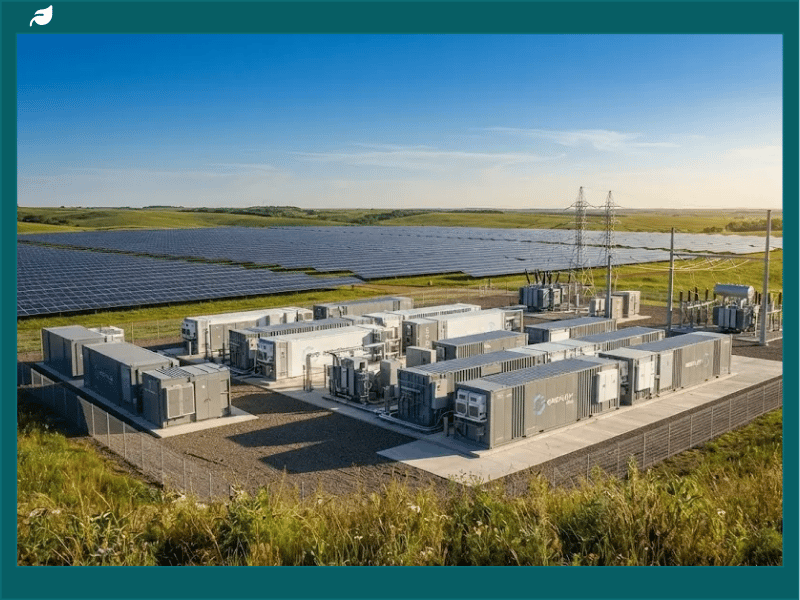
1. The ESG Advantage: Cobalt-Free Chemistry and Responsible Sourcing
Modern enterprises face growing regulatory and stakeholder scrutiny regarding their upstream supply chains. Traditional Nickel Manganese Cobalt (NMC) chemistries rely heavily on cobalt and nickel—materials linked to severe ethical sourcing issues, environmental degradation during mining, and volatile commodity pricing.
LiFePO4 eliminates these risks entirely. By replacing controversial heavy metals with abundant iron and phosphate, LiFePO4 offers a transparent and ethically viable supply chain solution. From an environmental footprint perspective, lifecycle assessments published by the U.S. Department of Energy (DOE) show that LiFePO4 manufacturing generates up to 20% lower embodied carbon emissions compared to high-nickel formulations. Furthermore, the inherent chemical stability of phosphate structures simplifies end-of-life recycling and thermal processing, aligning perfectly with corporate ESG mandates and circular economy principles.
2. Economics of Lifecycle: Optimizing LCOS Over Long Horizon
In commercial energy storage, upfront capital expenditure (CapEx) is only part of the financial equation. Institutional investors and business leaders increasingly evaluate storage assets based on Levelized Cost of Storage (LCOS)—a metric that measures the total cost per megawatt-hour (MWh) delivered over the asset’s lifespan.
BNEF’s annual battery price surveys highlight that LiFePO4 cell pack costs remain consistently 15% to 20% lower per kilowatt-hour (kWh) than NMC equivalents. Beyond lower entry costs, LiFePO4 demonstrates decisive economic superiority across long operational lifespans:
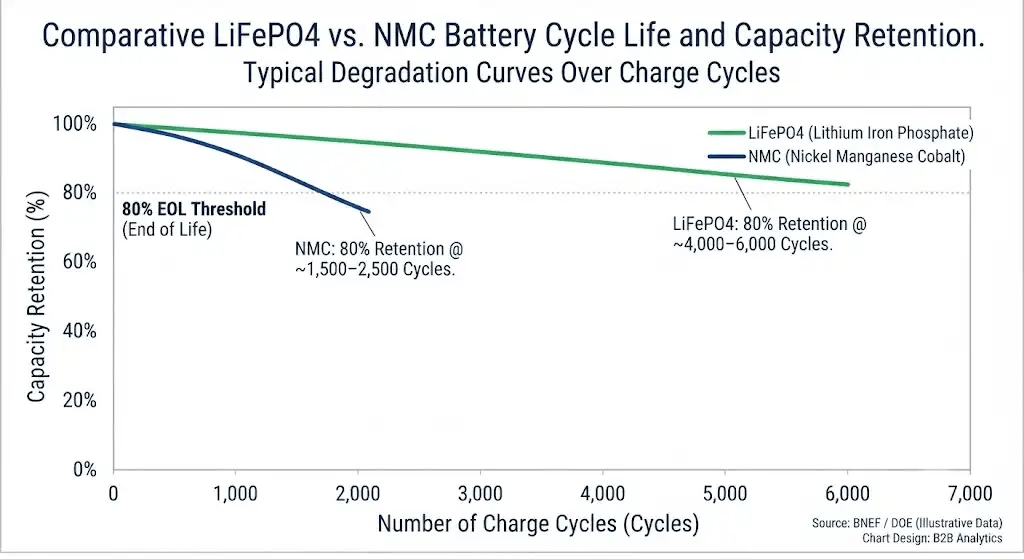
Extended Cycle Life: LiFePO4 cells routinely achieve 4,000 to over 6,000 charge-discharge cycles at 80% Depth of Discharge (DoD), compared to 1,500–2,500 cycles typical of NMC chemistries. This longevity translates to 10 to 15 years of daily operation without significant degradation.
Thermal and Operational Safety: LiFePO4 possesses a significantly higher thermal runaway threshold (around 270°C compared to NMC’s 210°C) and does not release oxygen during decomposition. Industry insurance reports indicate this inherent stability drastically lowers risk premiums, reduces thermal management requirements, and minimizes structural safety hazards in dense industrial deployments.
Lower O&M Costs: Reduced degradation rates and simplified cooling architecture translate directly into lower ongoing operation and maintenance (O&M) expenses, significantly improving lifetime project ROI.
3. End-of-Life Management: Second-Life Value and Circular Economy Challenges
A holistic sustainability case for energy storage must address what happens when batteries reach the end of their operational life. The physical robustness of LiFePO4 creates unique opportunities—and distinct industry challenges—in end-of-life (EOL) processing:
Second-Life Cascading Reuse: When EV or high-demand commercial batteries degrade to 70–80% capacity, LiFePO4 cells remain highly stable. These packs can be repurposed for lower-intensity stationary storage, extending their useful operational life by another 5 to 8 years before recycling.
The Recycling Paradox: Unlike NMC batteries, which yield high financial value during hydrometallurgical recycling due to expensive cobalt and nickel, LiFePO4 contains lower-value raw materials (iron and phosphate). This makes direct chemical recycling less lucrative purely on raw material extraction alone.
Policy-Driven Closed-Loop Solutions: To overcome this recycling economics gap, major markets are introducing extended producer responsibility (EPR) mandates and regulations (such as the EU Battery Regulation). These policies encourage direct direct-recycling technologies and standardized “Design for Disassembly,” transforming LiFePO4 EOL management from a cost burden into a strategic closed-loop supply chain.
4. Powering Decentralized Energy and New Commercial Frameworks
As policy landscapes evolve—such as recent adjustments to renewable tax credits and clean energy incentives across major global markets—commercial strategies are pivoting from outright asset purchases to dynamic service models. Wood Mackenzie projects that non-residential and commercial-scale storage will lead growth in decentralized power systems. High-durability LiFePO4 technology is enabling several key structural shifts:
PPAs and Battery-as-a-Service (BaaS): Third-party financiers and energy service companies (ESCOs) rely on assets with predictable degradation curves. The structural stability of LiFePO4 makes long-term Power Purchase Agreements (PPAs) and equipment leasing viable, lowering entry barriers for businesses adopting clean power.
Microgrids and Remote Operations: From commercial facilities looking to mitigate peak-demand charges to off-grid operations requiring independent power, modular LiFePO4 units offer high reliability under continuous heavy usage. High-quality B2B energy storage systems serve as the operational backbone for these decentralized grids.
Virtual Power Plants (VPPs): Aggregating distributed storage assets into VPPs requires batteries that can withstand frequent grid-arbitrage and frequency-regulation cycles. LiFePO4’s robustness under high C-rates allows commercial operators to monetize their excess storage capacity without compromising battery lifespan.
5.The Path Ahead: Scalability and Grid Resilience
The transition to a decarbonized economy requires energy infrastructure that is both resilient and economically sustainable. LiFePO4 technology bridges the gap between environmental responsibility and financial viability.
As manufacturing scaling continues to drive down cell costs and battery management software becomes more sophisticated, LiFePO4 is positioned to remain the benchmark chemistry for renewable integration. For forward-thinking enterprises, investing in robust portable and stationary energy solutions powered by LiFePO4 is no longer just an environmental commitment—it is a strategic imperative for long-term operational resilience.