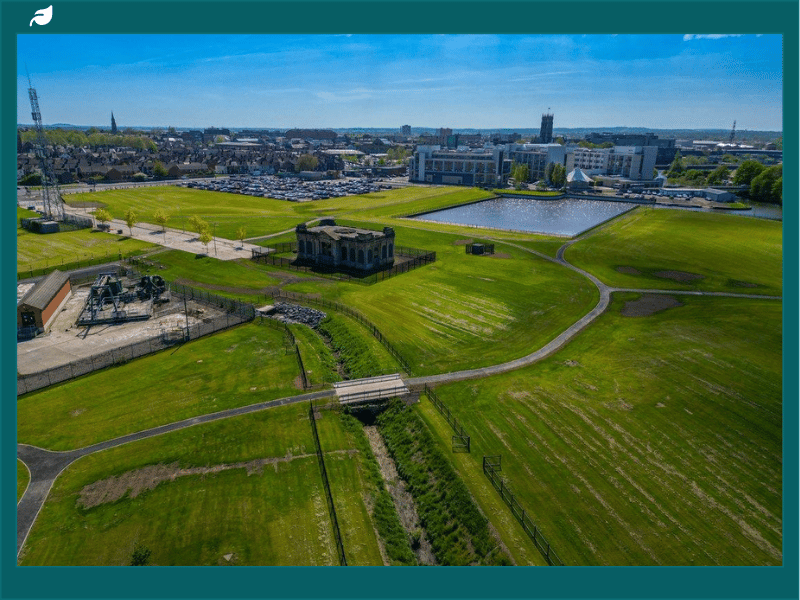
Pick Everard is redefining how contaminated urban land can be returned to public use, and its latest success story centres on Waterfront East Park in Doncaster, a 22-acre site that has just completed a major remediation programme. Once occupied by small car parks, industrial units, a scrapyard and a pumping station, the Chappell Drive site sat largely underutilised for years despite its prime position close to the city centre and the River Don. Appointed by the City of Doncaster Council and working under Perfect Circle via the SCAPE Consultancy Framework, the multi-disciplinary consultancy provided project management, cost management, quantity surveying, civil engineering, building and construction safety and environmental services alongside main contractor Keltbray. The result is one of the UK’s most prominent brownfield sites transformed into a green, open space ready for its next phase of development.
Treating Contamination At Source
The site’s industrial history meant a carefully sequenced approach to decontamination was essential before any redevelopment could be considered. Hydrocarbon contamination was addressed through bioremediation, mixing and aerating the soil to encourage naturally occurring microorganisms to break down pollutants, while areas of heavy metal contamination were managed with a clean cover system involving imported topsoil and subsoil.
Emelye Kenyon, director of environmental services at Pick Everard, said:
“Given the site’s former uses, it required us to bioremediate the land. This process involved mixing and aerating the soil to reinvigorate it and encourage naturally occurring microorganisms to break down contaminants. On this site, it was predominantly hydrocarbon contamination that we treated in this way.”
“There were also areas of heavy metal contamination, which were remediated using a clean cover system. This involved importing around 1,044 loads of topsoil and 64 loads of subsoil. By combining these approaches, we were able to maximise the amount of material treated on site, significantly reducing waste and supporting a more sustainable remediation strategy.”
Managing Invasive Species And Reviving The Land
Beyond chemical contamination, the site also carried an ecological challenge in the form of Himalayan balsam, an invasive plant found in significant quantities along the drainage ditch running through the land. A specialist contractor was brought in to remove the plant and associated contaminated soils, ensuring compliance with environmental regulations and preventing further spread. Once the wider remediation work was complete, hydroseeding was used to promote rapid vegetation establishment, applying pre-soaked seed within a gel medium to accelerate germination across the newly cleaned land.
A Circular Approach To Site Clearance
The scale of underground obstruction on site proved substantial, with historic concrete footings, former roadways, car parks and floor slabs all requiring removal. Clearing the concrete pad from a former gas holder revealed further sub-surface concrete, which was processed on site rather than sent for disposal, with crushed materials reused or sold on. Keltbray moved approximately 38,650 cubic metres of material across the site in total, reusing around 32,365 cubic metres, while of the 6,319 cubic metres of material produced during the works, 1,000 cubic metres was reused on site to infill soft spots, backfill excavations where water was encountered, and form haul roads.
David Sloyan, Regional Director – Major Infrastructure at Keltbray, said:
“Waterfront East Park is a fantastic example of how complex brownfield sites can be successfully transformed through innovative, sustainable remediation.”
“Working in close partnership with City of Doncaster Council and Pick Everard, we have been able to safely manage and treat significant contamination, while maximising the reuse of materials on site. This approach not only reduces waste but supports the long-term regeneration potential of the area.”
“We’re proud to have played a role in unlocking this important site for future development and creating a platform for lasting economic and social value.”
A Platform For Regeneration
The project was delivered by City of Doncaster Council and part-funded by the UK Government and South Yorkshire Mayoral Combined Authority. With remediation complete, residents have already begun using the new green space, marking a visible shift in how the Waterfront area is perceived within the city.
Mayor of Doncaster, Ros Jones said:
“The Waterfront area was one of the largest brownfield sites in the North, with significant potential for development. It is now a prime site for development, with incredible potential and within walking distance of the city centre, and local, regional and national transport links.”
“This project needed careful work to make sure that it becomes land that could be used for future development, and we are incredibly grateful to the work of all our partners who came together to manage and help remediate and clean up this piece of land. Residents have already begun using this green space and it is a delight to see it brought back to life.”
Setting Up The Next Chapter
Waterfront East Park stands as a demonstration of how a technically complex brownfield site, burdened by decades of industrial use, contamination and invasive species, can be methodically cleared and restored without relying on wholesale disposal of material. The combination of bioremediation, clean cover systems, on-site crushing and reuse, and habitat restoration through hydroseeding gives Doncaster a green, open space in the heart of the city while preserving its long-term potential for further investment and development.