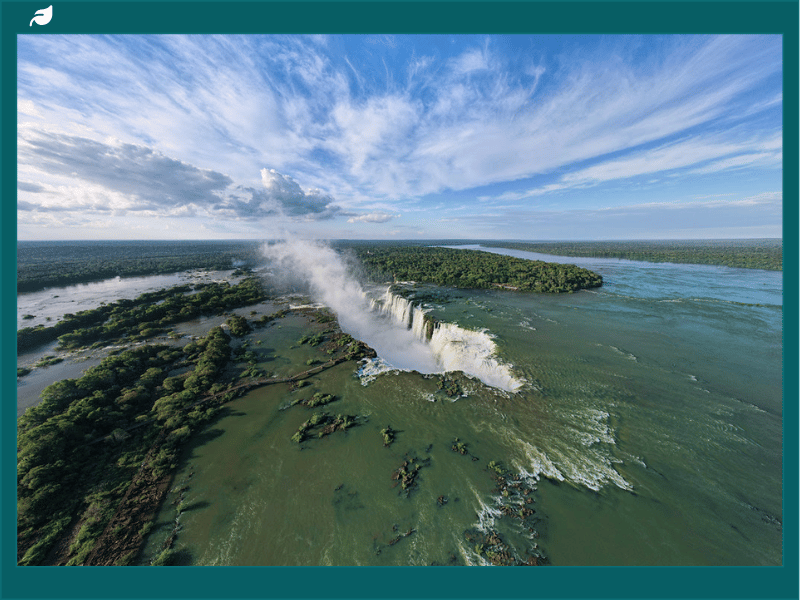
Brazil’s national tourism agency is positioning Foz do Iguaçu as a flagship destination for nature-based travel, promoting a portfolio of immersive experiences in and around Iguaçu National Park as international arrivals to the country climb to historic levels. The campaign, led by EMBRATUR, the Brazilian Tourist Board, frames the destination home to Iguaçu Falls, one of the Seven Natural Wonders of the World as a place where monumental nature, conservation, and visitor comfort converge.
The pitch arrives at a pivotal moment for Brazilian tourism. The country welcomed 9.3 million international visitors in 2025, a 37 per cent increase over the previous year and the strongest result in its history, and momentum has continued into 2026, with 3.74 million international arrivals recorded in the first quarter alone — the best opening quarter on record. For sustainability professionals watching the sector, the question is whether destinations like Foz do Iguaçu can absorb that growth while protecting the ecosystems that draw visitors in the first place. Travel And Tour WorldFinancialContent
A Gateway to Protected Atlantic Forest
Foz do Iguaçu serves as the entry point to Iguaçu National Park, a UNESCO World Natural Heritage Site sheltering one of the largest remaining tracts of Brazil’s Atlantic Forest among the country’s richest and most threatened biomes. The destination’s appeal rests on the scale of the falls themselves, but EMBRATUR’s promotion emphasises a broader set of experiences designed to deepen the connection between visitors and the surrounding environment.
Central to that offer is a guided forest immersion: a slow-paced walk to the Iguaçu River in which birdsong, vegetation aromas, filtered light, and small movements among the leaves invite visitors to engage attentively with the forest. The experience concludes with a healthy snack prepared from local ingredients, including unconventional edible plants known in Brazil as PANCs a detail that ties the tourism product to regional biodiversity and local food systems, a connection increasingly valued in sustainable destination management.
Adventure, Luxury, and the Night Sky
For travellers seeking intensity, the destination’s signature experience remains the speedboat journey along the Iguaçu River. The route begins within the forest before the vessel approaches the falls, where mist, wind, and sound envelop passengers in what the agency describes as a feeling of absolute presence before the power of nature.
At the other end of the spectrum sits in-park accommodation. A luxury hotel surrounded by Atlantic Forest, steps from the falls, allows guests to experience the park after day visitors depart when the landscape quietens and the sound of the water accompanies the stay in a more intimate register. The destination’s programming extends past sunset as well: guided astronomical observation sessions, using telescopes and binoculars, take visitors through constellations, satellites, and the ways different civilisations have interpreted celestial bodies throughout history.
The combination is deliberate. With a wide hotel network, diverse gastronomy, and straightforward air and land access, Foz do Iguaçu is marketing itself to multiple traveller segments simultaneously adventure seekers, wellness-oriented visitors, and the premium nature-travel market that has grown sharply since the pandemic.
Conservation Funded by Visitation
The sustainability case for the destination rests substantially on its governance model. In 2022, Brazil’s federal conservation agency ICMBio awarded a 30-year concession contract for visitor services in Iguaçu National Park, covering the revitalisation, operation, and maintenance of tourism infrastructure along with an obligation to fund conservation, protection, and management activities in the park. The arrangement is frequently cited as a leading example of public-private partnership in protected-area management, channelling visitor revenue directly into conservation outcomes.
Visitation has rebounded strongly under the new structure. The park received 1.8 million tourists in 2024, its busiest year since the pandemic, and passed the one-million-visitor milestone 11 days earlier in 2025 than in 2024, with travellers from 186 nationalities recorded.
Growth of this kind is not without scrutiny. UNESCO has noted concern over proposals to expand tourism-related infrastructure within the property, including a cable car, and conservation bodies continue to monitor how development pressure interacts with the park’s Outstanding Universal Value. The park’s Public Use Plan, developed through multi-stakeholder consultation, is intended to keep visitation growth within regulated, sustainable bounds — a balancing act that will become more demanding as Brazil’s tourism boom continues.
What It Signals for the Sector
For the wider sustainable tourism industry, Foz do Iguaçu offers a live test of whether high-volume nature tourism can finance conservation rather than erode it. EMBRATUR expects Brazil to surpass 10 million international arrivals in 2026, supported by expanded air connectivity and event-led marketing, and iconic natural destinations will carry a significant share of that demand.
If the concession model holds directing investment into both visitor experience and ecosystem protection Foz do Iguaçu could become a reference point for protected-area tourism across Latin America. If infrastructure ambitions outpace environmental safeguards, the destination risks illustrating the opposite lesson. Either way, businesses across the travel value chain, from tour operators to hospitality investors, will be watching how Brazil manages the next phase of growth at one of the world’s most recognisable natural sites.