Higher education is not what it used to be.
There was a time when institutions could rely on reputation, rankings, and a steady stream of applicants to keep things moving. Students applied, universities processed, and enrollments followed. The system worked, even if it wasn’t perfect.
But that world is gone.
Today, universities are operating in a completely different environment. Student expectations are higher. Competition is global. Costs are rising. Teams are stretched thin. And perhaps most importantly, students now have more choices than ever before.
In this new reality, the margin for inefficiency is shrinking fast.
And yet, in many institutions, the admissions process still looks like it did a decade ago.
That gap between what students expect and what institutions deliver is where the real problem starts.
Admissions: The Most Underrated Growth Lever
When people think about growth in higher education, they often focus on marketing, partnerships, or program expansion.
But admissions is where growth actually becomes real.
It is the point where interest turns into intent. Where a curious student becomes an applicant. Where a decision is made that directly impacts enrollment numbers.
More than that, admissions is the first real experience a student has with an institution.
Before the classroom, before orientation, before campus life, there are admissions.
And that experience matters more than most institutions realize.
If it is slow, confusing, or impersonal, students notice. If it is smooth, responsive, and supportive, they notice that too.
In many ways, admissions sets the tone for everything that follows.
The Current State: Hard Work, Broken Systems
Walk into any admissions office, and you will see a team that is deeply committed to what they do.
But you will also see systems that are holding them back.
A typical admissions workflow today might involve:
- Reviewing transcripts manually, often line by line
- Downloading and organizing documents from emails
- Responding to repetitive student queries
- Updating multiple systems with the same information
- Managing communication across disconnected platforms
None of these tasks is simple. And none of them are going away anytime soon.
But here is the issue.
Most of this work is repetitive. It is time-consuming. And it does not scale.
As application volumes increase, the workload increases at the same rate. There is no real leverage.
So what happens?
Teams work longer hours. Turnaround times stretch. Errors creep in. And eventually, something gives.
Often, that “something” is the student experience.
Why Is This a Sustainability Problem?
At first glance, this might seem like an efficiency issue.
But it is much bigger than that.
This is about sustainability.
A sustainable system is one that can handle growth without breaking down. One that can adapt to change without requiring constant firefighting. One that supports people instead of exhausting them.
Traditional admissions systems tend to fall short across all three areas:
1. Linear Scaling
More applications mean more work. There is no multiplier effect. The only way to handle volume is to add more people or extend timelines.
2. Rising Costs
Manual processes are expensive. Not just in terms of salaries, but in terms of lost opportunities, delayed decisions, and inefficiencies.
3. Human Burnout
Admissions teams often work under constant pressure, especially during peak cycles. Over time, this can lead to fatigue, disengagement, and higher turnover.
4. Inconsistent Outcomes
When processes rely heavily on manual work, maintaining consistency becomes difficult. Similar applications may be evaluated differently, increasing the risk of errors.
5. Student Frustration
Students today expect speed, clarity, and responsiveness. When they don’t get it, they move on.
Put all of this together, and you have a system that is not built for the future.
What Admissions Modernization Really Means?
Modernization is often misunderstood.
It is not about replacing systems just for the sake of it. It is not about adding more tools or creating more complexity.
It is about rethinking how admissions works from the ground up.
At its core, modernization is about one simple idea:
Let machines handle the repetitive work so humans can focus on meaningful decisions.
Here is what that looks like in practice.
Automating High-Volume Tasks
Tasks like document processing, transcript evaluation, and data entry can be automated to a large extent.
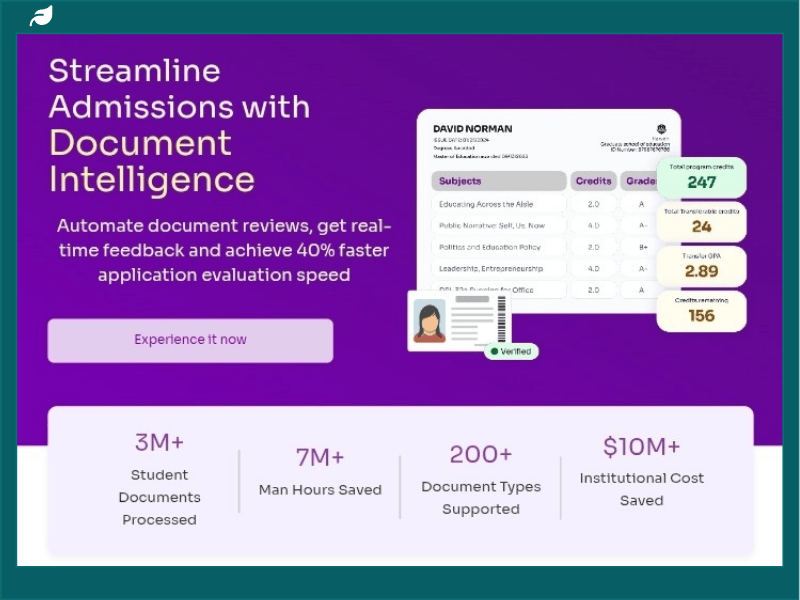
Automated Tools such as Document Intelligence and the GPA Calculator automate the process of reviewing and analyzing large volumes of documents, such as transcripts and applications, with minimal human intervention.
Instead of spending hours manually reviewing documents, systems can extract, organize, and present information in a structured way.
This does not remove human oversight. It enhances it. Admissions officers can focus on interpreting the data instead of gathering it.
24×7 Student Engagement
Students do not operate during office hours.
They apply late at night, ask questions over the weekend, and expect quick responses.
Modern systems enable institutions to respond instantly through AI-driven chat and voice interactions.
This does not replace human interaction. It ensures that students are never left waiting.
Unified Workflows
One of the biggest challenges in admissions today is fragmentation.
Different systems for CRM, document management, communication, and evaluation often do not talk to each other.
Modernization brings these workflows together.
Data flows seamlessly. Processes are connected. Teams have a single view of each applicant.
This reduces friction and improves efficiency across the board.
Real-Time Decision Making
Instead of waiting on reports or pulling data together by hand, modern systems give you instant insights.
Admissions leaders can:
- Track application trends
- Identify bottlenecks
- Monitor conversion rates
- Adjust strategies quickly
This shift from reactive to proactive decision-making is critical.
The Human Side of Modernization
One of the biggest fears around modernization is that it will replace people.
In reality, it does the opposite.
It gives people their time back.
Think about it.
If an admissions counselor spends 70% of their time on administrative tasks, how much time is left for actual student interaction?
Not much.
Modernization changes that balance.
It allows counselors to:
- Have more meaningful conversations with students.
- Provide personalized guidance.
- Focus on complex cases that require judgment.
- Build relationships instead of processing paperwork.
In other words, it brings the “human” back into admissions.
The Shift from Reactive to Proactive Admissions
Traditional admissions is mostly reactive.
A student applies, the institution reviews the application, and then a decision is made.
But modern admissions work differently. It’s proactive.
It begins much earlier in the student journey. It stays engaged throughout and helps guide students every step of the way.
With the right systems in place, institutions can:
- Spot serious, high-intent students even before they apply.
- Send timely, personalized reminders and nudges.
- Answer questions and resolve concerns instantly.
- Reduce drop-offs at every stage of the process.
This isn’t just about being more efficient. It’s about having a real impact.
Institutions that reach students early and stay connected throughout are much more likely to turn interest into enrollment.
Why Is Student Experience Now the Key Factor?
In a competitive world, the thing that matters the most is experience.
Students don’t just compare schools based on academics; they also consider how easy the application is, how fast they get responses, and how supported they feel throughout the process.
A slow or confusing admissions process sends the wrong message.
It tells the student that the institution may not be as responsive or organized as they expect.
On the other hand, a smooth and transparent process builds trust.
It creates confidence.
And in many cases, it becomes the deciding factor.
Operational Sustainability: The Missing Piece
When institutions talk about sustainability, the focus is usually on finances or the environment.
But there’s another side that matters just as much: how your operations hold up over time.
At its core, it comes down to a simple question:
Can your system scale without adding the same pressure and cost?
That is exactly what modern admissions systems are built to manage.
They basically:
- Minimize dependence on manual tasks.
- Improve consistency and accuracy.
- Help teams manage higher volumes without burning out.
- Create processes that are predictable and easy to scale.
That’s what long-term sustainability really looks like.
The Cost of Not Modernizing
Sometimes, doing nothing is the biggest risk.
Institutions that delay modernization may face:
- Declining conversion rates
- Longer decision cycles
- Increased operational costs
- Difficulty attracting and retaining talent
- Reduced competitiveness
These effects are not always immediate.
But over time, they compound.
And by the time the impact becomes visible, it is often harder to catch up.
A More Resilient Future
Modernizing admissions is not just about fixing what’s broken today.
It’s about getting ready for what’s coming next.
Higher education is constantly changing. New technologies will keep emerging, student expectations will keep rising, and competition will only get tougher.
Institutions that build flexible and scalable systems now will be in a much stronger position to adapt.
They won’t just keep up with change.
They’ll be the ones driving it.
Final Thoughts
Admissions is no longer just a process.
It is a strategic function that sits at the heart of institutional growth.
Modernizing it is not optional anymore. It is essential.
Not because technology is trendy.
But because the current system is no longer sustainable.
The institutions that recognize this early and take action will be the ones that thrive in the years ahead.
Because in today’s world, sustainability is not just about doing more.
It is about doing it smarter, faster, and with the student at the center of everything.