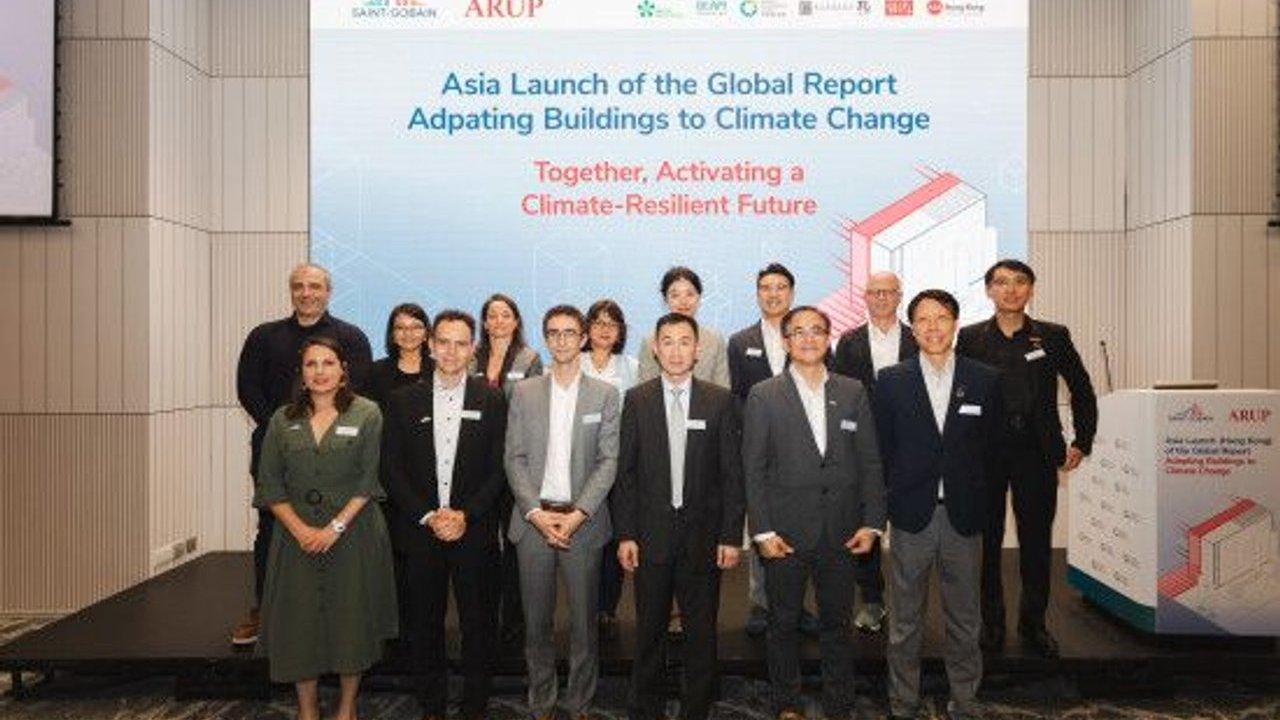
Arup and Saint-Gobain have launched their global Adapting Buildings to Climate Change report in Hong Kong, bringing more than 100 built-environment leaders together to examine climate resilience, retrofit priorities and AI-enhanced building design. Supported by the Hong Kong Green Building Council, BEAM Society Limited, Business Environment Council, the Hong Kong Institute of Architects, Royal Institute of British Architects and American Institute of Architects Hong Kong, the event marked the report’s Asia launch. It followed a European launch in Brussels earlier this year and opens a wider Asia Pacific discussion on climate-responsive buildings. The report sets out three design approaches, robustness, adaptiveness and flexibility, alongside construction solutions intended to help buildings withstand heat, flooding and storms.
Hong Kong Launch Brings Sectors Together
The Hong Kong event placed building adaptation alongside decarbonisation as a practical concern for owners, investors, designers and operators. Government and diplomatic representatives attended the launch, including Mr Sammy Yeung, JP, Commissioner for Climate Change at the Environment and Ecology Bureau, HKSAR Government, and Mr Benjamin Hubin, Deputy Consul General of France in Hong Kong and Macau.
Presentations and a panel discussion considered climate-responsive design, retrofitting and advanced technologies across the building lifecycle. Participants also examined how digital tools and artificial intelligence can support more informed decisions in design and operation, while extending asset life and creating social and economic value.
The gathering gave the report a relevant regional setting. Hong Kong’s dense development, rising temperatures, heavier rainfall and substantial existing building stock create a clear case for measures that protect buildings and occupants while lowering operational emissions.
A Clear Adaptation Imperative
Climate-related hazards are already shaping the performance requirements placed on urban buildings. The release cites more than 7,000 major climate-related disasters worldwide between 2000 and 2019, with nearly US$3 trillion in associated losses. Heatwaves, floods, storms and extreme rainfall are all becoming more frequent and severe.
In dense cities, elevated local temperatures can intensify both health risks and cooling demand. Arup’s research found that the urban heat island effect can raise city temperatures by up to 8.5°C compared with rural surroundings. This makes passive measures, effective building envelopes and local climate awareness particularly important considerations in property upgrades and new development.
Ir Dr Vincent Cheng, Arup Fellow and APAC Environment, Climate and Sustainability Services Leader at Arup, said:
“Climate adaptation is no longer a future consideration. It is a present-day imperative for our cities, communities and economies. Buildings account for a significant share of our urban assets, and enhancing their resilience is essential to protecting people, livelihoods and long-term prosperity. Through this report, Arup and Saint-Gobain aim to provide practical insights that help the industry move beyond identifying climate risks and towards implementing solutions. By combining adaptation, decarbonisation and digital innovation, we can create buildings that are not only more resilient, but also healthier, more efficient and better equipped to support thriving communities.”
Design Principles Across Asset Life
The report examines climate impacts on buildings throughout the asset lifecycle and identifies robustness, adaptiveness and flexibility as complementary design approaches. Together, these principles point to buildings that can withstand present conditions, respond to changing circumstances and accommodate longer-term needs.
Its proposed families of construction solutions range from thermal envelope and solar protection systems to green infrastructure and enhanced-resistance measures. These options recognise that climate adaptation is not a single intervention, but a set of choices shaped by local hazards, building condition and the needs of occupants.
For existing assets, the focus on retrofit is especially pertinent. Upgrading buildings can help protect their value and service life while improving occupant wellbeing. The report also positions proactive adaptation as an opportunity to support more resilient cities rather than simply responding after an extreme weather event.
Integrated Construction Solutions
Saint-Gobain’s contribution centres on combining materials, systems and building-science expertise to respond to climate risks at project level. The company’s perspective reflects the value of connecting envelope performance, solar protection, resilience measures and wider building design, rather than treating individual products in isolation.
Mr Ludovic Weber, CEO Asia at Saint-Gobain, said:
“Building adaptation to climate change cannot be addressed through one discipline, one stakeholder or one product alone. This report reinforces and accelerates Saint-Gobain’s long-standing approach of combining materials, systems and building-science expertise to deliver integrated, performance-based solutions tailored to specific climate risks and local needs. Together with Arup, we aim to turn knowledge into practical action and help create buildings that are more resilient, sustainable and valuable over the long term.”
The framing is well suited to a sector in which architects, engineers, developers, manufacturers and public bodies must coordinate their roles. A high-performing adapted building depends on decisions made from early design through construction, operation and renewal.
A Regional Conversation Begins
Arup and Saint-Gobain’s Hong Kong launch has created a useful platform for Asia Pacific stakeholders considering how climate adaptation can be incorporated into building investment and design decisions. The report brings resilience, decarbonisation and digital innovation into the same conversation, reflecting the interconnected nature of building performance.
For Hong Kong and other dense urban centres, the direction of travel is clear: better prepared buildings can help safeguard assets, support occupant wellbeing and reduce exposure to intensifying climate conditions. The report’s emphasis on practical construction measures and lifecycle thinking offers a timely reference point for organisations seeking to build resilience into both existing portfolios and future projects.