enfinium, one of the UK’s leading energy from waste operators, has published its latest annual ESG Report for 2022. The report, “New Horizons”, sets out the business’s progress against a range of ambitions to deliver on its goal of building more sustainable, diverse and equitable local communities in the UK. The business manages 2.3 million tonnes of waste a year and generates enough home-grown energy to power 500,000 homes.
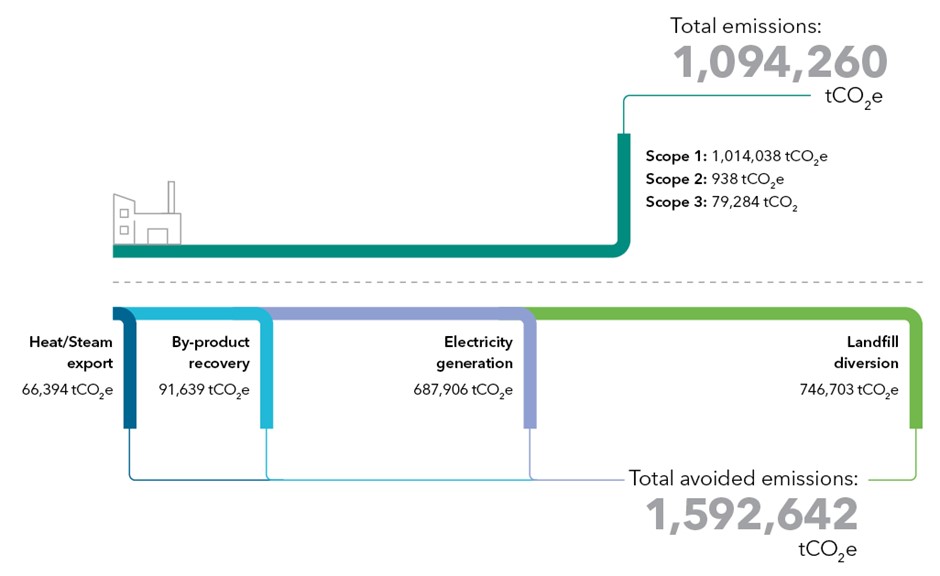
New Horizons reports that enfinium achieved a significant net carbon emission saving of 498,382 tonnes in 2022. When calculating the overall avoided emissions, the firm measures the impact of its emissions by assessing its carbon “balance sheet”. This sets out the direct and indirect emissions from its activities, compared to the emissions saving the business achieves through diverting waste from landfill, generating electricity, giving heat to industrial partners, metals recovery and materials recycling.
When it comes to disposing of waste that has not been recycled, generating energy from it remains a more attractive option than landfill in terms of reducing overall greenhouse gas emissions. Research has suggested that creating energy from waste has a 41% lower emissions footprint than landfill. The greenhouse gas emissions avoided through diverting waste from landfill is one contributor to enfinium’s avoided emissions.
Another way that enfinium avoided emissions is through supplying steam to industrial partners. In 2022, enfinium’s Kemsley facility more than doubled its steam supply to its heat offtake partner, paper mill operator DS Smith. The DS Smith paper mill, located adjacent to enfinium’s Kemsley facility, is the largest mill for recycled papers in the UK and the second largest in Europe. Total steam supplied in 2022 reached 432,413 tonnes (compared to 201,735 tonnes in 2021) which contributed to a significant reduction in the amount of natural gas DS Smith required for its own operations.
Mike Maudsley, CEO of enfinium, said: “ESG isn’t a bolt on to our strategy at enfinium, it is our business strategy. This new report shows the remarkable progress we have made across several critical areas thanks to the enthusiasm of our people and support of our many stakeholders”.
“The report is clear evidence of the commitment to transparency and accountability that underpins all of our work at enfinium, from pursuing opportunities around the transition to a low-carbon economy to investing in underserved local communities.”
The report also highlighted the business’s future ambitions for decarbonisation. The UK government has a target to halve ‘residual waste’ (waste that is left over after sorting and recycling) by 2042 from 2019 levels. Even if the government achieves this target, that still means that as much as twelve to sixteen million tonnes of waste will remain that will need to be dealt with. enfinium suggests that ‘decarbonised’ energy from waste is the “only proven long-term solution” for managing this waste.
The business’ plan is to create local “Decarbonisation Hubs” powered by the nation’s waste. enfinium claims it can deliver carbon removals, or “negative emissions”, by utilising technology such as carbon capture, utilisation and storage. Earlier this year, enfinium announced a partnership with Navigator Terminals to explore the development of the UK’s first carbon capture rail corridor – transporting carbon captured in enfinium’s Ferrybridge facilities in West Yorkshire to Teeside using rail freight, where the carbon could be taken out to sea and stored.
The firm is also exploring producing electrolytic hydrogen and contributing to local heat networks as other ways to deliver on their vision of decarbonised energy from waste.