
A new plug-in heater developed during the peak of Europe’s energy crisis is entering the UK market, positioning itself around reduced electricity use, safety engineering and software-led control. G-WILL, founded by software engineer William Ye, is now available to UK customers following a successful crowdfunding campaign and the start of mass production.
The product emerged in 2022 as household energy prices rose sharply following Russia’s invasion of Ukraine. At the time, UK consumers were actively searching for extremely low-cost electric heating options, reflecting growing pressure on household budgets. Ye, who holds a Master’s degree in Informatics from the University of Edinburgh and previously worked on IBM’s WebSphere middleware, said the search data signalled both urgency and a gap in existing products.
“I noticed a surge in searches for ‘1p per hour electric heater’ on Google and Amazon UK,” Ye said. “People were desperate for affordable warmth. But traditional fan heaters are notorious energy guzzlers—a standard 1500W unit costs around 37 pence per hour to run. I became determined to create the world’s most energy-efficient plug-in heater. Even if I couldn’t achieve the mythical 1p per hour, I’d try my best to get closer than anyone ever had.”
The resulting G-WILL Smart Plug-in Heater applies software-style control logic to hardware design. While rated at 600W, the company says the unit typically operates at a much lower average draw once a stable temperature is reached. According to internal testing, average power consumption during steady operation is around 150W, supported by an embedded control algorithm that adjusts output in response to ambient conditions.
Ye wrote the heater’s firmware himself in C, drawing on his experience designing software for high-availability enterprise systems. He said the development approach differed from standard appliance testing practices, which often rely on nominal ratings rather than extended real-world measurement.
“Very few heater manufacturers actually test power consumption by running the device and reading the meter,” Ye said. “We do, and we took a very different approach.”
Using custom Java software, Ye recorded real-time power readings at short intervals over long test periods. This produced detailed power curves showing how consumption fluctuates during warm-up and stabilisation. The company says the data informed refinements to the control algorithm, reducing unnecessary energy use while maintaining comfort.
Manufacturing takes place in Shenzhen at a facility with more than 30 years of experience, which supplies multiple publicly listed companies. The factory holds ISO environmental and quality management certifications. G-WILL states that all plastic components use V0-rated fire-retardant materials and that the heater relies on a ceramic PTC element for heat generation.
Design choices also extended to tooling. The company invested in higher-grade moulds more commonly used for consumer electronics rather than small appliances. G-WILL says this was intended to improve surface finish, durability and perceived quality, positioning the heater as a visible household product rather than a purely functional item.
Safety has been a central focus of the design, particularly given previous recalls in the UK plug-in heater market. One widely sold 500W unit was withdrawn following government intervention over safety concerns. G-WILL says its product incorporates four independent layers of protection.
These include dual temperature sensors monitoring both internal and ambient conditions, a software-based safety system that analyses temperature data in real time, a V0-rated fire-resistant housing, and a copper thermal cut-off switch that physically disconnects power if internal temperatures exceed safe limits. The final cut-off operates independently of software or sensors.
When abnormal conditions are detected, the system displays warning codes, shuts down automatically and locks user controls to prevent immediate restart. The company says this approach is designed to reduce the risk of overheating during unattended operation, such as overnight use.
Alongside efficiency and safety, the heater introduces a programmable wake-up timer, a feature not commonly found in plug-in heaters. Users can set the unit to preheat a room ahead of waking, reducing reliance on continuous overnight heating or the discomfort of cold morning temperatures.
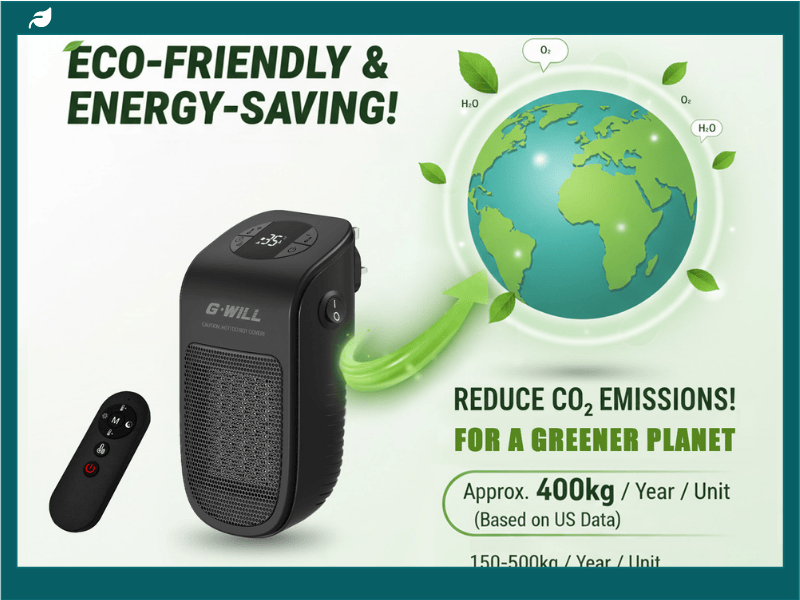
From an emissions perspective, G-WILL estimates that reduced electricity use can translate into lower associated carbon emissions. The company calculates annual savings of between 150 and 500 kilograms of CO₂ per unit compared with conventional fan heaters, depending on grid intensity. For the United States, it estimates savings of up to 400 kilograms per year.
The product completed a Kickstarter campaign prior to entering mass production. As of December 2025, it is available to UK customers via Amazon UK, with additional markets under consideration. The company has not disclosed sales volumes.
G-WILL operates under the legal entity YUEQING G WILL INDUSTRIAL CO., LTD and describes itself as a smart home heating company focused on energy-efficient heating and cooling products. While the long-term roadmap has not been detailed publicly, Ye said the initial heater reflects a broader aim to apply software measurement and control techniques to everyday energy use.
From its origins in a period of acute energy insecurity, the G-WILL heater illustrates how consumer pressure, data signals and engineering practice intersected to produce a new entrant in the small appliances market. Whether it gains traction at scale will depend on price, performance and trust, but its development highlights continued experimentation around household energy demand at a time of ongoing cost and climate pressures.