Introduction to the Nephila: Golden Orb Weaver Spider
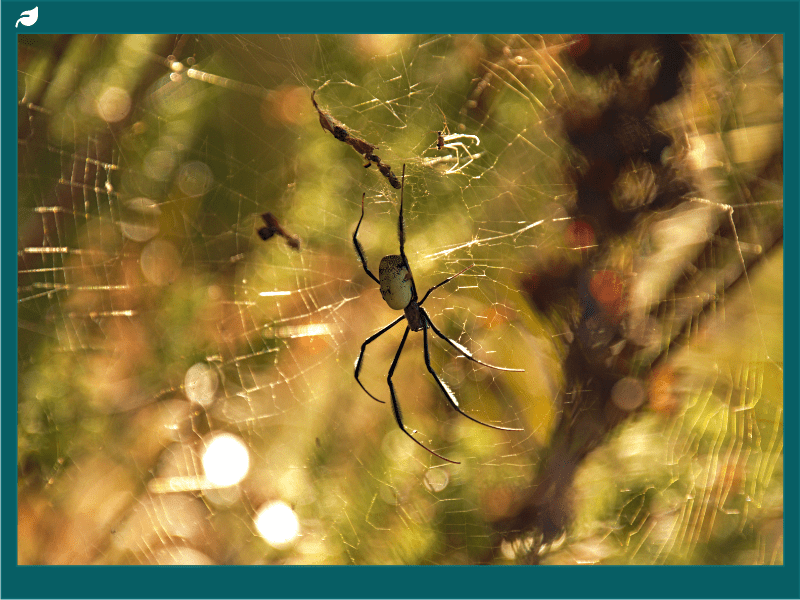
Picture a web the size of a doorway, strung between two trees, glowing amber in the morning light. That web belongs to a Nephila, the golden orb weaver spider, and it’s one of the most striking things you’ll find in a tropical forest. These orb-weaving spiders have been doing this for millions of years, and they’re very, very good at it. According to [research published via the National Institutes of Health, Australian golden orb weaver (*Nephila pilipes*) silk exhibits an average toughness of 150 MJ m⁻³, with significantly higher strain capacity than its smaller congener (*Nephila clavipes*).
Nephila belongs to the family Araneae Nephilidae, a lineage of large, long-lived orb weavers found across tropical and subtropical regions worldwide. The genus Nephila is the group that scientists and naturalists keep returning to, partly because the animals are so conspicuous and partly because almost everything about them turns out to be more interesting than expected. The silk is stronger than steel by weight. The females dwarf the males.
The webs persist for weeks. And that golden color? There’s a reason for it, and it’s more cunning than you might think.
So let’s get into it: what actually makes Nephila worth your attention?
Characteristics and Unique Features
Start with size, because it’s the first thing you notice. Female Nephila are large spiders by any measure. A mature female golden orb weaver can reach a body length of around 5 centimeters (roughly 2 inches), and with legs extended she’s considerably bigger than that. Males are a different story entirely.
They’re tiny, often less than a quarter of the female’s body length. That gap is one of the most dramatic examples of sexual dimorphism in the entire spider world.
This isn’t just a curiosity. The size difference shapes almost everything about how these animals live. Female Nephila are the hunters, the web architects, the long-term residents of a territory. A female will occupy a web for weeks, maintaining it, expanding it, repairing damage after a storm, and feeding steadily on whatever flies into it.
Males, by contrast, are transient. They move between webs, sometimes feeding on the scraps at the edges of a female’s web without contributing anything to its construction. They’re waiting for a mating opportunity, and when one comes, they approach with considerable caution. The female can and sometimes does eat a male that misjudges his timing.
That’s a strong evolutionary pressure toward being small, quick, and careful.
The golden silk that gives these spiders their name is produced by the female and woven into her orb webs. Under direct sunlight those webs glow a warm amber-gold, which is distinctive enough that you’ll recognize a Nephila web the moment you walk into one (an experience most people remember). The silk isn’t golden because of any pigment exactly; the color emerges from the specific protein structures in the thread and shifts with the angle of light. It’s both beautiful and functional, and we’ll get into exactly why in the next section.
Species within genus Nephila have spread widely. You’ll find them in the forests of Central America, across Southeast Asia, through sub-Saharan Africa, and into northern Australia. Nephila pilipes is one of the larger and more studied members of the genus, distributed through much of Asia and the Pacific. The fossil record stretches the genus back further still: Nephila jurassica, described from a specimen preserved in Inner Mongolia, dates to roughly 165 million years ago, which makes Nephila one of the oldest known spider genera with a fossil record.
These animals are not a recent experiment. They are a proven design.
What makes Nephila spiders particularly interesting to ecologists is their role as indicators. Where you find large, healthy golden orb weaver populations, you typically find a balanced insect community and a reasonably intact habitat. When those populations thin out, it’s worth asking why. The spiders sit near the top of the invertebrate food web in their ecosystems, catching everything from flies and beetles to the occasional small bird or bat that blunders into an especially large web.
Their presence matters.
The social dynamic around a single female Nephila web can be surprisingly complex. Several males may loiter at the periphery simultaneously, each waiting for a chance. Kleptoparasitic spiders from other species sometimes take up residence as well, stealing food from the web’s edges. The female, anchored at the hub, monitors it all through vibration.
She can tell the difference between a struggling insect, a tapping male, and a potential threat, all through the tension of her silk. It’s a sensory system built into the architecture of the web itself.
So when you look at a Nephila, you’re not just looking at a spider. You’re looking at something that’s been refined over more than a hundred million years into an efficient, adaptable, ecologically important predator. That’s worth taking seriously.
The Art of Weaving: Nephila’s Golden Silk
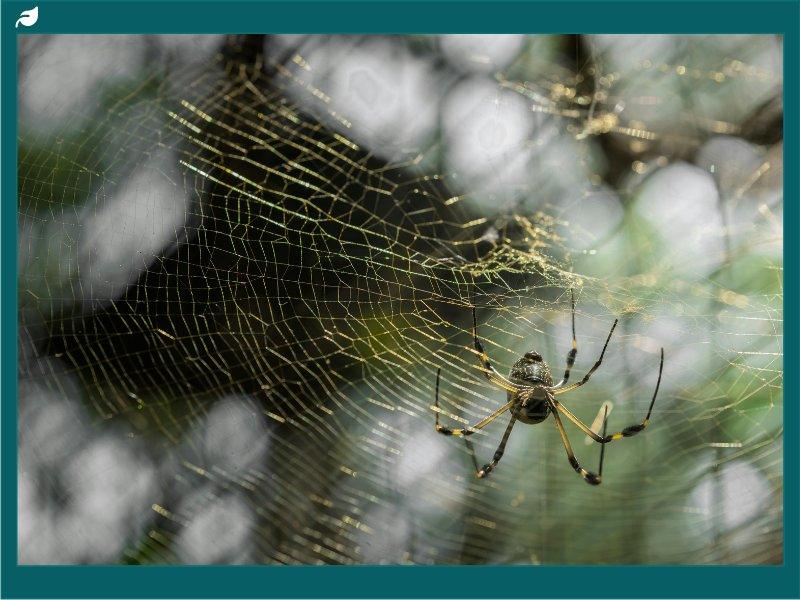
There’s a moment, hiking through a forest in Southeast Asia or Central America, when a shaft of light hits at the right angle and the whole web appears. It hangs there, golden and enormous, with a spider the size of your palm sitting at the center. It’s genuinely startling. And the more you learn about that silk, the more startling it gets.
Why Golden Silk Stands Out
The tensile strength of Nephila silk has been compared to high-grade steel on a weight-for-weight basis. That comparison gets repeated so often it risks becoming a cliche, but it’s rooted in real measurements. The silk stretches before it breaks, absorbing energy rather than transmitting it through the structure. When a large insect hits the web at speed, the orb doesn’t shatter.
It flexes, dissipates the impact, and holds. The insect is caught, the web survives, and the spider doesn’t have to rebuild from scratch. That matters enormously for an animal that invests significant energy and body resources into constructing a large web.
The spiral threads of the orb are coated with a sticky substance that grips prey on contact. But the radial threads, the spokes of the wheel, are dry and non-sticky. That distinction is deliberate. The spider moves along the radial threads when she approaches caught prey, avoiding her own trap.
The two silk types are produced by different glands and serve entirely different mechanical purposes. Golden orb weaver silk is not one material but a system.

The golden color of the silk has attracted specific scientific attention because it appears to be more than aesthetic. One hypothesis, supported by some field observations, is that the golden hue mimics the appearance of sunlight filtering through leaves. Insects navigating through dappled forest light may not register the web as an obstacle until they’re already in it. The web doesn’t look like a web.
It looks like the background. That’s a remarkable trick, achieved entirely through the optical properties of the silk itself.
There’s also evidence that the golden coloration may attract certain prey insects that are drawn to yellow tones, which some species associate with flowers. If that’s correct, the web is both camouflage and lure simultaneously. That kind of dual function is exactly the sort of thing that makes biologists excited and makes everyone else realize nature is considerably sneakier than it appears.
Beyond predation, the silk plays a structural role in the ecosystem. A large Nephila web, suspended between trees in a forest understory, intercepts flying insects on a scale that influences local populations. One spider catching dozens of insects per day over weeks adds up. In forests where Nephila are abundant, their collective predation exerts measurable pressure on insect communities.
The material science community has spent decades trying to synthesize spider silk or produce it at scale through genetic engineering, inserting silk-producing genes into bacteria, yeast, and even goats. Nephila silk has been a primary reference point for much of this work because of its combination of strength, elasticity, and light weight. Medical researchers are interested in its biocompatibility for sutures and scaffolding. Engineers want its tensile properties for textiles and armor.
None of the synthetic versions have yet matched the real thing completely, which is itself an interesting comment on how sophisticated biological production systems can be.
The golden orb weaver doesn’t think about any of this, of course. She just builds her web, repairs it when needed, and waits. The silk is what it is because it works. That’s the whole story from her perspective, and honestly, it’s a pretty good one.
Species Diversity within the Nephila Genus
Walk into a library and look up genus Nephila and you’ll quickly realize this isn’t a tidy, small group of closely related look-alikes. These spiders have diversified across continents and climates, picking up distinct traits along the way. Some are forest giants. Some are more modestly sized.
Some have markings that warn predators; others rely entirely on camouflage. The genus is a genuinely varied collection of animals, united by their silk and their orb-weaving habit but separated by millions of years of evolution in different environments.
Identifying Different Nephila Species
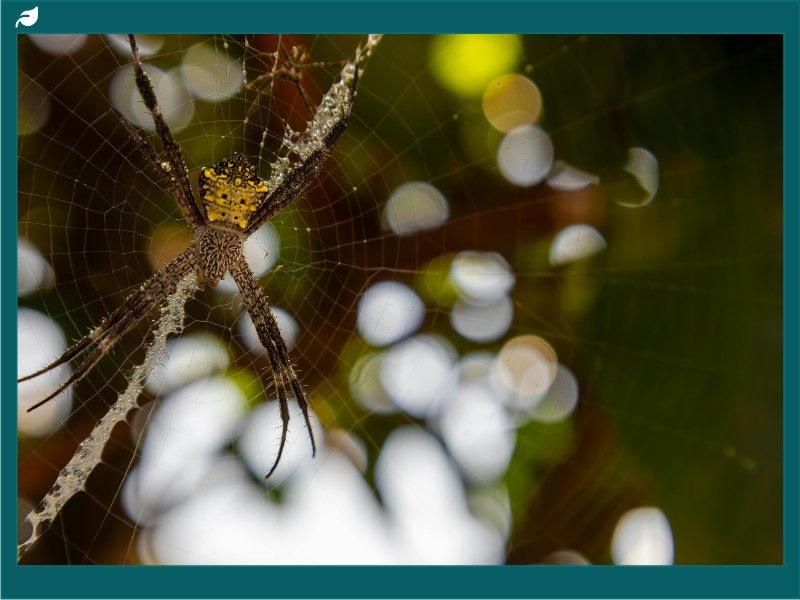
Nephila pilipes is probably the most frequently encountered large species in Asia, found across a range that includes India, China, Japan, Malaysia, the Philippines, Papua New Guinea, and Australia. Female pilipes are among the largest orb-weaving spiders in the world. Their abdomens are elongated and distinctively patterned, typically dark with yellowish markings, and the legs are long and banded. When you see a pilipes female on her web in a Southeast Asian forest, the scale of the animal is genuinely impressive.
Males are so much smaller that first-time observers sometimes assume they must be a different species entirely.
Nephila clavipes is the North and Central American representative, one of the few Nephila species found in the continental United States (mainly Florida and the Gulf Coast states) and ranging south through much of South America. Female clavipes have distinctive tufts of hair on their leg joints and a characteristic pattern of yellow spots on a dark abdomen. Their webs appear in forest edges, gardens, and parks, often at eye level or just above, which means encounters with humans are common. They’re not aggressive, and they’re not particularly dangerous to people, but an unexpected face-full of golden orb web at dawn is a memorable way to start a morning.
Nephila senegalensis and related African species occupy a different ecological context entirely, distributed across sub-Saharan Africa in habitats ranging from savanna woodland to coastal forest. African Nephila populations have been studied for their role in controlling agricultural pests, with some research suggesting that webs placed near crop fields may reduce insect damage. That’s an applied benefit that goes beyond the ecological.
The ancient species Nephila jurassica, known from the mid-Jurassic fossil record, helps place the entire genus in evolutionary context. At roughly 165 million years old, this fossil demonstrates that the orb-weaving habit, the large-female body plan, and presumably the silk production system were already established before the breakup of the supercontinents. The genus Nephila has simply persisted while entire orders of dinosaurs appeared and vanished. That’s staying power.
What all Nephila species share is the core formula: large females, small males, golden or golden-tinged silk, large orb webs in open or semi-open settings, and a primarily insectivorous diet. Within that framework there’s considerable variation in color pattern, preferred microhabitat, web placement height, and geographic range. Researchers use a combination of morphology and genetic analysis to distinguish species, and the taxonomy of the group has been revised multiple times as molecular tools have improved. Some species previously placed in Nephila have been moved to related genera, and ongoing work continues to refine our understanding of how many distinct species the genus actually contains.
Males across all Nephila species share the same general challenge: they need to approach a female who could easily eat them, mate successfully, and ideally survive to mate again. Different species have developed slightly different timing and behavioral strategies for managing this, but the fundamental tension is the same everywhere in the genus. It’s one of the more dramatic mating dynamics in the animal kingdom, and it’s driven directly by the female’s size advantage and her predatory reflexes.
What this species diversity tells us, broadly, is that the Nephila strategy works across a remarkable range of conditions. Tropical rainforest, subtropical scrub, African woodland, Pacific island forest: golden orb weavers have found a way to make a living in all of them. That’s not luck. That’s a body plan and a behavior set that are genuinely flexible, capable of tuning to local conditions without abandoning the core approach.
The genus Nephila earns its reputation.
Habitat and Distribution of Nephila Spiders
Golden orb weavers are, at their core, creatures of warm climates and open structure. They need somewhere to hang a large web, enough flying insects to make the investment worthwhile, and temperatures that stay above a certain threshold year-round. Tropical and subtropical environments provide all three, which is why the distribution of genus Nephila maps so neatly onto the tropics and the warmer subtropical zones on either side.
Preferred Environments and Geographic Range
The ideal Nephila habitat is a forest edge or a semi-open woodland where the canopy isn’t completely closed. Dense, dark understory doesn’t suit them as well as spots where light penetrates and insects fly through predictable corridors. Forest clearings, riverbanks, trail edges, garden borders: these are the places where you’re most likely to find a golden orb weaver web. The spider positions her orb to intercept the flight paths of insects moving between light and shade, which is both ecologically smart and geometrically elegant.
In Central America, Nephila species occupy humid forest edges and secondary growth, where the mix of disturbed and intact habitat creates exactly the kind of open-yet-sheltered structure they prefer. In Southeast Asia, Nephila pilipes is common in lowland forest, plantation edges, and gardens throughout the region. In Australia, populations occur in Queensland and the Northern Territory, again concentrated in areas with reliable warmth and abundant insect life. African Nephila species span an enormous latitudinal range across the continent, adapting to local vegetation structure while maintaining the same basic web-building and hunting approach.
What’s notable is how well these spiders tolerate human-modified environments. Nephila aren’t specialists that can only survive in pristine wilderness. They’ll build webs on the structural framework of a wooden building, under the eaves of a rural house, between fence posts at the edge of a farm. Urban parks with sufficient tree cover in warm cities regularly host golden orb weaver populations.
That said, wholesale habitat destruction does affect them. Intensive agriculture with heavy pesticide use reduces insect populations below the threshold needed to sustain large Nephila webs. Deforestation that removes all tree cover eliminates the attachment points for webs. Dense urbanization replaces open structure with surfaces that don’t support web construction.
So while Nephila are more adaptable than many spiders, they’re not indestructible. Their presence in a landscape tells you something useful about its condition.
The geographic limits of Nephila distribution are set largely by temperature. These spiders don’t tolerate sustained cold well. Their northern and southern range limits correspond roughly to the boundaries of reliably frost-free climates. Within those thermal limits, they’re constrained mainly by habitat structure and prey availability rather than any more specific environmental requirement.
That combination of thermal limitation and habitat flexibility explains the pattern you see on a global distribution map: a broad tropical and subtropical band, with populations concentrated where open forest structure and warm temperatures coincide.
Female Nephila, given their size and the energy they invest in large webs, tend to be more site-faithful than males. A female will occupy a productive web location for extended periods, rebuilding or repairing rather than relocating unless the site becomes truly unsuitable. Males range more widely, crossing open ground between webs in search of mating opportunities. This difference in movement patterns has implications for gene flow and local population structure, and it’s one of the reasons that studies of Nephila genetics across a landscape often show interesting patterns of connectivity and isolation.
Conservation of Nephila spiders, where it’s considered at all, usually comes in the form of habitat protection rather than targeted management of the spiders themselves. Protect the forest edge, maintain the insect community, avoid intensive pesticide use nearby, and the spiders generally look after themselves. They’re resilient animals with a long evolutionary history of adapting to change. What they can’t adapt to is the complete removal of everything they need.
Behavior and Lifestyle of the Golden Orb Weaver
A golden orb weaver doesn’t rush. She builds her web, takes her position at the hub, and waits. That patience is not passivity. It’s a finely calibrated energy budget.
She expends resources on silk production and web construction, then recoups those resources through predation. The web does most of the work. Her job is to be ready when it delivers.
That economy of effort, combined with the sheer engineering quality of the web, is what makes the golden orb weaver’s behavior so worth understanding in detail.
Web Construction and Hunting Techniques
Building a Nephila web is a multi-stage process that can take an hour or more, and it begins with a structural problem: how do you string a thread between two points that are separated by empty air? The answer is wind. The spider releases a fine silk thread and lets it drift until it makes contact with a surface on the other side of the gap. Once that bridge line anchors, she walks across it, reinforcing it with additional silk and using it as the foundation for everything that follows.
The radial threads come next, the spokes of the wheel radiating out from the hub. These are laid in non-sticky silk, because the spider needs to be able to move along them without getting caught in her own web. Once the radial frame is complete, she lays the spiral. This starts as a temporary scaffold spiral, also non-sticky, which guides the placement of the final capture spiral.
Then she goes back and replaces the scaffold with the real thing: sticky silk loaded with a viscous adhesive coating that grips insects on contact and holds them while the spider responds.
The hub, where she sits, is often reinforced with a denser mesh of silk and may have a stabilimentum, a zigzag band of thicker silk, in some species. The purpose of stabilimenta is still debated. They may warn birds away from flying through the web (birds hitting webs is a real problem for large orb-weaving spiders). They may attract prey insects.
They may make the spider harder to see against the web’s structure. Possibly all three. Nephila and related orb-weavers sometimes add decorations of dried prey remains or plant material to the web’s periphery as well, which may serve a camouflage function.
Once the web is operational, the spider’s hunting technique is almost entirely reactive. She monitors vibration through her legs, which are in contact with the radial threads at all times. A struggling insect creates a distinctive high-frequency vibration that differs from the low-frequency sway of the web in the wind, and the spider can locate the source accurately by comparing vibration intensity across different legs. She moves directly to the prey, bites it to inject venom, and then wraps it in silk to immobilize it completely before beginning to feed.
The wrapping process, sometimes called swathing, involves rotating the prey rapidly while extruding silk from the spinnerets, essentially creating a tight cocoon around it within seconds. This neutralizes any defensive capability the prey still has and preserves it for later consumption if the spider isn’t immediately hungry. Golden orb weavers often maintain a larder of wrapped prey hanging in the web, a food cache they return to between captures.
Large webs catch large prey. Nephila webs are documented to catch not just flying insects but occasionally small birds and bats that blunder into them, particularly webs built in flight corridors at dusk. The spider doesn’t necessarily eat these animals, since they may be too large or too difficult to handle, but the web’s strength is sufficient to hold them temporarily. Those incidents tend to get photographed and shared widely, which probably overstates how frequently it happens, but it does demonstrate the tensile capacity of the silk.
The female golden orb weaver also manages her web as a long-term structure rather than rebuilding from scratch daily the way many smaller orb-weaving spiders do. She repairs damaged sections, removes debris, and adjusts the web’s position as environmental conditions change. This maintenance approach makes sense given the energy cost of producing large quantities of golden silk. Why discard a functioning web when you can fix it?
Males on and around the female’s web behave very differently. They’re not building or maintaining anything. They’re watching, waiting, and occasionally stealing a small item from the web’s edge when the female is occupied. When a mating opportunity arises, the male approaches along the web’s periphery using movements designed to minimize the vibrations that might trigger the female’s predatory response.
Timing is everything. Approach during a feeding event and she’s distracted. Approach at random and the outcome is much less predictable.
Interactions between Nephila Spiders and Humans
People and Nephila have been sharing the same environments for as long as humans have lived in tropical regions, which is a very long time. The relationship has generated folklore, scientific discovery, practical applications, and more than a few startled hikers. It’s one of those human-wildlife interactions that’s almost impossible to be neutral about. You encounter a golden orb weaver web of the size Nephila produces and you have a reaction.
Most people do.
Cultural Significance and Conservation Efforts
In parts of Papua New Guinea and the Pacific Islands, Nephila webs have been used as fishing nets for small fish and insects. The silk is strong enough for this purpose, and the practice of collecting webs on frames bent from green wood has been documented across multiple island cultures. That’s not folklore. That’s applied materials science, developed empirically by people who understood the properties of the silk through direct experience long before any laboratory characterized them formally.
In various parts of Asia, golden orb weavers appear in folk traditions as symbols of patience, skill, and the rewards of careful preparation. The web as a metaphor for intricate planning or for the interconnectedness of things appears in storytelling traditions from China to Southeast Asia. The specific visual of a golden web catching the morning light is arresting enough to embed itself in cultural memory. In some Chinese traditions, spiders more broadly are considered lucky, and the conspicuous, visually striking Nephila web would have been hard to ignore as a symbol.
Modern scientific interest in Nephila silk has accelerated in recent decades. Researchers have inserted Nephila silk-producing genes into bacteria, yeast, and mammalian cell lines in attempts to produce spider silk protein at scale. The properties that make the silk interesting for materials science are the same ones that make the golden orb weaver’s web so effective: high tensile strength, significant elasticity, light weight, and biocompatibility. Medical applications under investigation include sutures, wound dressings, and scaffolding for tissue engineering. Engineering applications range from high-performance textiles to protective materials. None of the synthetic analogs produced so far have fully replicated the real thing, which continues to motivate research.
Conservation of Nephila depends almost entirely on habitat. These spiders don’t face the kinds of direct persecution that some larger, more dramatically dangerous animals do. People are startled by them, occasionally, but serious conflict is rare. The real threats are the background threats: deforestation, agricultural intensification, pesticide use that collapses insect populations, and urban development that converts suitable edge habitat into surfaces where webs can’t be built.
Addressing those threats means addressing land use at a scale much larger than any individual spider or web.
Community education has played a role in some regions. In areas where golden orb weavers occur in gardens and around houses, programs that explain the spiders’ ecological role (controlling insect pests, contributing to biodiversity) and their non-aggressive nature have helped shift public opinion from fear toward tolerance. That shift matters practically because people who aren’t afraid of a spider don’t destroy its web, and people who don’t destroy the web allow the spider to keep doing its ecological job.
The use of Nephila as bioindicators is a conservation tool that deserves more attention. If you’re trying to assess the health of a tropical forest edge or a secondary woodland, the presence and density of golden orb weaver populations gives you meaningful information quickly and inexpensively. You don’t need laboratory equipment. You need to walk the habitat and look for webs.
A landscape with abundant Nephila webs in good condition is a landscape with a functioning insect community and adequate structural complexity. One without them raises questions worth investigating.
Ultimately, the relationship between humans and Nephila spiders is one of long cohabitation. These animals live alongside us in tropical cities, farms, and forests, catching insects that would otherwise find their way into our homes and crops, building structures that have inspired both art and engineering, and demonstrating daily what a hundred and sixty-five million years of refinement looks like in practice. They don’t need much from us. Mostly they need us not to take everything away.
The golden orb weaver will keep building its amber web in the morning light, with or without our appreciation. But the more you understand about what it’s doing and why, the harder it is not to appreciate it.