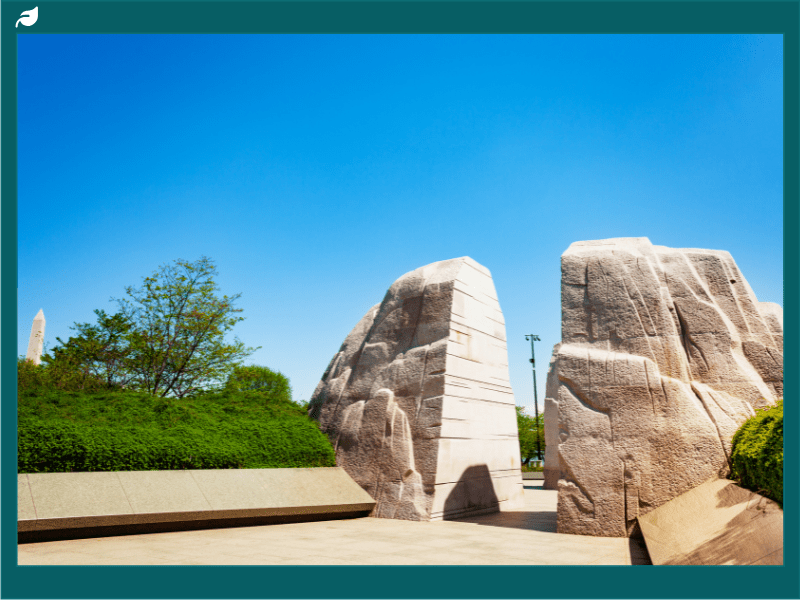
The 1963 March on Washington drew 250,000 people to the National Mall. His “I Have a Dream” speech landed in the national consciousness like a pressure wave, and it hasn’t dissipated.
The legislative results were concrete. The Civil Rights Act of 1964 banned discrimination based on race, color, religion, sex, or national origin. The Voting Rights Act of 1965 targeted the specific mechanisms southern states used to keep Black Americans away from the ballot box. These weren’t symbolic wins.
They rewrote American law.
Martin Luther King’s influence also crossed borders. International press covered the movement. World leaders took notice. The idea that a civil rights struggle inside one country could reshape global conversations about justice, that was new, and King helped make it happen.
Luther King Day each January is the annual reminder that this work came at enormous personal cost, and that the dream he described still hasn’t fully arrived.
Celebrating Martin Luther King Day in January
Martin Luther King Day falls on the third Monday of January each year. That’s the date to put in your calendar, and more importantly, the date to actually do something with. As a federal holiday, it carries weight beyond the day off. Communities across the country are planning events, and the range is wide enough that there’s genuinely no excuse not to participate in some form.
Ways to Honor the Legacy of Martin Luther King
Watching a documentary counts, but it’s a starting point, not a finish line. The most direct way to honor Martin Luther King Jr. on this day is to do something he would recognize: show up for someone else.
Service projects are the most common entry point. Food drives, neighborhood clean-ups, mentorship programs, all of these carry the practical spirit of King’s work forward. Educational workshops offer a different angle, particularly for people who want to dig into civil rights history with more depth than a school curriculum ever provided. There’s a lot of news and information out there, and not all of it is accurate.
Primary sources, speeches, court documents, contemporaneous press coverage, go there if you can.
Schools carry real responsibility on this day. Discussions, readings, and structured reflection give younger students a framework for understanding why Martin Luther King Jr. matters beyond the holiday name. Luther King Jr.’s teachings on equality and non-violence aren’t abstract.
They apply directly to the conflicts students see in the news every day. That connection is worth making explicit.
Sharing content online is fine. But pairing it with something tangible, a donation, a volunteer hour, a real conversation with someone whose experience differs from yours, that’s where the day earns its meaning.
Events and Activities Planned Nationwide
Parades run through major American cities every January. Atlanta, where King was born, holds one of the largest, anchored by the King Center’s annual King Holiday Observance and its commemorative service. Washington, D.C. hosts wreath-laying ceremonies and public addresses.
But the most interesting events are often local: community centers staging reenactments of King’s speeches, civil rights panels bringing together historians and activists, congregations holding interfaith services rooted in King’s theology of justice.
Media coverage expands significantly around the holiday. News programs air archival footage. Streaming platforms surface documentaries. Press outlets run long-form retrospectives.
All of that creates entry points for people who want more context.

Local volunteer coordinators often report their highest sign-up numbers of the year on Martin Luther King Day. That’s not a coincidence. King spent his career arguing that justice required participation, not just sympathy. The holiday activates something in people that stays dormant the other 364 days, and organizers have learned to channel it.
The Influence of Video Tributes in Modern Commemorations
Digital media has changed how communities honor Martin Luther King Jr. Video tributes, shared across social platforms and screened at public events, can reach audiences that a parade or a panel never will. Done well, they’re not just a recap of King’s greatest hits. They’re an argument for why his work still matters right now.
Creating Your Own Video Tribute
Start with solid information. Go to primary sources: King’s actual speeches, civil rights archives, verified historical footage. The American civil rights movement is well-documented, and authentic material is accessible. Using it correctly means your tribute will hold up to scrutiny, which matters if you want people to share it.
Build a storyboard before you touch any editing software. Decide what specific aspect of King’s legacy you want to communicate. His philosophy on non-violence? His opposition to the Vietnam War?
His economic justice work, which often gets less attention than the “I Have a Dream” speech? A focused tribute is more powerful than a general one.
Modern editing tools are genuinely user-friendly now. Add captions, because many viewers watch without sound. Choose music carefully, King’s movement had a soundtrack, and it’s worth honoring. Keep transitions clean and let the archival footage breathe.
Once it’s done, post it. Share it on community education portals, social media, local news channels. A tribute that sits on your hard drive helps no one. Martin Luther King Day works best when the information moves, when more people encounter King’s words and feel something shift.
That’s how his legacy stays alive: not preserved behind glass, but passed forward, year after year, January after January.