Pressure-compensating drippers and the small rubber part that gives every plant in a row the same share of water
Farming is by far the largest user of fresh water on the planet. According to the AQUASTAT Water Data Snapshot 2025 published by the Food and Agriculture Organization of the United Nations, agriculture accounted for 71 percent of global freshwater withdrawals in 2022, well ahead of industry and of the water that reaches homes and towns. Drip irrigation is one of the ways growers try to bring that share down, since it delivers water to the root zone instead of wetting the whole field, but the savings hold only as long as every emitter along a line releases roughly the same amount. Whether it does depends on a component that rarely gets a second look, the dripper itself, and on the way it handles the pressure of the water that reaches it.
From the pump to the drop
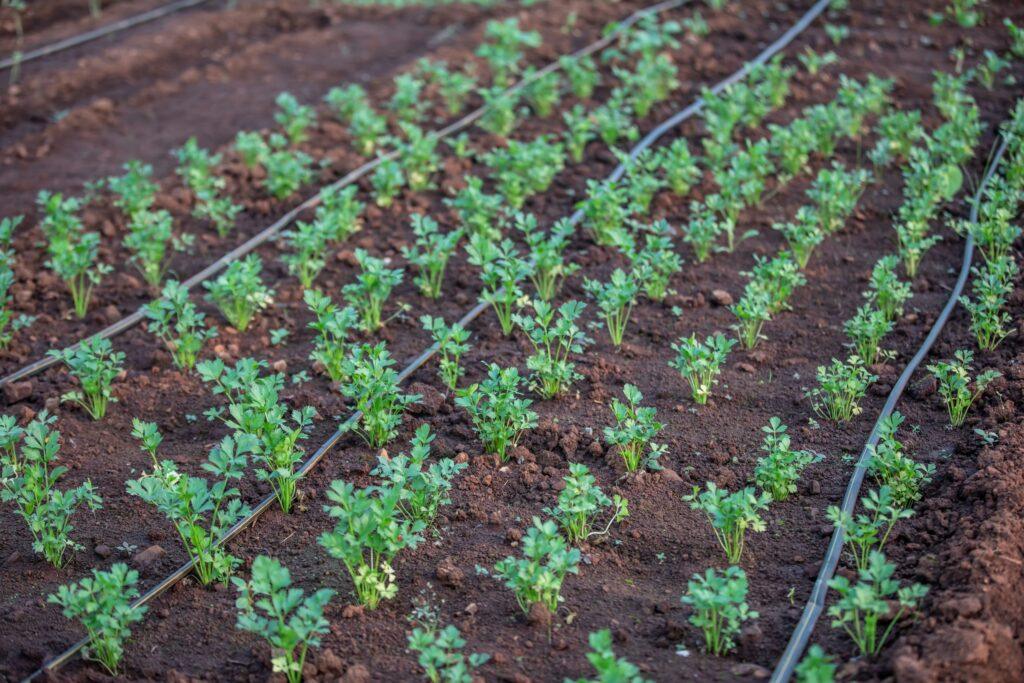
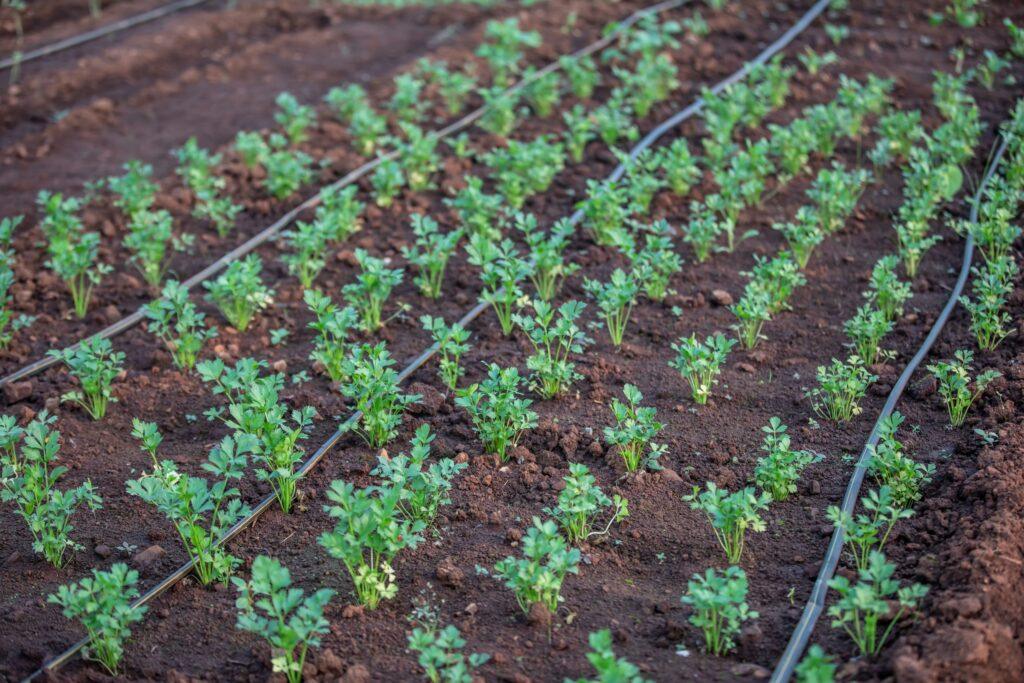
A drip system starts with water under pressure, pushed by a pump or supplied by a municipal or district network, which passes through a filter and often a pressure regulator before it enters the mainline. From there it branches into the laterals, the thin plastic tubes laid along each row, and finally reaches the emitters, small devices built into the tube or plugged into it at regular intervals. Each emitter has to turn water moving at several pounds per square inch into a slow, steady trickle at the base of a plant.
Ordinary emitters manage this with a long, narrow and often winding passage, in which the water loses energy as it rubs against the walls. The design is simple and inexpensive, yet the flow it delivers still rises and falls with the pressure at its inlet, so that an emitter that sees more pressure releases more water. On a short, flat bed the difference between the first dripper and the last one is small enough to ignore.
Why long rows and slopes call for compensation
The picture changes when the rows get longer or the ground is uneven. Water loses pressure through friction as it travels down a lateral, which means the drippers at the far end of a long run receive less of it than those near the inlet, while on a slope the water gains pressure as it flows downhill and loses it as it climbs. With ordinary emitters the plants at the low end of a field can end up waterlogged while those at the top go short, and a grower who extends the run time to reach the driest spot ends up overwatering everywhere else.
Pressure-compensating emitters were developed to break that link. Within their working range they hold a nearly constant flow whether the inlet pressure is high or low, so a whole block can be irrigated on the same schedule. Advisers at the University of California Cooperative Extension list pressure-compensating drip tape among the ways to manage elevation changes along a field, together with regulators that keep the pressure steady in each irrigation block.
It follows that the uniformity of an entire field, and with it a good part of the water that drip irrigation is supposed to save, rests on a component small enough to balance on a fingertip. In many compensating drippers, as in the inline flow regulators fitted to irrigation lines, the part doing the work is a disc or a membrane of rubber whose compound and shape have to match the housing it sits in, because a slightly stiffer or softer material would change the amount of water every plant receives. Designing those parts is a job for specialists in elastomers, the rubber-like materials used to control the movement of fluids, and among the makers of such flow controls is Vernay, whose catalog at vernay.com/products/flow-control-valves lists the nominal flow, outer diameter and material of each part, with samples available to order.
A piece of rubber that narrows as pressure rises
Vernay’s own description of its flow controls sums up the principle in a few lines. A flexible rubber component sits in a pocket in the flow path, and as the pressure increases the rubber deforms and the hole at its center gets smaller, so that the extra push of the water is offset by a narrower opening. The properties of the material and the shape of the part are what keep the rate of flow constant, and the company gives a typical useful pressure range of 20 to 120 psi, or 138 to 827 kPa.
Two details from the same description explain why these parts cannot simply be swapped from one product to another. Each control is designed to work with a specific pocket shape, which means the housing and the rubber are developed as a pair, while some very low rate controls, the ones used in drippers, rely on what the company calls a flat stock design. Its technical material also mentions membranes for self-compensating driplines among the uses of its rubber components in irrigation and water management.
Every compensating emitter also has a lower limit, which its manufacturer states and which varies from model to model. Below that pressure the rubber no longer deforms enough to regulate the flow, and the dripper behaves like an ordinary one, releasing less water as the pressure drops. For this reason whoever designs a system checks the lowest pressure expected at the end of the longest row against the minimum declared for the chosen emitter, since that is the point where compensation is most likely to give out.
Clogging, filters and the routine that protects the savings
A compensating emitter solves the pressure problem but does nothing about dirt. The passages inside a dripper are narrow, and sand, algae and mineral deposits can block them partly or completely, so that one plant gets nothing while its neighbors carry on as usual. A clogged emitter is hard to spot from a distance, and by the time a dry patch shows up in the crop the loss has already happened.
Extension guidance therefore places filtration at the head of every system and treats maintenance as part of irrigation itself. Material from the University of California Cooperative Extension recommends a regular schedule for cleaning and flushing the filters, flushing the lateral lines by opening their ends, and walking the system to look for leaks, clogged emitters and blocked filters. Its advisers also suggest checking and recording the pressure during every irrigation, because a reading that drifts away from the usual value is often the first sign that something has changed along the line.
A pressure gauge at the head of each block and another at the far end of the longest lateral cost little compared with a season of water. Comparing the two readings at the start of the season, and again whenever the crop looks uneven, is a quick way to confirm that every emitter is still working inside the range it was built for.
Frequently Asked Questions (FAQ)
What is a pressure-compensating drip emitter?
It is a dripper designed to release about the same amount of water across a range of inlet pressures. Inside, a flexible rubber part changes shape as the pressure rises and narrows the opening the water passes through, so the higher push is balanced by a smaller passage and the flow stays close to its rated value.
Are pressure-compensating emitters better than standard drippers for a home garden?
It depends on the layout. On short, level beds fed from a steady supply, standard emitters usually deliver an even enough flow and cost less. Where the lines are long, run up or down a slope, or the supply pressure changes during the day, compensating emitters keep the plants at both ends of the row on a similar ration of water.
How often should a drip irrigation system be flushed and its filter cleaned?
There is no single interval, since the right frequency depends on how much sand, organic matter and dissolved minerals the water carries. Well water and water drawn from ponds or canals generally call for closer attention than treated municipal supply. A practical habit is to flush the lines at the start of the season, clean the filter on a regular schedule, and check again whenever the pressure readings or the look of the plants change.