Introduction to Amazon River Dolphins
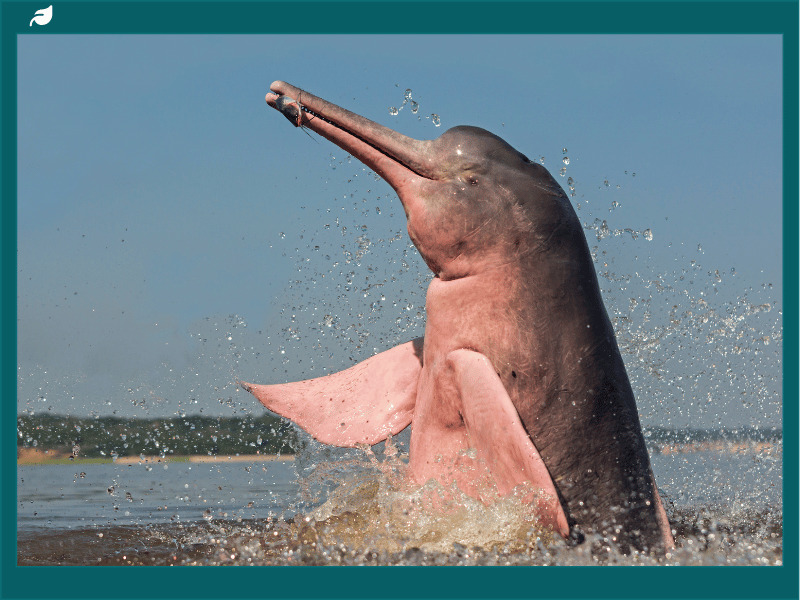
Picture a dolphin the color of bubblegum navigating a flooded forest, threading between tree trunks ten meters below the canopy. That’s not a fever dream. That’s Tuesday morning for the Amazon River Dolphin. Known to locals as the boto, this pink river dolphin is one of the strangest, most compelling animals on the planet, and it lives in a world most of us will never see: the dark, warm, sediment-thick waters of the Amazon and Orinoco river systems.
Unlike the sleek grey dolphins you’d spot off a coastline, these river dolphins have spent millions of years adapting to a completely different kind of water. Shallow, tangled, seasonally flooded, full of submerged trees and hidden prey. The result is an animal that looks different, moves differently, hunts differently, and carries an entire mythology on its pink back. Among the five freshwater dolphin species alive today, the Amazon dolphin stands out the furthest, and not just because of the color. riverdolphins.org reports that Amazon river dolphins have a significantly slower reproductive cycle than many mammals, with an average interval between births of 4.6 years, a statistic that contributes to their vulnerability when populations decline.
The intelligence, the flexibility, the ecological weight it carries: all of it earns a longer look.
Unique Characteristics of the Pink Dolphin
Start with the color, because everyone does, and because it genuinely demands it. Baby Amazon river dolphins are born grey. Dull, unremarkable, easy to overlook. But as they mature, something shifts beneath the skin.
Capillaries sit close to the surface, and repeated abrasion over years of active living wears the skin thinner. The result is that flush of pink, deeper when the animal is excited or warm, paler when it’s calm or cool. So the color is partly mood, partly age, partly temperature. A living blush.
But color is the least of it.
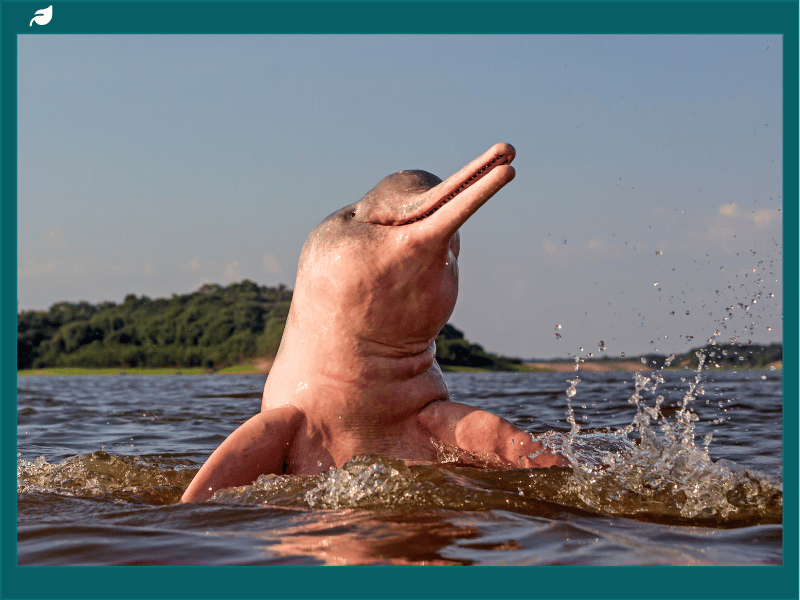
The anatomy of a pink dolphin is built for a world of obstacles. That long, narrow snout, almost beak-like, can probe under submerged roots and between rocks where fish hide. The pronounced forehead, the melon, focuses the echolocation clicks the dolphin fires into murky water to build a sound-picture of its surroundings. Visibility in the Amazon can be near zero.
These animals navigate and hunt almost entirely by sound. Their echolocation is extraordinarily refined, finely tuned to bounce off small fish concealed in sediment or tucked under a waterlogged tree in the Peruvian Amazon.
Here’s the thing that stops most people: the neck. Almost every dolphin has fused neck vertebrae. Rigid. Fixed forward.
The Amazon river dolphin does not. Its vertebrae are unfused, which means it can rotate its head up to 180 degrees sideways. Horizontal. It can look directly to its left while swimming forward.
In a maze of submerged forest, that flexibility is not a quirk. It’s a survival tool.
The boto also has a reputation among researchers for being what one field biologist memorably called a “cookie” of evolution: a creature that kept the useful ancestral traits most cetaceans discarded, like that mobile neck and broad pectoral fins, while layering on new adaptations for an obstacle-filled river. The combination reads as almost improvised, yet it works with remarkable precision.
And then there’s the role these dolphins play in holding the ecosystem together. As apex predators, they regulate fish populations across the river system. Pull them out of the equation and the food web wobbles. But their significance doesn’t stop at ecology.
In Amazonian communities, the boto occupies a place in the spiritual world that few animals anywhere in the world can match. Reverence, superstition, myth: all of it woven around this pink creature in the brown water.
Habitat and Distribution
The Amazon River Dolphin doesn’t live in one river. It lives in a system, a branching, flooding, seasonally shape-shifting network of waterways that spans multiple countries and millions of square kilometers. The Amazon and Orinoco rivers are the main arteries, but the dolphins push into tributaries like the Madeira River, into flooded forests during the wet season, into channels that don’t exist for half the year. They follow the water wherever it goes.
Exploring the Amazon River Ecosystem
The Amazon River is one of the largest river systems in the world by both length and volume, and it functions less like a single river than like a living circulatory system for an entire continent. During the wet season, it spills across floodplains that can extend for kilometers on either side of the main channel. Those temporary floodplains are hunting grounds. Fish spread out into the forest, and the river dolphins follow them in, threading between tree trunks, using their flexible necks and long snouts to root out prey in places no marine dolphin could ever reach.
The nutrient load in these waters is staggering. Runoff from the Amazon Basin feeds a fish diversity that supports not just dolphins but an entire pyramid of predators. The pink river dolphin sits near the top of that pyramid. What it eats, and how much of it, directly shapes the fish communities below.
That’s ecological leverage. It also makes the boto one of the clearest indicators scientists have for the health of the river itself. When the dolphins thrive, the system is working. When they struggle, something upstream has gone wrong.
And right now, things are going wrong in a number of places. Deforestation shrinks the floodplain habitat. Dam construction blocks migration routes and alters water temperature and flow. Pollution from agriculture and mining contaminates the fish the dolphins eat.
Behavior and Social Structure
Amazon river dolphins don’t school in the hundreds the way some marine species do. They tend toward smaller, more flexible groupings, pods that shift in size depending on food availability, season, and social dynamics. But smaller doesn’t mean simpler. The behavior within those groups is layered, communicative, and built on a sophistication that researchers are still working to fully map.
How River Dolphins Communicate
Click. Whistle. Pulse. The pink dolphin runs a repertoire of sounds that carries real information through water that would defeat vision entirely.
Each type of vocalization does a different job. Clicks, fired in rapid sequences, create the echolocation returns that tell a dolphin what’s in the water around it, the size, shape, and distance of a fish hiding under a muddy riverbed. Whistles function more like names. Individual dolphins develop signature whistles that others recognize, a way of saying “I’m here, it’s me” in a river where you can barely see two meters ahead.
Pulsed calls sit somewhere between the two, used in social contexts, during feeding coordination, during the establishment of who’s who within a pod. River dolphins hunting together need to communicate without tipping off their prey, and their vocalizations are precise enough to do exactly that.
The echolocation system deserves its own attention. These dolphins produce ultrasonic clicks that bounce off objects in the water and return information about position, texture, and movement. In the clear open ocean, a dolphin might rely partly on vision. In the Amazon, that’s not an option.
So the sonar has to be exceptional, and it is. It can detect a fish concealed beneath several centimeters of sediment, or pick out prey moving behind a submerged root in conditions of complete visual darkness.
Seasonal flooding changes everything about the social environment, and the dolphins adapt. Pods shift composition. New feeding areas open up. Temporary alliances form around productive patches of flooded forest.
The river dolphins don’t just tolerate this instability. They’re built for it. Their communication system is flexible enough to keep pace with a habitat that reinvents itself every year.
Conservation Status and Efforts
The Amazon River Dolphin carries an IUCN classification of Endangered, a designation that reflects decades of pressure from multiple directions at once. Conservation efforts exist, and some are making real progress, but the threats are numerous and they don’t wait for funding cycles.
Challenges and Threats to the Largest Freshwater Dolphins
The Amazon river dolphin is one of the largest freshwater dolphins in the world, and it belongs to the broader group of toothed whales, an evolutionary lineage that includes sperm whales and orcas. That lineage matters because it tells you something about the animal’s intelligence and social complexity. And it raises the stakes for what losing this species would mean.
Habitat destruction is the biggest driver of decline. Deforestation along river margins destabilizes banks, increases sediment load, and destroys the flooded forest habitat the dolphins use for seasonal feeding. Dam construction on the Madeira and other major tributaries fragments river systems that the dolphins once moved through freely. When you break a river into isolated sections, you break the gene pool too.
Pollution is the quieter threat, the one that doesn’t make headlines. Agricultural runoff carries pesticides. Gold mining releases mercury directly into river systems. That mercury moves up the food chain and concentrates in the large fish that river dolphins eat most.
Fishing pressure creates two separate problems. Overfishing reduces the prey base the dolphins depend on. And active fishing creates bycatch risk: dolphins caught in nets, sometimes accidentally, sometimes not. In some areas, dolphins have historically been killed for use as bait in commercial catfish fisheries, a practice that conservationists have worked hard to reduce but that has not disappeared entirely. Neotropical Marine Mammal Fund reports that recent field assessments in the Colombian Amazon have preliminarily confirmed that the death of river dolphins in the Tarapoto Lakes is directly caused by entanglement in fishing nets placed across channels during the low-water season, a specific human-induced threat recently documented.
The response to all of this requires more than one lever. Protected river reserves matter. Sustainable fishing regulations matter. Pollution controls matter.
So do the community-level awareness programs that bring local fishers and indigenous communities into the conservation process rather than around it. The dolphins are culturally significant to those communities. That’s an asset, not a complication, and the best conservation efforts treat it that way.
Cultural Significance in Local Communities
Ask someone along the upper Amazon about the boto, and you’ll get a story before you get a biology lesson. These pink dolphins have lived in the imagination of Amazonian communities for as long as anyone can remember, occupying a space somewhere between animal and spirit.
Folklore and Traditions Surrounding the Amazon River Dolphin
The most famous story goes like this: at night, the boto transforms. It takes the shape of a handsome young man, dressed in white, hat covering the blowhole it can’t quite hide, and walks into riverside villages. It seduces, it charms, and by morning it’s gone back to the water. Children born without a clear father are sometimes attributed to the boto.
This isn’t just colorful local detail. It’s a reflection of how deeply the dolphin is embedded in the social and spiritual fabric of communities that have lived alongside the Amazon river for centuries. The boto isn’t just an animal to these communities. It’s a presence.
Some traditions hold that harming a boto brings bad luck, illness, or worse. That belief has historically offered the dolphins a layer of protection that no regulation could manufacture.
Festivals along the Amazon river celebrate the boto directly, with dances and performances that frame the dolphin as a symbol of the river’s power and mystery. In these contexts, the dolphin functions as a cultural ambassador for the entire ecosystem, a way of saying that this river is alive, that it matters, that it deserves protection. Conservation programs that understand and work within this cultural framework tend to get further than those that ignore it.
The tradition also carries an implicit environmental message. Many of the stories emphasize respect for the river and its creatures. The boto’s supernatural status discourages casual harm. That’s a form of ecological stewardship, informal, unwritten, but functional across generations.
Comparisons with Other Aquatic Mammals
The pink dolphin of the Amazon shares a family tree with the largest animals on Earth. Both river dolphins and whales are cetaceans, descended from land mammals that returned to the water roughly 50 million years ago. But the environments they returned to could not be more different, and those environments have pulled their biology in completely opposite directions.
Differences Between River Dolphins and Whales
A sperm whale navigates open ocean. It dives to depths of over 1,000 meters, uses echolocation across vast ranges, and travels thousands of kilometers in a single season. The Amazon river dolphin navigates a flooded forest. It threads between tree trunks, rotates its head sideways to check under roots, and hunts fish in water so murky that vision is functionally useless.
Same ancient lineage, radically different outcomes.
The bodies show it. Whales, especially the large baleen species, have evolved toward size and streamlining for distance travel in open water. River dolphins went the other direction: smaller, more flexible, with that unfused neck and the elongated snout shaped for tight quarters. The pronounced melon on a river dolphin is larger relative to body size than in most whales, because the echolocation demands of a turbid, obstacle-filled river are higher than those of open ocean.
Social structure differs too. Many whale species form stable, long-term family groups with complex hierarchies and vocal cultures passed across generations. Toothed whales like sperm whales have been documented with regional dialects in their click patterns. River dolphins tend toward smaller, more fluid social groups that reconfigure around seasonal changes in their habitat.
Stability isn’t a luxury the Amazon river affords.
Ecologically, the roles these animals play are scaled to their environments. A blue whale feeding in the Southern Ocean influences nutrient cycles across hundreds of square kilometers through its movement and its waste. An Amazon river dolphin regulates fish populations in a localized river system, but with consequences that ripple through everything that depends on those fish populations, from smaller predators to the fishing communities that depend on the river for food.
What both groups share is a signal function. Healthy whale populations indicate healthy oceans. Healthy river dolphins indicate healthy river systems. In both cases, when the apex animal at the top of the food chain is declining, the ecosystem beneath it is under stress.
The Amazon river dolphin’s status as an endangered species is not just a conservation concern for one animal. It’s a reading of the health of one of the world’s most important freshwater systems, and right now, that reading demands attention.