Synthetic fuels produced from renewable electricity are gaining attention as industries search for ways to reduce emissions without replacing existing infrastructure. Known as e-fuels, these fuels are created by combining green hydrogen from water electrolysis with captured carbon dioxide.
Research from IDTechEx indicates that while biofuels will dominate near-term supply, large-scale production of e-fuels will be needed if aviation and maritime sectors are to reach net-zero targets by 2050.
The analysis appears in the report “Sustainable Biofuels & E-Fuels Market 2026–2036: Technologies, Players, Forecasts.” According to IDTechEx, early investment in technology development and commercial projects will be required if production is to scale during the next decade.
e-Methanol Leads Early Development
Among the various e-fuel pathways, e-methanol is currently the most mature. Production reached a milestone in 2025 when Mitsui and European Energy launched what they describe as the world’s first commercial-scale e-methanol facility in Kassø, Denmark.
The plant has a production capacity of 42,000 tonnes per year. This development places e-methanol ahead of other electrofuels such as e-kerosene or e-methane in terms of commercial readiness.
The fuel can serve as a drop-in replacement for conventional methanol in existing markets. It is also attracting interest as a marine fuel option, particularly as shipping companies face increasing pressure to reduce emissions.
Global production capacity is expected to increase rapidly. Several projects capable of producing hundreds of thousands of tonnes annually are already under construction, many of them located in China.
China’s Position in the e-Methanol Supply Chain
China holds a strong position in the global methanol industry and could play a major role in the expansion of electrofuel production. The country already leads in conventional methanol production and consumption.
It is also the largest producer of green hydrogen, which forms the main feedstock for electrofuels. Electrolyser manufacturers such as PERIC and Sungrow have already built manufacturing capacity exceeding 3 GW.
This combination of existing methanol infrastructure and hydrogen production capacity places China in a strong position to scale e-methanol output. The fuel could be used domestically to support national decarbonisation goals or exported to markets such as Europe where demand for low-carbon fuels is increasing.
e-SAF Technologies Under Development
While e-methanol is leading early deployment, much of the current project pipeline is targeting e-SAF, or synthetic aviation fuel. Aviation remains one of the hardest sectors to decarbonise due to the energy density required for long-distance flight.
A number of technical pathways are under development. These include improvements in reverse water gas shift reactors, new methods for generating synthesis gas, and redesigned Fischer-Tropsch reactors.
Companies such as Velocys and INERATEC are working on compact microchannel Fischer-Tropsch reactors designed to increase efficiency and reduce plant size. At the same time, UK-based OXCCU has developed a catalyst capable of converting captured carbon dioxide and green hydrogen into jet-range hydrocarbons in a single step.
Some developers are taking a different route by producing methanol first and then converting it into aviation fuel through a methanol-to-jet process.
IDTechEx forecasts that large-scale production of e-SAF will begin to expand after 2030 as technology matures and policy support strengthens.
Progress and Challenges for e-Methane
Another electrofuel pathway under development is e-methane. Production can take place through thermocatalytic or biological methanation processes, both of which have already been demonstrated commercially at smaller scales.
Many projects are linked to existing biogas and biomethane facilities. By supplying additional green hydrogen to the methane and carbon dioxide generated from anaerobic digestion, operators can increase methane output by around 60 percent compared with standard biogas upgrading.
Current facilities remain relatively small. The largest operational plants produce roughly 1,000 tonnes of e-methane annually. Companies such as TES and Ren-Gas are planning larger facilities that could expand production capacity in the coming years.
Electrofuels and the Automotive Sector
Electrofuels have also been discussed as a potential option for road transport. In practice, electric vehicles offer much higher energy efficiency than synthetic fuels.
Even so, many vehicles currently on the road still rely on liquid fuels. Electrofuels such as e-diesel and e-gasoline could provide a drop-in alternative for existing engines as the global vehicle fleet transitions away from fossil fuels.
Early electrofuel projects have focused on this segment. Facilities such as HIF’s Haru Oni plant and Infinium’s Pathfinder project are producing fuels intended for road transport. Companies including Porsche and Amazon have supported these efforts as part of voluntary initiatives to develop low-carbon fuel alternatives.
Policy Expected to Shape Market Growth
Government policy is likely to play a central role in determining the scale of future electrofuel production. At present, most regulatory support is focused on aviation and maritime sectors rather than road transport.
In the European Union, new legislation has already introduced specific targets for synthetic aviation fuel. The ReFuelEU Aviation regulation requires at least 1.2 percent of jet fuel supplied at EU airports to be e-kerosene by 2030. This requirement rises to 35 percent by 2050.
A similar approach exists in maritime transport. The FuelEU Maritime framework sets a two percent sub-target for renewable fuels of non-biological origin beginning in 2034.
These mandates are expected to stimulate demand for electrofuels in sectors where direct electrification is difficult.
Market Outlook
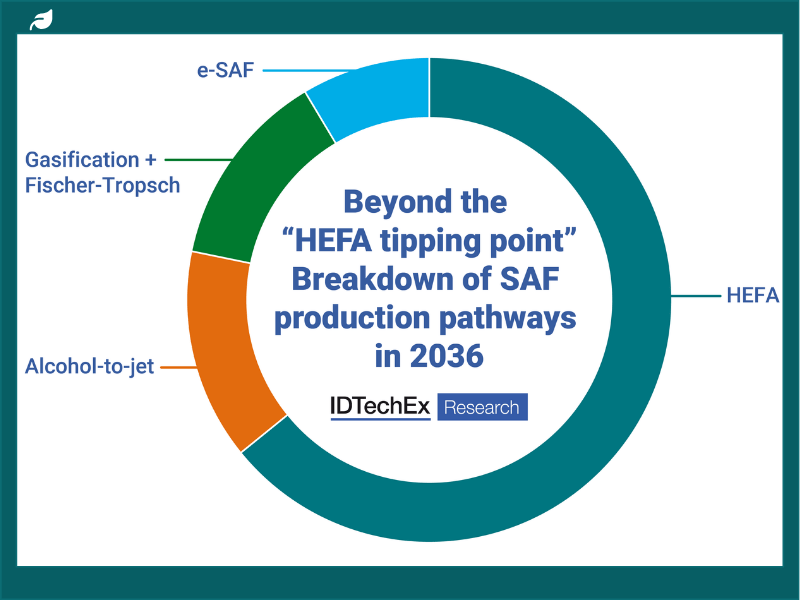
Electrofuels remain more expensive than several alternative pathways for low-carbon fuels, including hydroprocessed esters and fatty acids (HEFA) and alcohol-to-jet processes. These options are expected to dominate supply in the near term due to lower costs.
Feedstock limits may restrict the long-term expansion of biofuel production. According to IDTechEx, this constraint could increase the need for electrofuels during the 2030s as aviation and shipping industries seek deeper emission reductions.
The report forecasts that e-SAF could account for around nine percent of global aviation fuel production capacity by 2036. Continued progress in electrolyser manufacturing, carbon capture, and fuel synthesis technologies will be required if the sector is to reach that scale.