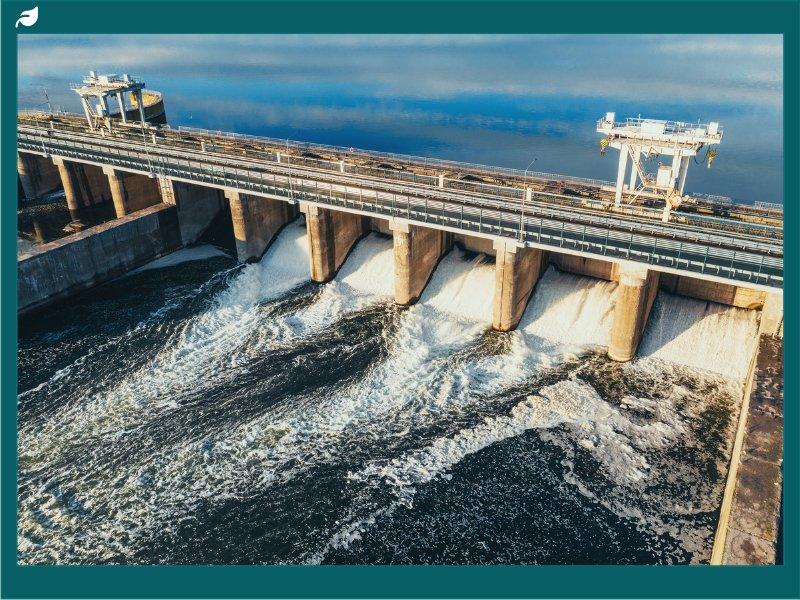
Over the next few decades, the hydropower industry is expected to grow exponentially.

Hydropower’s Carbon Footprint
Undoubtedly, the environmental benefits of hydropower far outweigh fossil fuel alternatives. However, like most alternative energy sources, hydropower also produces a carbon footprint. This is incurred through manufacturing, construction and operation processes.
While there are some hydropower facilities which have pledged to become carbon neutral, such as Iceland’s Landsvirkjun, on average, the Intergovernmental Panel on Climate Change (IPCC) states that hydropower has a median greenhouse gas (GHG) emission intensity of 24 gCO₂-eq/kWh. By comparison, the median figure for coal is 820 gCO₂-eq/kWh.
By 2050, Hydropower Capacity Needs to Double
The need to mitigate this carbon footprint somewhat intensifies when considering the huge role hydropower is set to play in supporting a net zero emissions by 2050 pathway (in line with The Paris Agreement).
According to the International Energy Association’s (IEA) ‘Net Zero by 2050’ Roadmap (revised version 2021), the required growth of hydropower is colossal – with the capacity needing to ‘double by 2050’. This would position the industry as ‘[…] the third-largest energy source in the electricity mix by 2050.’
Modernising Aging Plants
One way of increasing hydropower capacity is by, what the IEA describes as ‘modernising ageing plants’. According to their Roadmap, between now and 2030, USD 127 billion – or almost one-quarter of global hydropower investment – will be spent on modernising ageing plants.
According to the IEA, in regards to these ‘ageing plants’, in North America, the average hydropower plant is nearly 50 years old and in Europe, the average is 45 years old.
The report goes on to say how: ‘These ageing fleets – which have provided affordable and reliable renewable electricity on demand for decades – are in need of modernisation to ensure they can contribute to electricity security in a sustainable manner for decades to come.’
How Industrial Coatings and Composites can Extend the Lifespan of Hydropower Assets

Industrial protective coatings and epoxy repair composites play a fundamental role in ‘modernising ageing plants’. In turn, this supports the decarbonisation of the hydropower industry.
Through the investment of this polymeric technology, aged assets can be repaired, protected and improved for the long term. Thus, this process successfully helps to mitigate the carbon footprint of hydropower facilities as it breathes new life into assets that would otherwise be decommissioned, replaced or sent to landfill.
Companies such as Belzona, (established in 1952) have a comprehensive range of protective coatings and repair composites that have been used in the hydropower industry for decades as a means of improving the efficiency and performance of hydropower assets.
Specified for rebuilding damage and restoring efficiency in areas such as turbines, wicket gates and turbine casings, the epoxy paste, Belzona 1111 (Super Metal) and composite repair polymer, Belzona 1311 (Ceramic R-Metal), can be deployed (based on the level of erosion resistance required).
The two-part epoxy coating, Belzona 1341 (Supermetalglide), can increase the efficiency of fluid handling equipment, such as pumps, by up to 7% on new equipment and up to 20% on refurbished equipment.
In a study carried out by Leeds University, it was found that when compared to polished stainless steel, Belzona 1341 (Supermetalglide) was 15 times smoother
For areas that are particularly subjected to high levels of cavitation, such as Kaplan turbine blades, the two-part polyurethane resin, Belzona 2141 (ACR-Fluid Elastomer), can be deployed. This system offers an outstanding level of protection against cavitation at ultra-high velocities (up to 115 knots with no damage).
Belzona’s portfolio of polymeric systems can be specified in the following application areas, amongst others: turbines, penstock gates, generators, spiral casings, draft tubes, transformers, powerhouses, control valves, dams, stilling basins and spillways.
Carbon Footprint Mitigation
Investment in industrial protective coatings and epoxy repair composites can significantly increase the lifespan of key hydropower assets. As a result, this supports more sustainable operations within hydropower facilities and, therefore, helps to mitigate the carbon footprint of the industry.