Meet the Sand Crab: A Small Creature With a Big Job
Every time a wave pulls back off a beach, something in the sand is already at work. It isn’t a fish, and it isn’t a shellfish stuck in one spot waiting for the tide to bring dinner. It’s a sand crab, and by the time the water has settled, it has already flipped itself over, dug back in, and started catching its next meal.
Scientists call it Emerita. Most people just call it a sand crab, and once you know what to look for, you’ll spot them everywhere the surf meets soft sand. These are small, egg-shaped creatures, usually light gray, and despite the name they’re completely harmless. You won’t get pinched picking one up. Wikipedia) notes that Emerita sand crabs can bury themselves completely in about 1.5 seconds, moving tail-first into the sand as they disappear from view.
What you will get, if you watch closely, is a front-row seat to one of the more efficient survival acts on any beach. In Tasmania, sand crabs are a prize catch for anglers who use them as bait. Along the California coast, they’re something else entirely: a subject serious enough that citizen scientists and researchers have built a long-running monitoring program around them. Both stories matter, and both start with the same small crab.
How Sand Crabs Live and Move
Forget the idea that a beach is a static strip of sand. For a sand crab, it’s a moving target, and its whole life is built around chasing it. Sand crabs live in the intertidal zone, the stretch of shoreline that’s underwater one minute and exposed the next, and everything about their behavior follows the tide’s rhythm. They need constant contact with oxygen-rich water, so rather than picking one spot and defending it, sand crabs migrate up and down the beach face as the tide rises and falls, always keeping themselves in the sweet spot between the waves.
Soft sand is the key to their whole strategy. It lets them burrow fast, in a matter of seconds, ducking below the surface the moment a shadow, a bird, or a curious hand comes near. That same shifting sand also hides them from the sun and from predators during the hours they’re not actively feeding. Low tide is prime time for a sand crab. Related sand crabs in the family Albuneidae are obligate diggers as adults, according to the Journal of Coastal Research, meaning they conceal themselves completely in sand and leave no visible traces on the beach surface.
Feeding is where sand crabs really show their engineering. They don’t hunt anything. Instead, as a wave recedes, a sand crab extends a pair of feathery antennae into the water, straining out plankton and organic particles as the backwash flows over it. It’s filter feeding, plain and simple, done a few inches from the surface of the sand with the whole ocean doing the delivery work.
That constant filtering also makes sand crabs a genuine link in the coastal food chain, pulling energy out of the water column and passing it up to the birds, fish, and other predators that hunt them in turn.
Their numbers rise and fall with the seasons too. Warmer months tend to bring more food, and populations of sand crabs can swell noticeably when conditions are right, turning a quiet stretch of beach into a genuinely busy little ecosystem. Even their reproduction is timed to the tide: females release their larvae in sync with tidal cues, giving the next generation the best possible conditions for dispersal. None of this is dramatic to watch, but it adds up to a small animal doing an outsized amount of ecological work every single day, and it’s a big part of why researchers keep coming back to study them.
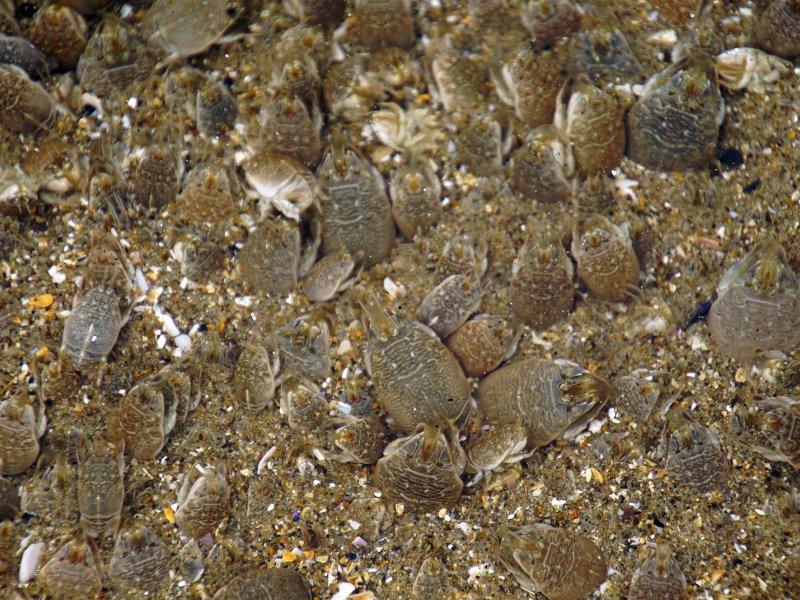
It’s also worth saying plainly that sand crabs are harmless. You can find them tucked under sandy rocks or working the surf zone where the sand stays soft, and picking one up carries none of the risk you’d expect from a crab. That combination, harmless to handle and constantly active, is exactly what makes them such an approachable subject for both anglers and citizen scientists alike.
Fishing for Sand Crabs on Tasmania’s Shores
Fishing for sand crabs in Tasmania is a different pursuit from most bait hunting, and it rewards patience over brute force. You’re not standing at the water’s edge with a rod. You’re reading the beach itself, watching for the telltale flash of a pink-hued shell as a wave pulls back, and moving in before the crab has time to vanish. Identifying that shell color against wet sand is half the skill, and the rest comes down to knowing which stretch of beach to work and when.
Gear and Technique That Actually Work
Start with the basics: a net with fine mesh, since anything coarser lets small crabs slip straight through, and a sturdy bucket to keep your catch alive and undamaged until you’re ready to use it. Some Tasmanian anglers go a step further and use drop nets, which sit on the sea bed and get hauled up at intervals. Drop nets are especially effective on medium-sized crabs that tend to hide under small sand dunes or forage just offshore, out of easy reach of a hand net.
Where you fish matters as much as what you fish with. Shallow, calm stretches of water tend to hold the most activity, since that’s where sand crabs are searching for food or moving along their tidal migration path. Timing counts too. Early morning and late afternoon are the hours most Tasmanian anglers swear by, when sand crabs are at their most active and least wary.
A little bait scattered near your net, bread or scraps of raw fish, will draw them out of hiding faster than waiting alone ever will.
The rest is observation. Stillness and patience beat speed every time, because a sand crab that senses movement will burrow and disappear before you get near it. Watch for that quick shimmer of a pink-hued shell under the rippling shallows, and you’ll start to read the beach the way experienced anglers do. Done well, catching sand crabs in Tasmania is as satisfying as it is sustainable, a low-impact way to interact with a coastline that rewards close attention.
LiMPETS: The Long-term Monitoring Program for Sand Crabs
While Tasmanian anglers are chasing sand crabs for bait, researchers along the California coastline are chasing something different: data. LiMPETS, the Long-term Monitoring Program for Sand Crabs, brings scientists, educators, and students together to track a species that’s easy to overlook but surprisingly important. Sand crabs function as one of the keystones of the coastal ecosystems they inhabit, and by putting ordinary volunteers to work counting and measuring them, LiMPETS turns a small, unglamorous crab into a genuine early warning system for the health of the shoreline.
What the Program Contributes to Marine Biology
The program’s strength is consistency. Its volunteers monitor sand crab populations year round, which is what lets researchers actually see change happening rather than guessing at it after the fact. Field identification is part of the training: sand crabs are light gray, some carry distinctive dark orange oval eye patches, and certain individuals show two distinctive red markings that make quick visual identification possible even for a first-time volunteer. Far from being the aggressive creatures the name might suggest to someone who’s never seen one, sand crabs are gentle, and their real value lies in what their numbers can tell researchers.
Shifts in abundance or distribution can point to pollution, climate change, or other stress on the coastline long before those problems are obvious anywhere else. That data has real weight. LiMPETS reports feed into peer-reviewed research and inform the policy decisions that shape coastal management along the California coast. The program also tracks the reproductive behavior of female sand crabs, giving scientists a window into breeding patterns and how environmental change is affecting the next generation before population declines become visible on the surface.
Engaging With Marine Life Through LiMPETS
What makes LiMPETS different from a typical research project is who’s doing the counting. Instead of restricting fieldwork to professional biologists, the program opens its doors to students and volunteers and hands them the same tools researchers use. That decision does two things at once: it multiplies the amount of data LiMPETS can collect, and it builds a generation of people who understand their local shoreline because they’ve spent real hours crouched over it.
Training Students to Do Real Science
For students, the training is hands-on from day one. They learn to identify sand crabs by their physical markings, measure water temperature, and record habitat conditions with the same rigor a professional researcher would use. They’re taught to track population patterns and connect what they’re seeing on the beach to bigger questions: is this drop in numbers pollution, a shift in climate, or just a normal seasonal dip? Answering that takes practice, and LiMPETS builds that practice directly into the curriculum rather than leaving it to a textbook.
The payoff goes beyond the data sheet. Students who spend a season measuring sand crabs come away with sharper critical thinking and a direct, personal stake in what happens to their coastline afterward. That’s the quiet aim behind the whole program: not just better numbers, but better stewards.
What Recent Sand Crab Monitoring Has Found
LiMPETS’ latest reporting shows real progress in understanding how sand crab populations are shifting over time. Cataloging those changes, month by month and year by year, is how the program catches the early signs of trouble: a drop in numbers on one stretch of beach, a shift in where crabs are concentrated, a change in breeding timing among female sand crabs. Each of those signals, tracked carefully enough, points back to a cause, whether that’s pollution, warming water, or another pressure on the habitat.
Community involvement is what makes this scale possible. By training students and everyday citizens rather than relying solely on paid researchers, LiMPETS has extended its reach across long stretches of coastline that a small professional team could never cover alone. Every report the program publishes adds another data point to a growing picture of coastal health, and every volunteer who collects that data walks away more invested in protecting it.
That combination, rigorous science paired with public participation, is why LiMPETS reports carry weight in coastal management decisions. They give policymakers something concrete: real trends, tracked over real time, gathered by people who live near the coastline they’re studying.
Two very different relationships with the same small animal, then: in Tasmania, sand crabs are bait, chased across the sand with a net and a bucket. In California, they’re data, tracked meticulously by students and scientists working side by side. Both depend on the same thing, a healthy, functioning shoreline, and both, in their own way, keep people paying attention to it. Whether you’re hunting sand crabs at dawn on a Tasmanian beach or logging their numbers on a California monitoring sheet, you’re taking part in the same quiet, ongoing relationship between people and the coast.