
Meta description: Administrative overload is driving burnout and turnover among pediatric therapy providers, and children and families pay the price. Here is how better billing and authorization workflows help.
Featured image · key figures
A child with autism, a speech delay, or a motor disorder can make real progress when the same trusted therapist shows up week after week. When that therapist leaves, the progress often stalls. One of the least discussed causes of that departure is not the work with children at all. It is the paperwork that follows it.
For organizations thinking seriously about social sustainability, the stability of the people who deliver care is a core measure of whether a service can last. In pediatric therapy, that stability is under strain.
A Workforce Running on Empty
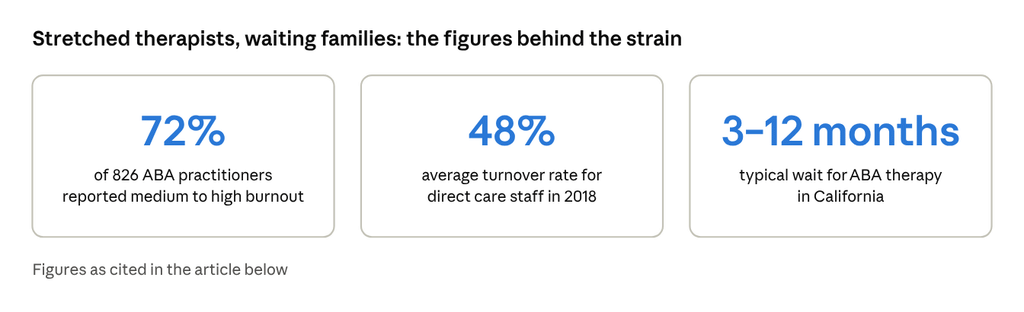
The scale of burnout in applied behavior analysis (ABA), one of the most common therapies for autistic children, is striking. In a peer-reviewed study of 826 ABA practitioners, 72% reported medium to high levels of burnout. The same research notes that the average turnover rate for direct care staff in 2018 was 48%. More recent industry reporting suggests the picture has not improved. CentralReach’s 2025 market report found ABA organizations averaging annual turnover between 77% and 103% in 2024, with mid-size and enterprise clinics seeing the highest rates.
Pay and difficult caseloads matter, but they are not the whole story. Industry analysis has found that board-certified behavior analysts spend an average of 46% of their workweek on reporting, documentation, and other administrative work. A separate provider survey found that 61% of BCBAs say administrative burdens interfere with their ability to provide care. These figures come from software vendors, so they deserve some caution, but they point in the same direction as the peer-reviewed findings: the more time clinicians lose to administration, the closer they get to leaving.
Why Billing Sits at the Center
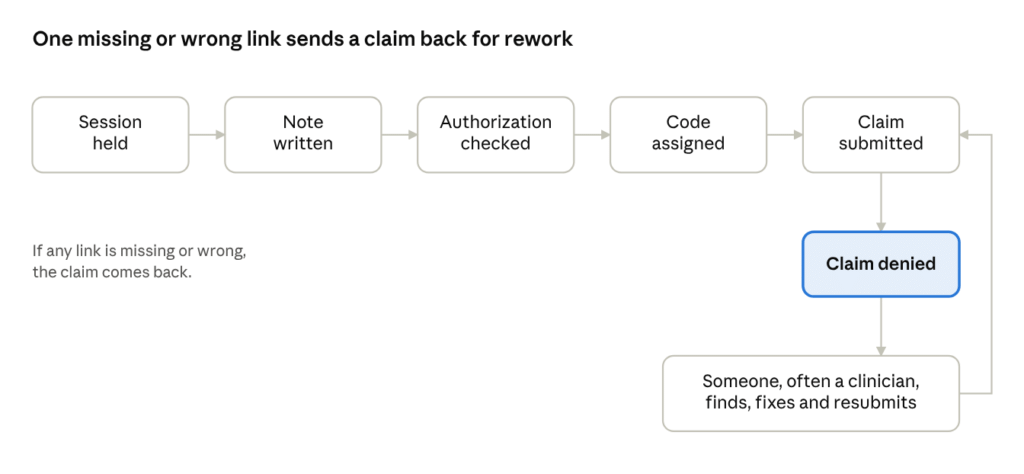
Administrative work is not one task. It is a chain of handoffs. A session happens, a note is written, an authorization is checked, a code is assigned, and a claim is submitted. If any link is missing or wrong, the claim is denied and someone, often a clinician, has to chase it.
Billing chain · where a claim gets sent back
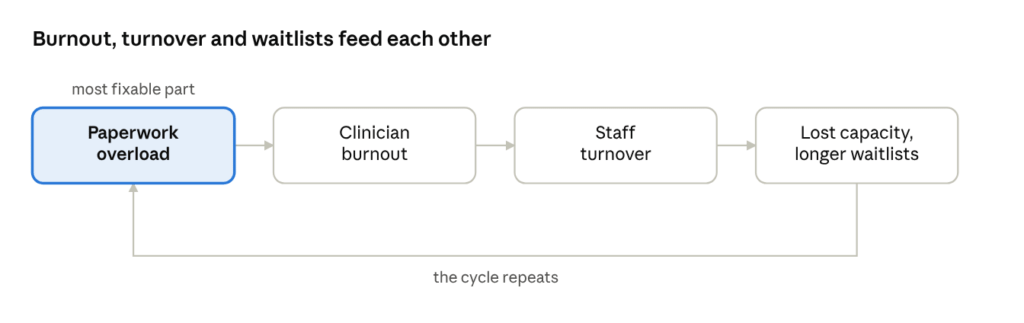
When clinicians are consumed by administrative tasks, they have fewer chances for the coaching, modeling, and feedback that support junior staff, which can contribute to higher turnover and reduced continuity of care. In other words, a billing problem becomes a training problem, then a retention problem, then a care problem.
This is why more providers are separating clinical work from claims work. Some of the clearest improvements come from assigning authorization tracking and claims follow-up to dedicated billing staff rather than to the clinicians delivering therapy. One practice-management analysis recommends that prior authorization workflows be owned by administrative or billing staff, not BCBAs. Smaller and mid-sized clinics often cannot hire a full in-house revenue team, which is where outsourced ABA billing services can take over the claim cycle so that clinical staff can concentrate on children.
The Cost of Churn Falls on Children
Turnover is expensive for organizations. One industry estimate puts the cost of replacing a single ABA therapist at $15,000 to $25,000, counting recruiting, onboarding, and lost productivity. That figure comes from a vendor blog rather than a formal study, but even a conservative reading shows why retention is an economic issue as well as a human one.
The more important cost is harder to price. High turnover in ABA means lost continuity for families, fractured therapeutic relationships, and delays in reaching goals. For young children, for whom early intervention matters, interruptions are not a minor inconvenience.
An Access Problem Hiding in the Back Office
Staffing and administration also shape who can get care at all. Families already face long waits. In California, wait times for ABA range from about three to 12 months, and in rural areas where few providers work, some families wait years. The American Academy of Child and Adolescent Psychiatry points to workforce shortages, long waitlists, and restrictive insurance policies as barriers to timely care.
When therapists leave, clinics lose capacity. When claims are denied or authorizations lapse, sessions get interrupted or delayed. Reducing back-office friction will not solve a national shortage, but it can help each clinic keep more of the staff and appointment slots it already has.
The burnout, turnover and waitlist cycle
What Sustainable Administration Looks Like
For provider organizations, the practical lessons are modest but concrete:
- Measure the burden. Ask clinicians how many hours a week go to non-clinical tasks. The answer is often higher than leadership assumes.
- Move claims work off clinicians’ desks. Use dedicated billing staff or an experienced billing partner for claims and authorization follow-up.
- Catch problems upstream. Flag expiring authorizations and incomplete documentation before a claim is submitted, not after it is denied.
- Treat retention as a service metric. Track turnover and caseload continuity alongside revenue.
None of this replaces fair pay, supervision, or manageable caseloads. It does remove a source of daily strain that has little to do with why people enter this field.
Conclusion
Pediatric therapy is a sector where the quality of care depends on the durability of relationships. Burnout, turnover, and waitlists are not separate problems. They feed each other, and administrative overload is one of the most fixable parts of the cycle. Providers who give clinicians their time back are protecting more than their bottom line. They are protecting the children and families who depend on them.