Climate commitments spent the last decade living in glossy PDF reports and Q4 marketing campaigns. The next decade will move them somewhere far less visible but far more powerful: inside the code that runs our businesses.
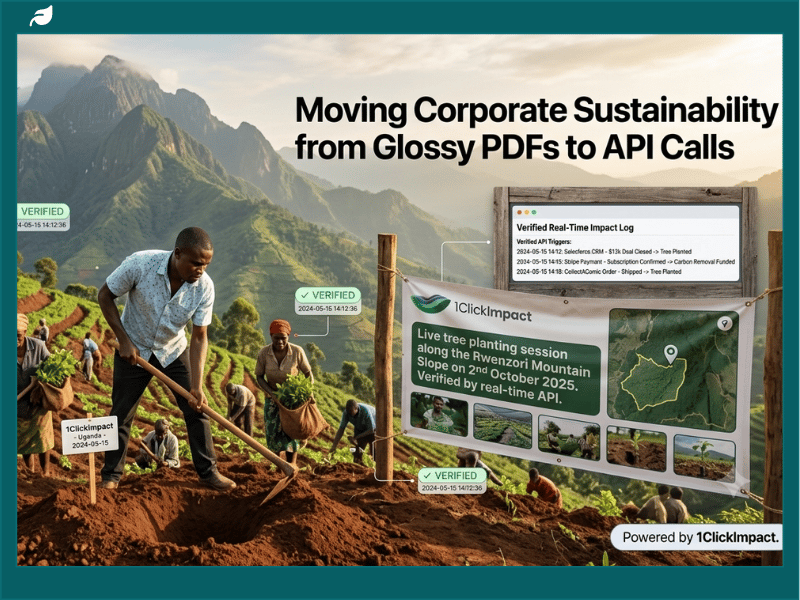
Climate action has historically suffered from a delivery problem. For years, corporate sustainability lived in its own silo usually managed by marketing teams or dedicated sustainability departments drafting annual ESG reports. But a quiet shift is happening. Sustainability is moving out of the boardroom and directly into the automated workflows that run businesses day-to-day. Until recently, embedding tangible environmental or humanitarian action into a company’s operations required bespoke engineering, complex multi-party legal agreements, and fragmented reporting tools. Today, a new infrastructure layer known as “Impact-as-an-API” is changing the game. It allows any business to trigger a verified, planet-positive outcome from any tool in its existing tech stack – be it a CRM, a billing platform, or a simple automated workflow.
The Infrastructure of Micro-Impact
Platforms like 1ClickImpact sit at the center of this shift. By combining a single REST API with native automation tools like Zapier, these services allow organizations to connect day-to-day business triggers to real-world outcomes. The mechanics are entirely familiar to modern operational teams; the only difference is the destination. Instead of an automated trigger simply updating another row in a database, it accomplishes something tangible:
- Sales: A closed Salesforce deal triggers a tree planting.
- Marketing: A new HubSpot lead triggers a food donation.
- Finance: A paid Stripe invoice funds verifiable carbon removal.
- Operations: A five-star review triggers an ocean plastic cleanup.
This model removes almost all historical friction. A subscription SaaS company can plant a tree every time a user signs up. A consulting firm can fund a meal when an invoice is settled. A digital agency can offset a client engagement the moment the contract is digitally signed. None of this requires custom development only an existing workflow and an API call.
Moving Beyond “Greenwashing”
This technical evolution arrives at a critical cultural and regulatory junction. Modern stakeholders – from Gen Z consumers to B2B procurement teams running strict ESG questionnaires – increasingly distrust broad, sweeping corporate pledges. Furthermore, impending regulations like the EU’s Green Claims Directive and tightening standards in the UK and US are forcing organizations away from vague annual disclosures and toward auditable data. The takeaway is clear: The most credible sustainability stories are no longer the loudest ones. They are the most precise. Per-action, per-transaction impact is inherently defensible. When every meal donated or kilogram of plastic removed is bound to a specific timestamp and a specific operational event, greenwashing becomes incredibly difficult to pull off.
Sustainability as a Side-Effect
We are already seeing this play out across diverse sectors. For example, a highly rated collectibles and comic retailer CollectAComic in Tennessee automatically fires a tree-planting action from its order pipeline every time a package is shipped. Other businesses have wired impact actions directly to internal milestones like triggering reforestation projects during monthly payroll runs or tying carbon removal to software releases. The broader implication is that sustainability is finally leaving the marketing department. It is becoming core infrastructure – a natural side-effect of doing business rather than a separate program competing for a slice of the quarterly budget. As regulation tightens and verifiable evidence becomes the baseline expectation, the organizations that win won’t just be those with the biggest sustainability budgets. They will be the ones that have wired impact directly into their automation layer.
Climate action no longer needs a department. It needs an API key.