Sustainable kitchen cabinets are not defined by one material or one green label. A credible assessment asks whether the installed system can remain useful, be repaired, document its emissions and material grade, and separate into recoverable parts at the end of service. Those five tests expose more than a vague “eco-friendly” claim.
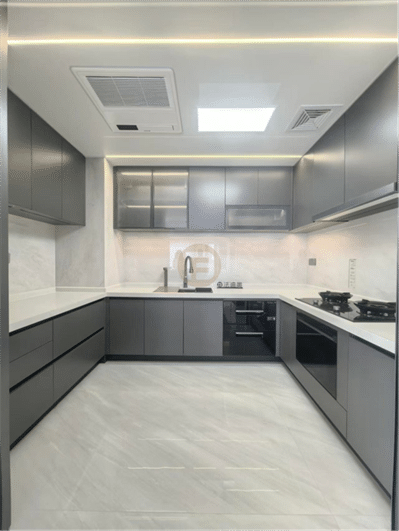
This completed kitchen is part of a 280 sqm whole-home 304 stainless steel cabinetry installation in Foshan, China. Photography courtesy of Fadior Home.
The distinction matters because cabinetry is an assembled product, not a raw material sample. Doors, bodies, shelves, coatings, hinges, runners, lights, sealants and installation details may have different service lives and different end-of-life routes. A renewable input can still be difficult to repair. A highly recyclable metal can still perform poorly if the assembly is short-lived or cannot be separated. A low-emitting panel does not establish that every coating and adhesive in the room has the same profile.
Circular-design guidance from the Ellen MacArthur Foundation therefore focuses on keeping products and materials in use at their highest value for as long as possible. It explicitly connects that goal with repairability, upgradability, reuse, remanufacture and recycling. The practical question for a kitchen is not “Which material sounds greenest?” It is “What evidence shows that this particular system can deliver those outcomes?”
Why a green label is not a complete answer
Environmental labels can be useful when their scope, issuer and test method are clear. They become misleading when a claim about one component is presented as proof for the whole cabinet.
| Marketing phrase | Evidence a buyer should request | What the evidence does not prove by itself |
| “Long-lasting” | Written warranty, replaceable-part policy, exposure limits and installed references | The exact future lifespan of one kitchen |
| “Low-VOC” or “formaldehyde-free” | Product-specific test report identifying the tested panel, coating or adhesive | That every material in the assembled cabinet has been tested |
| “Recyclable” | Material identification, separation method and a realistic local recovery route | That the product will actually be collected and recycled |
| “Stainless steel” | Grade, applicable material standard and order- or batch-level traceability | That fabrication, hardware, seals and installation are suitable for every environment |
| “Sustainable wood” | Chain-of-custody details, panel composition, emissions evidence and repair plan | That a wood cabinet always has a lower whole-life impact than a metal cabinet |
The table is deliberately material-neutral. Product-specific life-cycle assessment can support a comparison, but broad claims such as “steel is always greener” or “wood is always greener” are not defensible without aligned boundaries, service assumptions and data.
Test 1: expected service life under real kitchen conditions
The first sustainability test is whether the cabinetry is likely to remain functional and wanted. Replacement consumes materials, transport and installation again, so a longer useful life can change the whole-life calculation. It cannot be assumed from a material name.
Start with the conditions the installed system will face: water near sinks, cleaning chemicals, heat and steam near appliances, humidity, salt exposure in some coastal locations, loaded drawers and repeated hardware cycles. Then ask what part is expected to fail first and whether that part can be replaced without discarding the cabinet body.
The industry association worldstainless reports that stainless steel products remain in use for more than 20 years on average. That is useful material-level context, not a promised lifespan for a Fadior cabinet or any other kitchen. A cabinet’s service life also depends on fabrication, finish, hardware, seals, junctions, installation, cleaning and whether replacement parts remain available.
Useful procurement evidence includes:
1. separate warranty terms for cabinet bodies, doors, finishes, hinges, runners and lighting;
2. documented cleaning and exposure limits;
3. a parts list with expected availability;
4. completed installations that can be inspected; and
5. a written process for repairing local damage without replacing an entire run.
Test 2: repairability and design for disassembly
A durable cabinet that cannot be opened, adjusted or repaired can still become premature waste. The second test is therefore architectural: how do components come apart?
The European Commission’s Joint Research Centre describes repair as an effective strategy for extending product lifetime and is developing repairability requirements and scoring methods under the Ecodesign for Sustainable Products framework. The Commission’s 2025–2030 working plan identifies both furniture and steel among priority product groups and also calls for horizontal measures on product repairability.
For cabinetry, repairability is visible in ordinary details. Hinges and runners should be identifiable rather than anonymous. Service panels should remain accessible. A damaged door, shelf or drawer should be removable. Lighting drivers should not be buried behind permanently bonded surfaces. Mechanical fasteners can make separation easier than assemblies in which unlike materials are inseparably glued together.
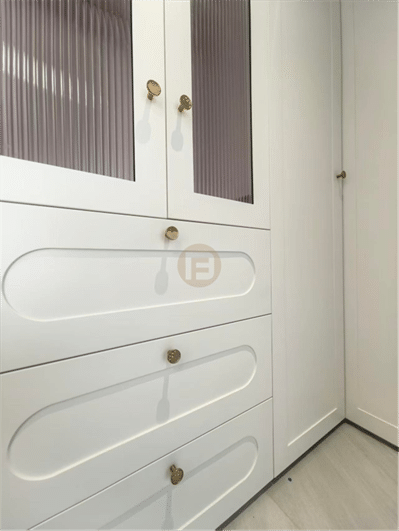
Doors, drawers, glass and hardware are separate service questions even when they form one visual composition. Photography courtesy of Fadior Home.
Before ordering, ask the supplier to mark replaceable parts on the shop drawings and identify which operations require a specialist. “Repairable” should mean more than the theoretical possibility of cutting a cabinet apart.
Test 3: indoor-air evidence for the complete material schedule
The third test concerns what is brought into the home. In the United States, the Environmental Protection Agency regulates hardwood plywood, medium-density fibreboard and particleboard under the formaldehyde standards for composite wood products. The agency explains that these products bind wood strands, particles, fibres, veneers or boards with adhesives and are commonly used in furniture and kitchen cabinets.
That rule provides a useful verification model: identify the product, the applicable limit, the test or certification body, and the label or production record. It does not justify claiming that all compliant wood products are unhealthy. Nor does choosing a metal cabinet body justify calling the entire kitchen “zero emission.” Paints, lacquers, sealants, adhesives, insulation, worktops and accessories require their own evidence.
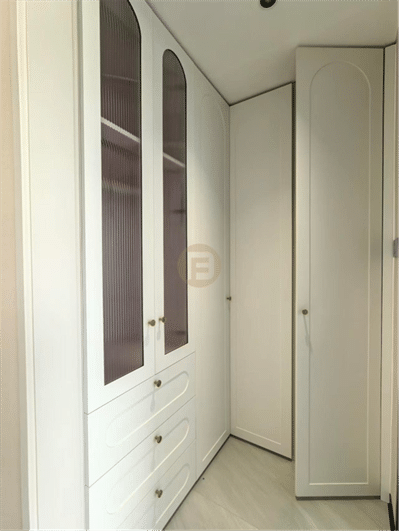
A finished cabinet combines a structural body with surface finishes, glass, hardware and installation materials; each needs the right evidence boundary. Photography courtesy of Fadior Home.
A responsible low-emissions review asks for a room-by-room material schedule and product-specific documentation. The schedule should distinguish the cabinet body from doors, decorative panels, edge treatments, coatings, adhesives and sealants. If a supplier uses phrases such as “formaldehyde-free” or “low-VOC,” the buyer should ask exactly which item was tested and whether the result applies to the supplied specification.
Test 4: traceable material and grade claims
The fourth test is whether a material claim can be traced beyond a showroom label. “Stainless steel” describes a family, not one universal grade or performance level.
Outokumpu’s grade overview estimates that 304 accounts for about half of stainless steel use and attributes its broad adoption to a combination of corrosion resistance, weldability and formability. The same source warns that another grade may offer better value for a specific application and that selection requires planning and expertise.
ASTM A240/A240M-26 is an active specification covering chromium and chromium-nickel stainless steel plate, sheet and strip for general applications, including architectural, building and aesthetic uses. Its public scope describes chemical-composition and mechanical-property requirements. Referring to a standard is useful only when the supplied material and documentation are actually connected to it.
A buyer should request:
· the stated grade for each structural steel component;
· the material standard used in the purchase specification;
· mill or supplier documentation that can be connected to the order;
· the thickness and finish schedule where these affect the design; and
· a clear list of components that are not stainless steel.
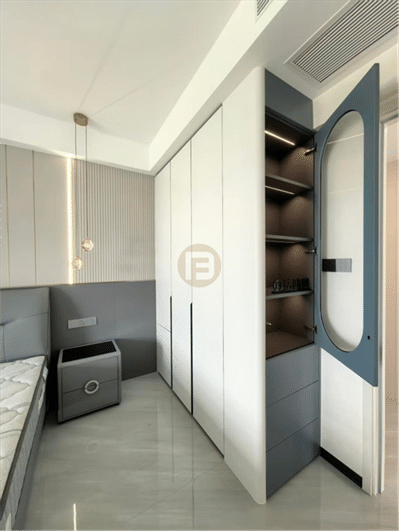
The visible white and blue-grey finish does not reveal the substrate or its grade; those facts belong in the specification. Photography courtesy of Fadior Home.
Traceability does not make a cabinet impact-free. It makes the claim auditable and gives the designer a basis for reviewing suitability.
Test 5: a credible end-of-life route
The fifth test begins before manufacture: can the materials be identified and separated when the kitchen is eventually altered?
Worldstainless states that around 95% of end-of-life stainless steel is collected and recycled globally, and that new stainless steel contains around 48% recycled scrap on average. Those figures describe the global stainless-steel material stream. They are not a product-specific recycled-content certificate, a recovery guarantee for one cabinet, or a life-cycle assessment of this home.
High recovery rates become more relevant when parts can reach that stream. Mixed assemblies, inaccessible fasteners, permanently bonded layers and missing material information can reduce practical recovery. A circular procurement package should therefore record the main materials, how they are joined, what can be reused, and who can take the components back or process them locally.
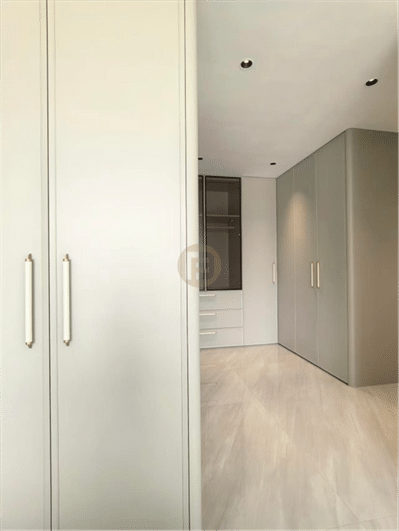
Repeated modules may support selective replacement, but photographs alone cannot establish how components separate or where they will be recovered. Photography courtesy of Fadior Home.
The preferred hierarchy is usually to keep the installed product useful, then repair or adapt it, then reuse components, and only then recover materials. Recycling matters; it should not be used to excuse a short-lived design.
A completed-home example: what evidence can and cannot show
Fadior’s Tianyue Shui’an case in Foshan, China, documents a 280 sqm private residence with whole-home 304 stainless steel cabinetry. The public completed-home record lists the living room, kitchen, primary bedroom, wardrobe, walk-in closet, study and children’s room within the delivered scope. Fadior’s Real Homes definition distinguishes these photographed, handed-over residences from renders and design studies.
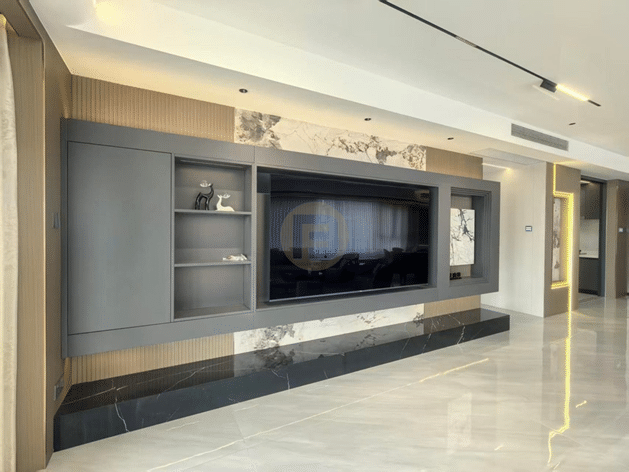
A full-height media wall extends the cabinetry system beyond the kitchen. Photography courtesy of Fadior Home.
The photographs support a narrow but useful observation: one documented cabinet-body material can accept different visible treatments and functions across a home. Slate grey, cream, white, sage, taupe and powder pink prevent material consistency from becoming visual repetition. Integrated desks and display areas show how a fitted system can respond to changing rooms.
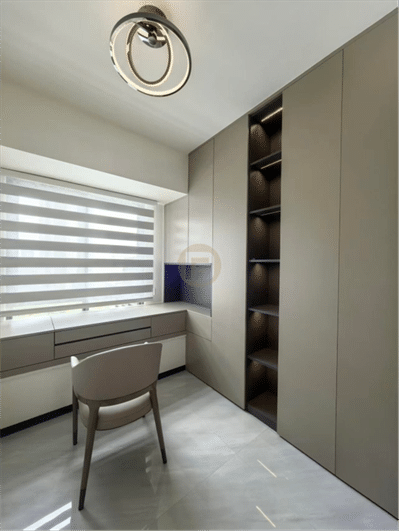
The study integrates storage, a desk and lighting within the recorded whole-home scope. Photography courtesy of Fadior Home.
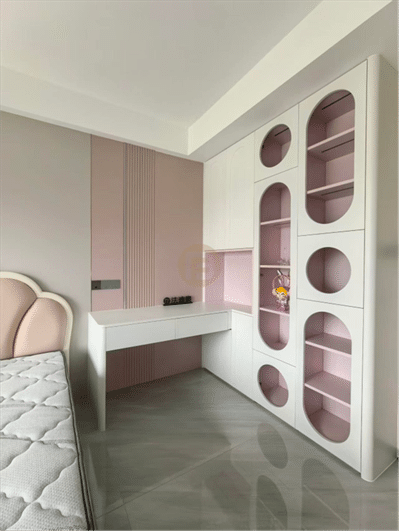
The children’s room changes colour and form while remaining within the same delivered cabinetry programme. Photography courtesy of Fadior Home.
The case does not establish years of service, independent batch testing, maintenance cost, occupant satisfaction, disassembly time or recovered material at end of life. Those outcomes require later records and product-specific evidence. The project is included as first-party evidence of delivered scope and adaptable design, not as proof that every sustainability test has already been passed.
A five-test procurement scorecard
The following scorecard can turn sustainability language into comparable questions. It is a decision aid, not a certification.
| Test | Strong evidence | Warning sign |
| Service life | Component warranties, exposure guidance, references and a parts policy | One lifetime claim covering every component |
| Repairability | Identified hardware, accessible services, replaceable modules and disassembly details | Permanently bonded mixed assemblies with no parts record |
| Indoor air | Complete material schedule and product-specific tests or certifications | One panel certificate presented as proof for the entire room |
| Traceability | Grade, standard, order-linked records and clear exceptions | Generic “premium stainless” or “eco material” language |
| End of life | Material identification, separable parts and a realistic local recovery route | “Recyclable” with no separation or collection plan |
No single row should cancel the others. A sound decision considers all five, records the unresolved items, and compares alternatives on the same functional scope and expected service period.
Questions to ask before signing the cabinet order
6. Which components are expected to last as long as the cabinet body, and which are routine replacement parts?
7. Can doors, drawers, hinges, runners, lights and service panels be removed without destroying adjacent components?
8. Which exact products have emissions evidence, and which coatings, adhesives or sealants fall outside it?
9. What grade, standard and order-linked records support the stainless-steel claim?
10. Which parts could be reused, and how would the remaining materials enter an actual local recovery route?
11. Which claim is backed by a product-specific life-cycle assessment, and which is only material-level context?
These questions make it possible to compare timber, composite wood, stainless steel and hybrid systems without granting any material an automatic environmental victory. They also shift attention from a marketing adjective to the design and evidence needed for a longer-lived kitchen.
In the completed Foshan home, Fadior demonstrates how a specified 304 stainless steel cabinetry platform can support different rooms and finishes. The next sustainability step is documentation: link the installed system to service, repair, emissions, traceability and end-of-life records over time.
Frequently asked questions
What are sustainable kitchen cabinets?
Sustainable kitchen cabinets are systems assessed across their useful life, not products defined by one material claim. Relevant evidence covers expected service life, repairability, indoor-air emissions, material traceability and realistic reuse or recovery at end of life.
Are stainless steel kitchen cabinets sustainable?
They can have useful durability and recovery characteristics, but the answer depends on the complete product and its context. Grade, recycled content, fabrication, replaceable parts, finishes, transport, service life and actual end-of-life route all matter. Global stainless-steel recycling data is not a product-specific life-cycle assessment.
Are wood cabinets more sustainable than stainless steel cabinets?
There is no universal answer. A fair comparison needs the same cabinet function, location, expected service period and life-cycle boundaries, plus product-specific data for sourcing, manufacture, emissions, repair, replacement and end of life.
Does “zero formaldehyde” mean a cabinet has zero emissions?
No. The phrase may apply to one panel, resin or tested component. Coatings, adhesives, sealants and other materials require separate evidence. Ask for a complete material schedule and the scope of each test report.
What documents should a buyer request?
Request the full material schedule, applicable test reports and certifications, grade and material-standard records, component warranties, maintenance guidance, replaceable-parts list, disassembly information and any product-specific environmental declaration or life-cycle assessment.
EVIDENCE APPENDIX
Sources and project evidence — retain with the publishable article
12. Ellen MacArthur Foundation, We need to radically rethink how we design — circular-design principles, repairability, upgradability, reuse, remanufacture and recycling.
13. European Commission Joint Research Centre, Product Repairability — repair as a product-lifetime-extension strategy and the repairability-scoring policy context.
14. European Commission, Ecodesign for Sustainable Products and Energy Labelling Working Plan 2025–2030 — furniture and steel priority groups and planned horizontal repairability measures.
15. US Environmental Protection Agency, Frequent Questions for Consumers about the Formaldehyde Standards for Composite Wood Products Act — regulated composite-wood types, cabinet use, emissions standards and certification context.
16. Outokumpu, 304 — The Trusted Figure — prevalence, material properties and application-specific grade-selection caveat.
17. ASTM International, ASTM A240/A240M-26 — active stainless plate, sheet and strip specification scope and requirements context.
18. worldstainless, Recycling — industry-level service-life, recovery and recycled-scrap figures; not product-specific Fadior data.
19. Fadior Home, Cream 304 Stainless Steel Kitchen Cabinets and a Charcoal Media Wall — project location, 280 sqm area, recorded cabinetry scope, spaces and after-handover images.
20. Fadior Home, Real Homes — evidence definition for completed, handed-over residences photographed on site.