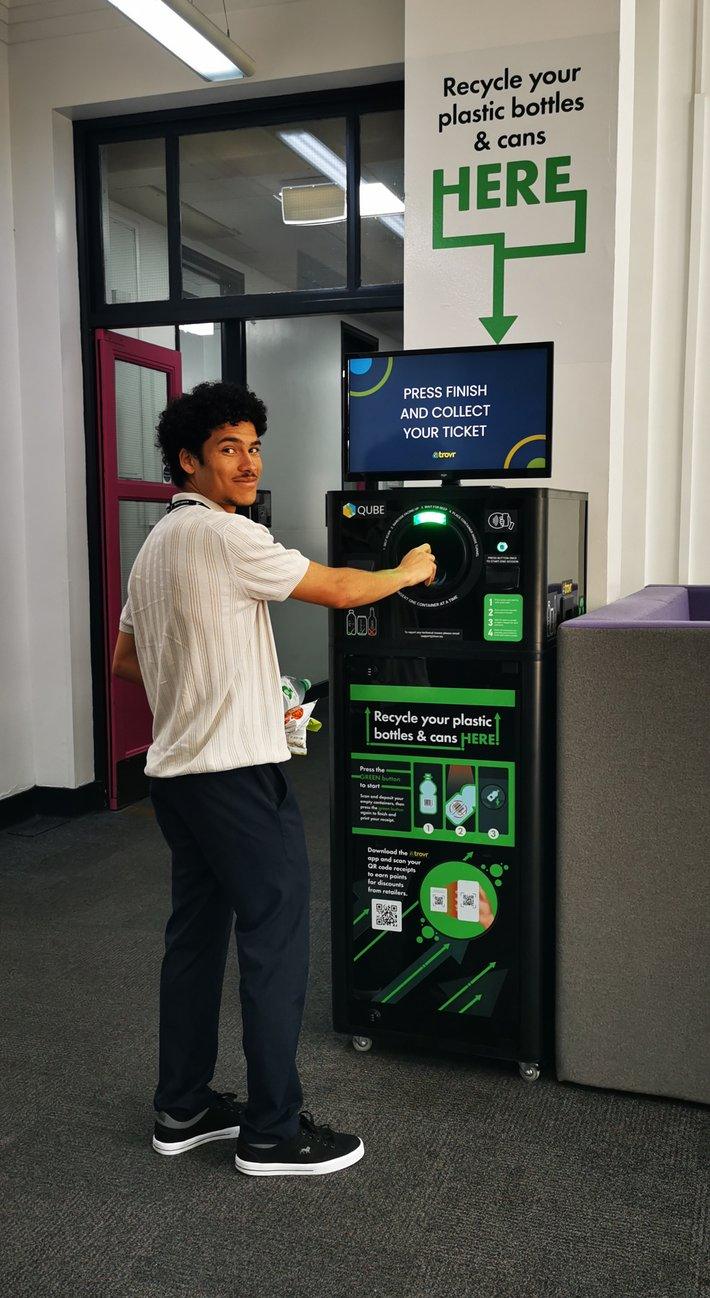
Trovr, the recycling technology company behind the TrovrQUBE, has installed its first unit at a UK educational establishment, placing the semi-automated recycling machine at Reading College and University Centre. The deployment gives students hands-on experience of deposit return recycling more than two years before the UK’s Deposit Return Scheme (DRS) comes into force on 1st October 2027. Students deposit empty PET bottles and aluminium cans into the unit and receive a printed receipt, a symbolic rehearsal for the process they will use as consumers once the scheme launches. The installation forms part of Reading College and University Centre’s sustainability goals within the Activate Learning group and marks the first time the TrovrQUBE has been deployed in an educational setting anywhere in the UK.
Education Before Legislation
When DRS goes live, retailers selling drinks in PET bottles or aluminium cans will be legally required to add a 20p deposit to each item at the till, reclaimable when customers return the empty container to a registered point for scanning and verification against a national database. The scheme carries fines for retailers who fail to participate. The TrovrQUBE lets students start forming the habit now, even though the deposits are not yet redeemable. The unit works without staff involvement: students deposit their own containers while the machine scans each barcode, verifies eligibility, identifies the material, and stores it securely, capturing data the college can use to track participation, measure return rates, and estimate CO2 savings.
Nick Yeatman, CEO and founder of Trovr, said:
“DRS will be one of the most significant behavioural changes asked of UK consumers in a generation, and the habits people form now will determine how successful the scheme is at launch. Getting students recycling through a TrovrQUBE today means they’ll arrive at 2027 already knowing exactly what to do. But this isn’t just about compliance, colleges can earn from handling fees, build community engagement, and become part of the national recycling infrastructure. This is about turning a looming regulatory shift into something genuinely positive.”
A Commercial Model For Colleges
Colleges are not obliged to become DRS return points, but once the scheme launches they can register voluntarily, and the financial case is straightforward. Exchange for Change, the industry-led organisation delivering DRS across England, Scotland and Northern Ireland, has confirmed that return point operators will earn 3p per container returned. Fully automated Reverse Vending Machines qualify for a higher 5p handling fee, but the TrovrQUBE’s manual return category offers a lower-cost, lower-complexity alternative that avoids crushing machinery and major infrastructure outlay. A college with 2,000 students returning ten containers each per month would generate 20,000 containers and £600 in monthly handling fees, funds that could support college improvements or charitable donations.
Janne Jarvis, West Suffolk District Councillor for Newmarket North, said:
“Getting local communities ready for DRS starts with education, and that means reaching people before the scheme launches, not after. Reading College and University Centre is exactly the kind of institution that can make a real difference here. Students who understand how deposit return works today will be the consumers and business owners who make the scheme a success in 2027.”
“After Reading College and University Centre contacted me about the West Suffolk Council reverse vending scheme, I was pleased to introduce them to Trovr. It is exciting to see this technology being brought into another community setting, and I hope this installation encourages other educational institutions across the UK to follow suit.”
Activate Learning’s Sustainability Push
For Activate Learning, the group encompassing Reading College and University Centre, the installation reflects a wider push to embed sustainable behaviour across its campuses, giving staff and students a practical route into everyday environmental action.
Philip Waddup, Group Director of Property, Environment and Sustainability at Activate Learning, said:
“We believe this initiative can make a real difference to our college community and reinforce Activate Learning’s commitment to delivering green and sustainable college campuses. It’s a fantastic example of how collaboration can turn an idea into meaningful action, and of how we’re working with colleagues across the organisation to identify and deliver practical initiatives that reduce our environmental impact and engage our students and staff in positive sustainable behaviour.”
“Small actions, when taken collectively, can make a significant impact on our environment and we hope this inspires our college communities to make recycling a regular habit while supporting a more sustainable future.”
Andrew Emberson-Poole, Group Designer and Sustainability Champion at Activate Learning, traced the project back to an initial conversation with Councillor Jarvis, describing how it grew into the college’s first TrovrQUBE installation, making it the first educational institution in the UK to introduce the technology. He added that the unit gives students the chance to play an active role in reducing waste while preparing them for changes that will become part of everyday life.
Setting The Standard For Community DRS Participation
European countries with established DRS programmes consistently achieve return rates above 90%, supported by dense return infrastructure that extends well beyond supermarkets into community spaces. The Reading College and University Centre installation positions educational establishments as an underexplored category of return point, sitting alongside independent retailers, petrol forecourts, and leisure centres in the network needed to hit national recycling targets. TrovrQUBE units are already operating at independent retailers in London, following a trial at leisure centres and colleges with West Suffolk Council, and the technology is live in Malta, Romania, Poland, and Austria. With the 2027 deadline approaching, Reading College and University Centre’s early adoption offers a template other institutions may look to follow as the UK builds out its deposit return network.